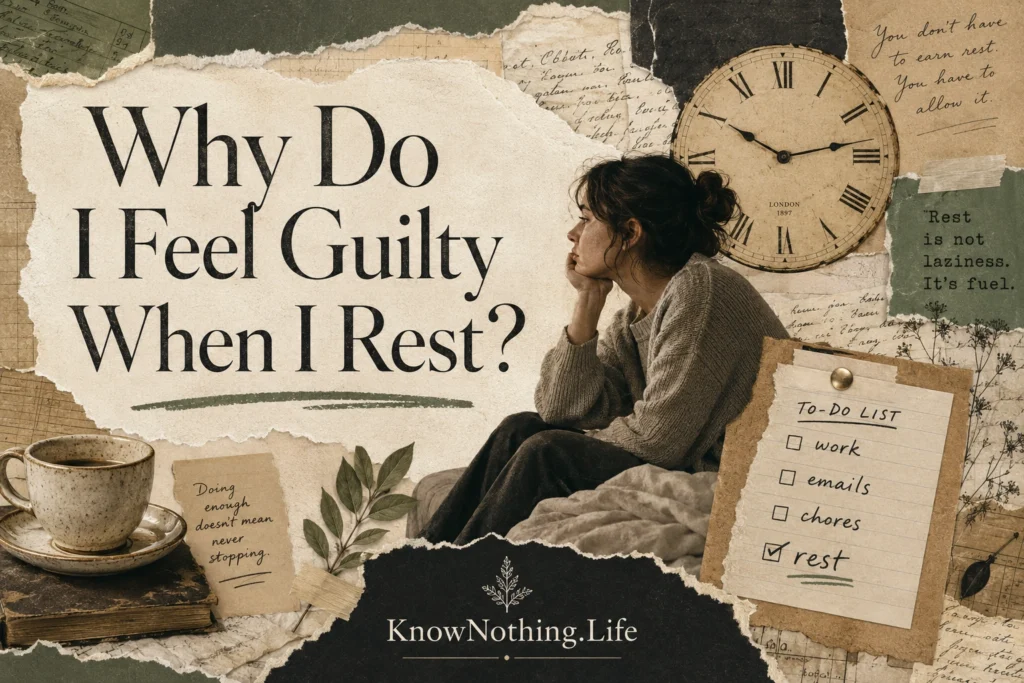
Rest should be one of the simplest human activities. When you are tired, you stop working. When your attention begins to fade, you take a break. When the day’s responsibilities are finished, you allow yourself to relax. Yet many people discover that stopping does not actually feel relaxing. The moment they sit on the couch, take an afternoon off, sleep late, watch a movie, or spend an hour doing nothing particularly productive, an uncomfortable thought appears: I should be doing something. Instead of recovering, they mentally review unfinished tasks, compare themselves with people who seem more productive, or calculate how the time could have been used more efficiently.
Psychologists increasingly study this experience as leisure guilt or, in related research, rest intolerance. It is not simply the recognition that an important responsibility has been neglected. A person can have completed everything reasonably expected of them and still feel guilty for resting. The deeper issue is often that productivity has become psychologically connected to worth, competence, responsibility, or identity. When working feels morally good, stopping can begin to feel morally suspicious. Recent research suggests that this seemingly harmless attitude can undermine the very psychological benefits that rest is supposed to provide.
Leisure Guilt Is a Real Psychological Pattern
In 2026, Hyunjin Koo of California State University San Marcos, Paul Piff of the University of California, Irvine, Friedrich Götz and Azim Shariff of the University of British Columbia, and Stefan Stieger of Karl Landsteiner University published one of the most direct investigations of leisure guilt. Across four studies, the researchers examined the uneasy feeling that arises when people spend time leisurely rather than productively. They developed a Leisure Guilt Proneness Scale and found that people who were more prone to leisure guilt tended to experience poorer leisure experiences and lower well-being. In an everyday experience-sampling study, participants reported guilt during approximately 14 percent of their leisure occasions, with guilt occurring particularly often during solitary leisure.
This distinction matters because feeling guilty while resting can prevent psychological recovery even when the body has technically stopped working. Someone lying on the couch while mentally rehearsing everything they “should” be accomplishing is not experiencing the same kind of rest as someone who has temporarily released themselves from those demands. Research among university students reveals the contradiction clearly. A 2025 investigation involving 280 students found that students generally understood that rest was important for productivity, yet many simultaneously reported guilt, worries about unfinished work, and difficulty allowing themselves to stop. Some waited until physical symptoms such as exhaustion, headaches, or eye fatigue made a break unavoidable.
In other words, people can intellectually believe in the value of rest while emotionally treating it as something they have not earned. The conflict is not necessarily about whether rest is useful. It is often about what resting appears to say about the person who is doing it.
When Productivity Becomes Part of Your Self-Worth
One powerful explanation comes from psychologist Jennifer Crocker’s research on contingencies of self-worth. Building partly on William James‘ ideas about self-esteem in The Principles of Psychology, Crocker and Connie Wolfe argued that people’s self-esteem depends not only on how positively they see themselves but also on the domains in which they have psychologically “staked” their worth. For one person, worth may depend heavily on appearance or social approval. For another, it may depend on academic achievement, competition, morality, or professional success.
Crocker and colleagues at the University of Michigan later studied 1,418 college students and identified several common sources of contingent self-worth, including academic competence, competition, approval from others, appearance, family support, virtue, and religious belief. Importantly, these contingencies predicted how students subsequently allocated their time. When self-worth becomes strongly tied to accomplishment, productive activity can provide more than practical results: it provides reassurance. Completing tasks says, I am competent. I am responsible. I am doing enough. Stopping removes that source of reassurance.
This can create an internal economy in which productivity functions almost like psychological currency. Work earns worth. Achievement earns permission. Rest becomes something that must be purchased by accomplishing enough first. The problem is that “enough” rarely has a stable definition. There is always another email, assignment, improvement, household task, workout, business idea, article, errand, or opportunity. When self-esteem depends heavily on output, the finish line continually moves.
Modern Culture Often Treats Busyness as a Sign of Importance
Rest guilt is not created entirely inside the individual. Cultural messages also shape what people believe a worthwhile life should look like. Historically, leisure could signify status because only wealthy people could afford not to work. Thorstein Veblen famously described conspicuous leisure in The Theory of the Leisure Class in 1899. In many modern professional environments, however, that status signal appears to have partly reversed. Being extraordinarily busy can now communicate importance.
Silvia Bellezza of Columbia Business School, Neeru Paharia of Georgetown University, and Anat Keinan of Harvard Business School investigated this shift in a series of studies published in the Journal of Consumer Research. They found that, particularly in the United States, people could infer greater status, ambition, competence, and market demand from individuals described as extremely busy and lacking leisure time. Busyness itself had become capable of functioning as a status symbol.
That cultural association can seep into personal identity. A full calendar suggests that you are needed. An overflowing inbox suggests importance. Working late can appear ambitious. Even statements such as “I’ve been insanely busy” can subtly communicate that one’s time is valuable because many people or responsibilities are competing for it. Against that background, an empty afternoon may feel uncomfortable not because anything is wrong with it, but because emptiness can be interpreted as evidence that you are not doing enough. Rest can begin to resemble laziness even when it is an ordinary biological requirement.
Believing Leisure Is Wasteful Can Actually Ruin Leisure
The problem becomes particularly clear when researchers ask what happens to people who believe leisure itself is wasteful. Gabriela Tonietto, Selin Malkoc, Rebecca Walker Reczek, and Michael Norton investigated this question across four studies involving 1,310 participants. Their research, published in the Journal of Experimental Social Psychology, found that people who regarded leisure as wasteful tended to enjoy leisure activities less. The effect was especially strong for activities pursued simply because they were enjoyable rather than because they served some additional productive purpose.
That finding helps explain a peculiar modern habit: turning relaxation into another productivity project. A person may feel comfortable exercising because it improves health, reading because it increases knowledge, socializing because networking is useful, meditating because it improves performance, or taking a vacation because it will make them more productive when they return. These activities may indeed provide those benefits. But psychologically, there is an important difference between doing something because it is intrinsically worthwhile and needing to justify every pleasant experience through some future return.
If every enjoyable activity requires a productivity explanation, leisure never becomes completely free from work. Even rest must submit a résumé. The person is technically relaxing but still evaluating the activity according to whether it improves performance. Genuine leisure becomes difficult because the internal productivity monitor remains active.
Your Brain Needs to Psychologically Leave Work
Decades of occupational psychology research show that recovery requires more than simply leaving the workplace. Sabine Sonnentag and colleagues have extensively studied psychological detachment, meaning the ability to mentally disengage from work during nonwork time. In a study of employees conducted at the University of Konstanz, Sonnentag and Ute-Vera Bayer found that psychological detachment during the evening was associated with better mood and lower fatigue. Detachment appeared especially important on days involving high time pressure.
Sonnentag and Charlotte Fritz later developed the Recovery Experience Questionnaire, identifying four major experiences associated with recovering from work: psychological detachment, relaxation, mastery, and control over one’s free time. Subsequent diary research found that evenings involving greater detachment, relaxation, and mastery experiences were associated with more favorable emotional states the following morning. A major 2022 review by Sonnentag, Bonnie Hayden Cheng, and Stacey Parker concluded that recovery during breaks, evenings, weekends, and vacations plays an important role in sustaining employee well-being, motivation, and performance.
Rest guilt interferes with exactly this process. If you stop working physically but continue working cognitively—replaying unfinished tasks, checking messages, criticizing yourself for stopping—the stressor remains psychologically present. This is why an hour of guilt-filled “rest” can leave someone feeling strangely exhausted. The activity stopped, but the internal demand did not.
The Unfinished Task Problem
Guilt during rest is often strongest when there is unfinished work. This does not necessarily indicate unhealthy thinking; sometimes the mind is correctly reminding us about obligations. But modern work creates a special problem because many tasks are structurally never finished. Email can always be checked again. A house can always be cleaner. Fitness can always improve. A business can always grow. Students can always study another chapter. Parents can always do more. Creative work can always be revised.
When people respond to these open-ended demands by waiting until everything is finished before allowing themselves to rest, rest becomes practically impossible. Psychological recovery research suggests that high workload itself can make detachment harder. Sonnentag and Bayer found that heavier workloads predicted greater difficulty mentally switching off after work. Research involving 2,520 Japanese employees similarly found that compulsive working was negatively associated with psychological detachment.
This produces a feedback loop. Heavy demands make it harder to stop thinking about work. Poor detachment interferes with recovery. Reduced recovery increases fatigue. Fatigue then makes work feel harder and slower, potentially creating even more unfinished tasks. The person may interpret the resulting reduced productivity as proof that they need to work more, when insufficient recovery is partly contributing to the problem.
Perfectionism Can Make Rest Feel Premature
For people with strong perfectionistic tendencies, stopping can also feel like accepting imperfection. There is almost always some way an outcome could be improved, and therefore rest can seem appropriate only after an impossibly high standard has been reached. Productivity becomes less about accomplishing a meaningful amount and more about avoiding the uncomfortable feeling that something could still be done.
Crocker’s research on contingent self-worth helps explain why these situations can become emotionally intense. When achievement is closely connected to self-esteem, setbacks do not remain simple information about performance. They can feel like information about the self. Crocker and colleagues have argued that although contingent self-worth can motivate considerable effort, pursuing self-esteem through achievement can also create vulnerabilities in self-regulation because success and failure become psychologically loaded.
Under these conditions, rest may feel dangerous because it involves voluntarily stopping the behavior that protects self-worth. Someone who has learned to feel valuable mainly while accomplishing things can become anxious when nothing is being accomplished. The apparent problem is inactivity, but the deeper discomfort may be the question inactivity exposes: Who am I when I am not producing something?
Rest Is Not the Opposite of Productivity
One of the most misleading assumptions behind rest guilt is that working and resting are competing uses of time, as though every hour spent recovering were simply an hour removed from achievement. Human performance does not work that way. Effort creates physiological and psychological demands, and recovery helps those systems return toward baseline. Occupational psychologists Sabine Geurts and Sabine Sonnentag describe recovery as a process of psychophysiological unwinding following effort expenditure. Without sufficient opportunities for recovery, temporary strain reactions may accumulate rather than resolve.
Research does not suggest that everyone must spend enormous amounts of time doing nothing. Rest can take many forms, and different people recover through different combinations of relaxation, social connection, sleep, physical activity, hobbies, mastery experiences, and changes of attention. The important point is that sustainable effort contains recovery within it. A 2011 intervention study conducted by researchers including Verena Hahn and Sonnentag found that employees who received training designed to improve recovery experiences subsequently showed improvements in recovery-related self-efficacy and sleep quality and later reported reductions in perceived stress and negative affect.
From this perspective, the question “Have I earned the right to rest?” is somewhat backwards. Recovery is not merely a prize handed out after sufficiently impressive productivity. It is one of the processes that makes continued concentration, emotional regulation, motivation, and work possible.
How to Stop Feeling Guilty About Rest
Reducing rest guilt does not require abandoning ambition. It requires separating rest from moral judgment. One useful shift is to define stopping points before beginning work rather than waiting to feel finished. If the rule is “I can rest when there is nothing left to do,” the mind can almost always generate another task. A predetermined boundary—after a certain task, at a particular time, or following a meaningful amount of effort—creates an external stopping condition rather than asking an achievement-oriented mind for permission.
It can also help to notice the language surrounding rest. Thoughts such as “I’m wasting time,” “I’m being lazy,” or “I should be doing something useful” are not neutral descriptions; they contain assumptions about what makes time valuable. Sometimes the most revealing question is not whether you could be working but why every unused minute needs to become work in the first place. Tonietto and colleagues’ research suggests that seeing leisure as wasteful can directly reduce its enjoyment, while the newer leisure-guilt research indicates that guilt can diminish the psychological benefits people receive from free time.
Finally, learning to rest may involve expanding the basis of self-worth. Work, achievement, and discipline can be important parts of identity without becoming the entire justification for one’s existence. Relationships, curiosity, creativity, play, kindness, experience, contemplation, and simply being alive do not need to produce measurable output to possess value.
Why You Feel Guilty When You Rest
You may feel guilty when you rest because your mind has learned an association that is extraordinarily common in achievement-oriented environments: doing means being valuable. Productivity can become evidence of competence, responsibility, ambition, status, or worth. Once that connection becomes strong enough, stopping work does more than interrupt a task. It temporarily removes one of the ways you reassure yourself that you are doing life correctly.
But psychological research presents a different picture of rest. Leisure guilt is associated with poorer leisure experiences and lower well-being. Seeing leisure as wasteful reduces enjoyment. Difficulty mentally detaching from work is associated with fatigue and poorer recovery, while genuine psychological detachment, relaxation, mastery, and control during nonwork time help replenish the resources required for tomorrow’s effort.
The goal is therefore not to become less motivated. It is to develop a form of motivation that can tolerate stopping. Sustainable productivity includes periods in which nothing is being produced. A mind that never receives permission to disengage eventually turns even leisure into another unfinished task. Learning to rest without guilt means recognizing that your value does not disappear when your output temporarily reaches zero—and that sometimes the most productive thing a human being can do is stop producing at all.