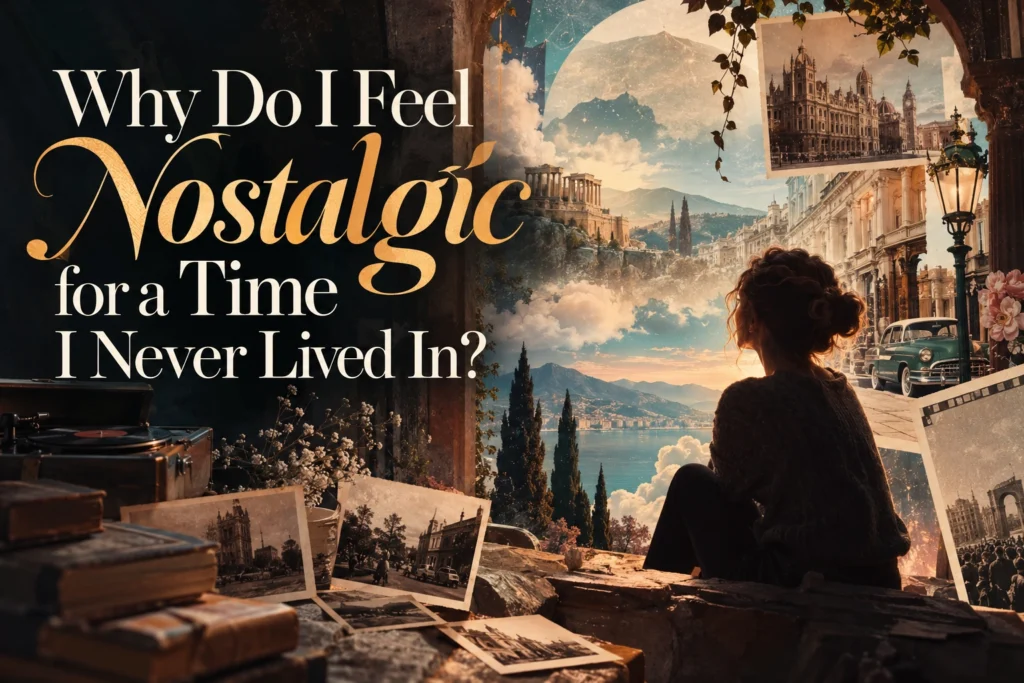
You hear a song recorded decades before you were born and experience an almost inexplicable homesickness. An old photograph of a 1950s diner, a Victorian street, a 1970s living room, or a childhood scene from the 1990s can create the strange impression that something personally meaningful has been lost—even though it was never personally yours. You may find yourself longing for old neighborhoods you never walked through, technologies you never used, cultural scenes you never participated in, or social worlds that disappeared before your own life began. The feeling can be remarkably specific: not simply I find that period interesting, but I wish I could go back there.
The experience is sometimes called anemoia, a modern literary term for nostalgia toward a time one never personally experienced. Psychological researchers more often speak of vicarious nostalgia or related forms of historical and collective nostalgia. Whatever label we use, the apparent contradiction is philosophically fascinating. Nostalgia seems to require memory, yet here we appear to miss something we cannot remember. The contradiction begins to disappear once we recognize that nostalgia is not simply memory. It is a form of longing through which human beings construct relationships between the present, the past, identity, belonging, and possibility. Sometimes the era we think we miss is less important than what that era has come to represent.
Nostalgia Was Originally About a Place, Not a Time
The history of the word itself reveals how flexible nostalgia has always been. In 1688, the Swiss medical student Johannes Hofer coined nostalgia from Greek roots associated with returning home and pain. He used it to describe severe homesickness, particularly among people separated from their native environments. Nostalgia was originally regarded not as pleasant reminiscing but as a potentially dangerous medical condition. A person suffered because home was elsewhere and inaccessible. Over the following centuries, the object of longing gradually shifted. People became nostalgic not only for distant places but for vanished periods of their lives and eventually for entire historical worlds.
Literary scholar Svetlana Boym, in The Future of Nostalgia, captured this transformation brilliantly, describing nostalgia as both a feeling of loss and “a romance with one’s own fantasy.” Her formulation helps explain why personal experience is not always necessary. The object of nostalgia can be partly imagined from the beginning. We may believe we are longing for a historical era, but what we actually desire is a symbolic version of it assembled from music, stories, photographs, architecture, movies, family histories, advertisements, clothing, and our present emotional needs. The lost “home” of nostalgia does not necessarily have to be somewhere we literally lived. It can be somewhere the imagination has learned to experience as home.
Vicarious Nostalgia Is a Real Psychological Phenomenon
Researchers Altaf Merchant and Gregory Rose examined precisely this paradox in their work on vicarious nostalgia. They defined it as emotional longing for periods or events that occurred before an individual was born and found that people can indeed develop meaningful emotional attachments to such imagined pasts. Their research identified fantasy and emotion as important dimensions of the experience and found associations between vicarious nostalgia, general nostalgia proneness, fantasy proneness, and feelings of alienation. In other words, nostalgia does not require an autobiographical memory stored from direct experience. People can emotionally inhabit reconstructed histories.
That matters because imagination does not simply produce cold simulations. Human beings routinely respond emotionally to events they know are fictional or indirectly experienced. A novel can make us grieve for someone who never existed. A film can make an invented hometown feel familiar. A photograph of strangers can create tenderness. Historical imagination operates through many of the same emotional capacities. When you repeatedly listen to music from a certain decade, watch its films, hear your parents or grandparents describe it, collect its objects, or learn its cultural symbols, the period acquires emotional associations. Eventually it may feel psychologically familiar even though it is not autobiographically remembered.
We Can Inherit a Past Without Personally Remembering It
The French sociologist Maurice Halbwachs argued that memory is never purely individual. In his work on collective memory, he proposed that remembering occurs within social frameworks. Families, communities, religions, nations, and cultures continually tell stories about their pasts, deciding which events are remembered, how they are interpreted, and what they mean in the present. A person born decades after an event may therefore inherit a surprisingly detailed emotional relationship with it through the community’s stories.
Media scholar Alison Landsberg later introduced the concept of prosthetic memory in her book Prosthetic Memory. She argued that mass media and cultural experiences can give people emotionally powerful relationships with historical events they never personally lived through. A movie, museum, photograph, recording, or historical narrative can become integrated into someone’s sense of self without becoming a literal autobiographical memory. We know intellectually that we were not there, yet the historical world becomes part of our emotional vocabulary.
Family history makes this process especially powerful. Perhaps your grandparents repeatedly described a neighborhood where everyone knew each other, or your parents played music from their youth throughout your childhood. Those memories are technically theirs, but the stories and sensory cues may become part of your own identity. You can inherit attachments to cars you never drove, cities you never saw in their former condition, traditions that disappeared before your birth, and social worlds reconstructed through other people’s memories. The past becomes personally meaningful without becoming personally remembered.
The Past Reaches Us Already Edited
The historical periods we become nostalgic for are rarely transmitted intact. They arrive through selection. Consider the 1950s: someone attracted to the decade may encounter diners, jazz, early rock and roll, chrome automobiles, neon signs, tailored clothing, neighborhood streets, and optimistic advertising. They are less likely to encounter those features in the same emotional package as racial segregation, Cold War anxiety, restrictive gender expectations, dangerous workplaces, medical limitations, or ordinary daily boredom. Every cultural image of the past contains a frame, and everything outside that frame temporarily disappears.
Psychological research on rosy retrospection shows that even our own experiences can become more favorable in memory. Terence Mitchell, Leigh Thompson, Erika Peterson, and Randy Cronk followed people’s evaluations of experiences such as vacations and found that participants later remembered events more positively than they evaluated them while actually living through them. Related research on the fading affect bias, associated with W. Richard Walker, John Skowronski, and others, has repeatedly found that negative emotion attached to autobiographical memories tends to fade faster than positive emotion. We do not preserve the past as a perfect recording.
Historical nostalgia has an even stronger filtering problem because we possess no firsthand memory against which the fantasy can be checked. We receive what generations preserved. Music that survived is often music people still consider worth hearing. Photographs kept and published are disproportionately meaningful or aesthetically interesting. Architecture still admired tends to be exceptional. Movies compress ordinary existence into stories. Fashion revivals select what looks compelling now. We compare the complete inconvenience of the present with the greatest hits of the past.
Sometimes You Are Not Longing for the Past—You Are Criticizing the Present
Longing for another era often intensifies when something feels missing now. Merchant and Rose’s research connecting vicarious nostalgia with alienation is revealing in this respect. Someone overwhelmed by digital communication may fantasize about a supposedly slower analog age. Someone experiencing weak community ties may romanticize small-town life. Someone exhausted by disposable consumer goods may become fascinated by objects imagined to have been durable and repairable. Someone surrounded by rapid cultural change may find comfort in an era that appears stable from historical distance.
This does not necessarily mean the nostalgic person literally wants to live in 1948, 1967, or 1985. The historical period may function as a philosophical contrast case. We construct an imagined past in order to identify something we dislike about the present. “I wish I lived then” may actually mean “I wish life contained more of what I associate with then.” Perhaps that means stronger community, slower communication, less surveillance, greater privacy, craftsmanship, optimism, aesthetic beauty, face-to-face interaction, or a clearer separation between work and leisure.
Boym distinguished between restorative nostalgia, which attempts to reconstruct an allegedly lost truth or home, and reflective nostalgia, which remains conscious of longing, contradiction, and historical distance. That distinction is crucial. Reflective nostalgia can ask what the fantasy teaches us about present dissatisfaction without pretending the past was actually perfect. The imagined past becomes a tool for understanding what we value rather than a historical claim that everything used to be better.
Nostalgia Helps Human Beings Create Meaning
Modern psychological research has overturned the older assumption that nostalgia is necessarily unhealthy. Tim Wildschut, Constantine Sedikides, Jamie Arndt, and Clay Routledge found across a series of studies that nostalgic experiences often involve meaningful relationships and important events. Nostalgia tended to strengthen social connectedness, positive self-regard, and positive affect. Later work by Sedikides and Wildschut emphasized its existential functions: nostalgia can increase feelings of meaning and help people maintain continuity between different parts of their lives.
Research by Wijnand van Tilburg, Sedikides, Wildschut, and Ad Vingerhoets further found that nostalgia can increase meaning through social connectedness and self-continuity—the feeling that one’s past, present, and future belong to the same continuing self. Ordinary nostalgia achieves this by connecting us with our own previous lives. Vicarious nostalgia may perform a related function on a broader cultural level. Instead of connecting me now with me then, it can connect me now with a story of where people like me came from, what human life once looked like, or what values I wish to carry forward.
This helps explain why old music, photographs, architecture, and objects can feel almost spiritually significant. They place a temporary bridge across historical time. Against the experience of rapid change, they suggest continuity. We did not exist when the record was made or the building was constructed, but we recognize ourselves in people who did. Their worries, pleasures, romances, mistakes, art, and everyday objects remind us that our present moment is not the entire universe. We belong to a human story that began before our arrival and will continue after us.
We May Be Nostalgic for Possibility Rather Than Reality
There is also a subtler form of longing involved. A past era we never lived through remains unspoiled by our actual experience of it. We know what happened historically, but we do not know what our own life there would have been. That missing personal history creates enormous imaginative freedom. Perhaps we picture ourselves in 1960s London, Renaissance Florence, 1920s Paris, or a quiet American town in 1975. Because the imagined self never had to endure the ordinary disappointments of that life, the scenario remains full of possibility.
The paradox resembles longing for a road not taken. We can idealize a career we never pursued, a city we never moved to, or a relationship that never happened precisely because reality never had the opportunity to complicate the fantasy. Historical eras work the same way. You can imagine the music, clothing, architecture, friendships, and atmosphere without having to experience the dental care, employment conditions, prejudice, political instability, monotonous routines, or bad Tuesday afternoons.
What feels like nostalgia may therefore partly be grief for possible lives. The past represents worlds permanently closed to us. We cannot discover what it would have felt like to walk into a jazz club in 1959, hear a famous band before anyone knew its importance, or experience a city before its skyline changed. Mortality means being confined to one narrow section of history. Historical nostalgia is one way the imagination protests that limitation.
The Danger of Romanticizing the Past
There is nothing inherently irrational about being moved by a historical period. The danger begins when emotional longing turns into historical certainty. Every era contained ordinary frustrations and severe injustices that its nostalgic image tends to hide. People living in those periods were nostalgic too—often for even earlier times. The supposedly simple past was somebody else’s confusing present.
This circularity should make us suspicious of claims that humanity has just recently fallen out of a golden age. Fred Davis, in Yearning for Yesterday, treated nostalgia sociologically and showed how it becomes especially relevant during periods of discontinuity and identity change. Nostalgia helps stabilize identity by creating contrast between “then” and “now.” But the contrast can easily become mythological. If the present feels chaotic, the past acquires order. If the present feels impersonal, the past acquires community. If the present feels morally confused, the past acquires certainty. We may unconsciously supply history with whatever the present appears to lack.
The remedy is not to destroy nostalgia with fact-checking every time an old song makes us emotional. It is to distinguish historical appreciation from historical idealization. You can love mid-century architecture without wishing to restore mid-century social inequalities. You can prefer analog objects while appreciating modern medicine. You can admire old communities while recognizing who may have been excluded from them. Reflective nostalgia allows affection and criticism to coexist.
What Are You Really Missing?
When you feel nostalgic for a time you never lived in, the most revealing question may not be “Why do I think the past was better?” Ask instead: “What does this past symbolize to me?” If old photographs make you long for slower living, perhaps you need more unstructured time now. If an earlier musical culture seems more communal, perhaps you are longing for shared experiences. If old architecture feels human and beautiful, perhaps your frustration is with contemporary environments. The emotion can point toward genuine values even when its historical picture is incomplete.
That is why nostalgia for an unlived past need not be dismissed as foolishness. The past has always been partly reconstructed by the present. Halbwachs showed that memory lives within social frameworks. Boym showed that nostalgia contains fantasy as well as loss. Merchant and Rose demonstrated that people can genuinely experience vicarious nostalgia for periods before their birth. Sedikides, Wildschut, Routledge, and their collaborators have shown that nostalgia can support connection, continuity, and meaning.
You cannot literally miss a life you lived in 1972 if you were not alive in 1972. But you can miss what 1972 has come to mean to you. Perhaps the deepest object of nostalgia is therefore not the past at all. It is a vision of belonging, possibility, beauty, simplicity, or meaning that the past allows us to imagine—and that we are still hoping to find somewhere in the present.