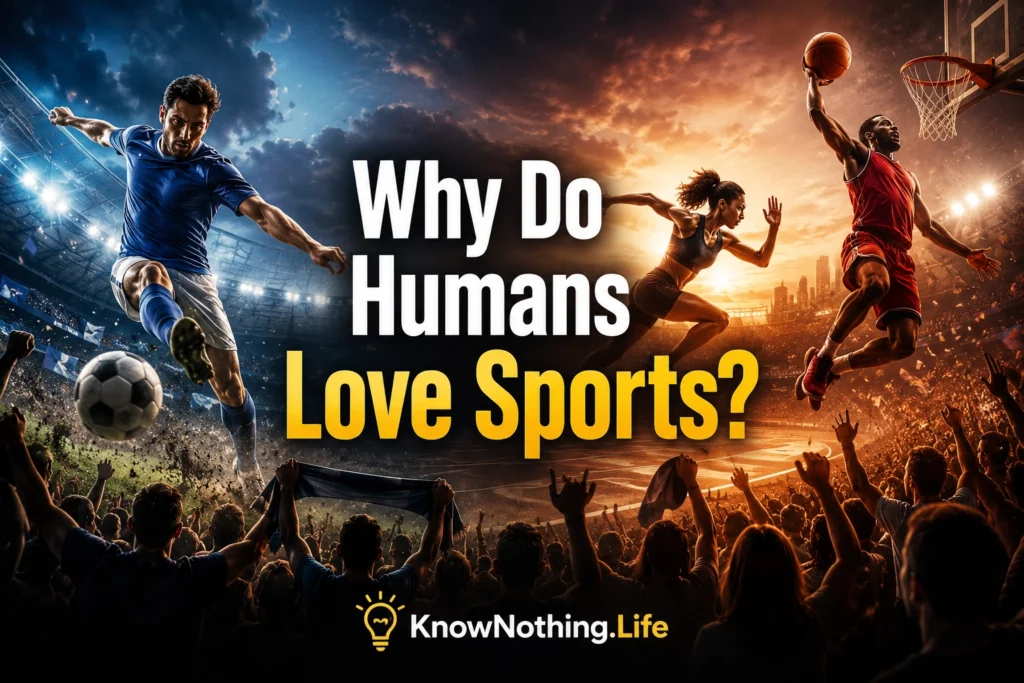
Humans love sports because sports concentrate many of the deepest forces in human nature: play, competition, belonging, skill, beauty, risk, emotion, identity, and story. A game is never only a game. It is a structured drama in which bodies, rules, chance, courage, failure, loyalty, and excellence become visible. People watch sports not merely to see who wins, but to feel suspense, witness mastery, share collective emotion, and attach themselves to something larger than the ordinary self.
Sports appeal across cultures because they transform basic human instincts into symbolic form. The desire to run, chase, throw, wrestle, compete, cooperate, test limits, defend territory, and prove ability is ancient. Long before stadiums, television contracts, fantasy leagues, or professional franchises, humans played physical contests, held ritual competitions, raced, fought, danced, hunted, and measured strength. Modern sports refine those impulses into rule-governed spectacle. They allow aggression without war, tribal loyalty without actual bloodshed, and heroic struggle without mythological monsters. In sports, human beings turn conflict into performance.
Sports Begin With Play
The foundation of sport is play. Dutch historian Johan Huizinga, in Homo Ludens, argued that play is not a childish leftover but a central feature of culture. Law, ritual, art, poetry, and competition all contain elements of play because they create temporary worlds with rules, boundaries, roles, and meaning. When people step onto a field or court, they enter a special space where ordinary life is suspended. A ball, line, whistle, net, clock, or goal suddenly matters because everyone agrees it matters.
French thinker Roger Caillois expanded this idea in Man, Play and Games, describing different forms of play: competition, chance, mimicry, and vertigo. Sports often combine all four. They involve competition between players, chance in the bounce of a ball or weather, mimicry in uniforms and roles, and vertigo in speed, danger, and physical intensity. This explains why sports are so absorbing. They produce a world that is artificial but emotionally real. The score may be invented, but the effort, pressure, disappointment, and joy are genuine.
Competition and the Test of Ability
Humans love sports because competition provides a clear test of ability. Life is often ambiguous. People work hard without obvious results. Talent can go unnoticed. Effort may not be rewarded fairly. Sports, at least in ideal form, offer visible measurement. Someone runs faster, jumps higher, scores more, defends better, lifts more, reacts quicker, or endures longer. The contest compresses uncertainty into a result people can understand.
This does not mean sports are perfectly fair. Referees make mistakes, resources differ, injuries happen, and luck matters. But sports still provide something rare: a public arena where skill and effort are displayed under pressure. Psychologist Albert Bandura’s work on self-efficacy helps explain the appeal. Humans are motivated by the belief that effort can produce competence. Sports dramatize this belief. Training becomes performance. Practice becomes mastery. The athlete’s body becomes evidence that discipline can transform possibility into achievement.
Tribal Identity and Belonging
Sports also satisfy the human need for belonging. A team gives people a shared identity. Fans say “we won” even though they never touched the ball. This may seem irrational, but psychologically it makes sense. Social identity theory, developed by Henri Tajfel and John Turner, argues that people derive part of their identity from the groups they belong to. A sports team becomes an emotional tribe: colors, chants, logos, history, heroes, rivals, rituals, and shared memory.
This belonging can be especially powerful because it crosses ordinary social barriers. People who differ in class, politics, religion, race, age, or personality may still unite around a team. A stadium becomes a temporary community. Strangers high-five, chant, groan, and celebrate together. Émile Durkheim’s concept of “collective effervescence” is useful here. In religious rituals, crowds experience emotional energy through shared focus. Sports can create a secular version of that experience. The crowd becomes one body, one voice, one nervous system.
Safe Aggression and Symbolic Battle
Sports give humans a way to experience conflict without destroying social order. Anthropologists and sociologists have long noticed that games often resemble symbolic combat. Teams defend territory, attack space, outmaneuver opponents, and pursue victory. Words like battle, war, fight, pressure, dominance, attack, and defense are common in sports language because athletic competition channels aggressive energy into rules.
Norbert Elias and Eric Dunning explored this in Quest for Excitement, arguing that modern sports help regulate emotion in civilized societies. People still crave intense feeling, risk, rivalry, and struggle, but everyday life often suppresses direct aggression. Sports provide controlled excitement. They allow people to feel danger without actual war, hostility without murder, and loyalty without permanent enmity. The game civilizes conflict by giving it boundaries.
Narrative, Heroes, and Meaning
Sports are addictive as stories. Every game contains characters, stakes, uncertainty, reversal, conflict, and resolution. There are heroes and villains, veterans and rookies, underdogs and dynasties, comebacks and collapses, curses and redemption arcs. A season unfolds like a serialized drama. The ending is not scripted, which makes it more powerful. Fans watch because nobody knows what will happen.
This narrative quality connects sports to myth. Joseph Campbell wrote about the hero’s journey as a recurring pattern in human storytelling: departure, trial, struggle, transformation, and return. Athletes often become modern heroic figures because their struggles are visible and embodied. They fall, fail, train, return, and sometimes transcend ordinary limits. The fan does not only admire talent. The fan identifies with effort against difficulty. The athlete’s battle becomes a symbolic version of everyone’s private struggle.
The Beauty of Skill
Humans love sports not only for winning, but for beauty. A perfect pass, graceful jump shot, precise serve, impossible catch, elegant footwork, or perfectly timed tackle can feel like art. The body becomes intelligent in motion. Skill at the highest level reveals harmony between perception, timing, strength, instinct, and imagination. The viewer witnesses a form of excellence that words cannot fully explain.
This is related to what psychologist Mihaly Csikszentmihalyi called flow, the state of total absorption that occurs when challenge and skill meet at a high level. Athletes in flow seem almost beyond ordinary effort. They react without hesitation, move with fluidity, and perform under pressure as if action and awareness have merged. Spectators may experience a secondary form of flow by watching. The mind becomes absorbed in the unfolding action, moment by moment, until the rest of life briefly disappears.
Uncertainty and Emotional Intensity
Sports are emotionally powerful because outcomes remain uncertain. A movie may move us, but it has already been filmed. A novel may surprise us, but the ending is fixed on the page. A live game is genuinely undecided. The next pitch, shot, possession, penalty, or mistake can change everything. This uncertainty produces suspense, and suspense produces emotional investment.
Psychologically, variable outcomes are highly engaging. Humans pay attention when rewards are uncertain but possible. A blowout may become boring because tension disappears. A close game holds attention because every moment matters. The possibility of heartbreak makes joy more intense. Fans suffer because they care, and they care because the outcome is not guaranteed. Sports turn uncertainty into communal emotion.
Memory, Tradition, and Family
People also love sports because sports become tied to memory. A team may connect someone to a parent, grandparent, hometown, childhood, school, country, or period of life. People remember where they were during a championship, a famous goal, a shocking upset, or a heartbreaking loss. Sports become emotional landmarks. They provide continuity across generations.
This is why fandom can feel inherited. A child wears the colors of a team before understanding strategy. They learn names, chants, rivalries, and rituals from family. Over time, the team becomes part of personal identity. Loving sports is not always about the sport itself. Sometimes it is about the people one watched with, the place one came from, and the memories that cling to the game.
Why Playing Matters
Playing sports offers something different from watching them. Participation teaches the body directly about effort, discipline, frustration, cooperation, and limitation. A person learns what pressure feels like, how failure burns, how improvement happens slowly, and how teammates depend on one another. Sports turn abstract virtues into physical experience. Courage is not an idea when a person must take the shot, make the tackle, run the final lap, or step back onto the field after failure.
This is why sports are often used in education and character formation. At their best, they teach resilience, teamwork, humility, leadership, and respect for rules. At their worst, they can teach arrogance, tribal hatred, violence, cheating, or obsession with winning. Sports do not automatically build character. They reveal and shape character depending on the values surrounding them.
The Dark Side of Sports Love
Because sports touch deep human needs, they can also become distorted. Tribal loyalty can become hostility. Competition can become dehumanization. Admiration for athletes can become celebrity worship. The desire to win can produce cheating, corruption, gambling addiction, exploitation, or abuse. Fans may use sports to avoid personal problems, and institutions may profit from bodies treated as disposable.
A serious understanding of sports must include this shadow. The same forces that make sports meaningful can make them dangerous. Belonging can become exclusion. Passion can become rage. Discipline can become obsession. Entertainment can become exploitation. The love of sports is powerful precisely because it is not trivial. It carries real psychological and social energy, and that energy can be used well or badly.
Final Thoughts
Humans love sports because sports make life visible in concentrated form. They show struggle, risk, skill, teamwork, identity, injustice, beauty, luck, discipline, and emotion within a clear structure. The scoreboard gives the drama shape, but the deeper attraction is human meaning. In a world that often feels confusing, sports offer rules. In a life filled with private effort, they offer public tests. In societies marked by loneliness, they offer belonging. In ordinary time, they offer moments that feel unforgettable.
Sports endure because they are not merely entertainment. They are ritualized human nature. They let people play, compete, hope, suffer, celebrate, and belong. They turn physical action into story and story into shared emotion. Whether on a neighborhood field, school gym, Olympic track, city stadium, or living room screen, sports remind humans of something ancient: we want to test ourselves, attach ourselves, witness excellence, and feel, together, that something matters.