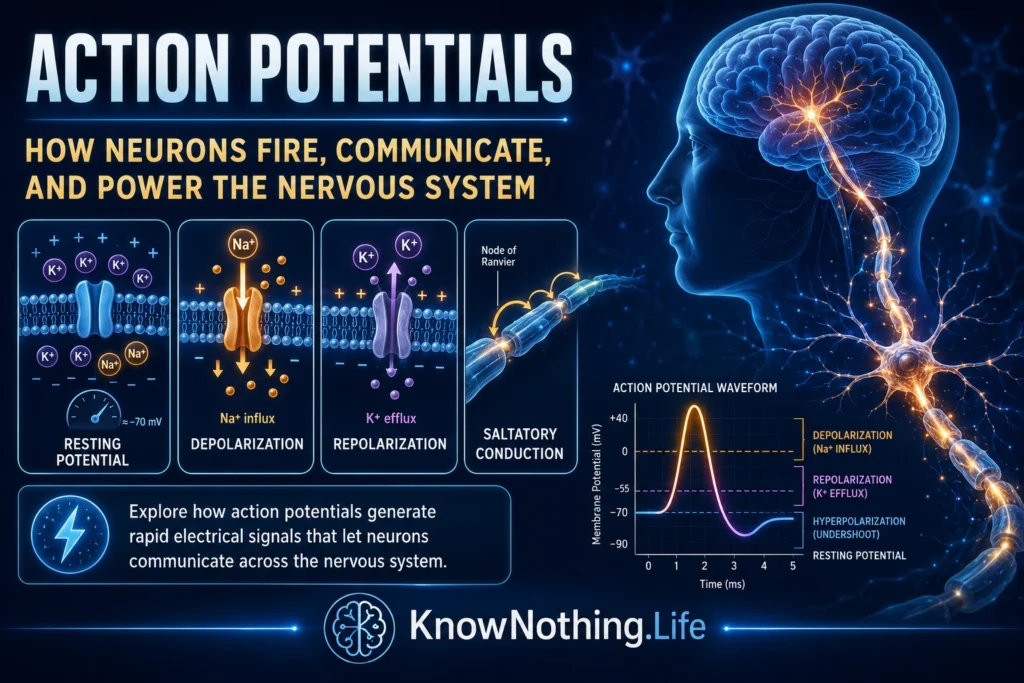
An action potential is a rapid electrical impulse that travels along the membrane of an excitable cell, especially a neuron. It is one of the basic events that makes nervous-system communication possible. When a neuron receives enough input, it can generate a brief change in voltage across its membrane, sending a signal down its axon toward other neurons, muscles, or glands. This electrical event allows the nervous system to transmit information quickly and reliably. A medical overview in StatPearls describes the neuronal action potential as having three main stages: depolarization, repolarization, and hyperpolarization.
Action potentials are essential because the nervous system depends on distance communication. A neuron may receive signals at its dendrites and cell body, but it often needs to send information far away through its axon. Sensation, movement, reflexes, pain, vision, hearing, memory, and thought all depend on neurons generating and transmitting these impulses. Without action potentials, the brain would not be able to send commands to muscles, receive signals from the body, coordinate reflexes, or build fast communication networks. They are not thoughts by themselves, but they are one of the fundamental biological mechanisms that make thought and behavior possible.
Resting Membrane Potential
Before a neuron fires, it has a resting membrane potential. This means there is a voltage difference between the inside and outside of the cell. The inside of a typical neuron is more negative than the outside, largely because ions such as sodium, potassium, chloride, and calcium are distributed unevenly across the membrane. The cell membrane contains ion channels and pumps that help maintain this imbalance. This stored electrical difference gives the neuron the ability to respond when the right stimulus arrives. It is like a charged system waiting for the proper trigger.
The resting state is not inactive in the simple sense. The neuron is constantly maintaining its internal environment. Sodium-potassium pumps use energy to move sodium and potassium ions against their concentration gradients, while leak channels allow certain ions to move more freely. The result is a stable but excitable membrane. This is one of the elegant features of neurophysiology: neurons are quiet because they are actively regulated, not because nothing is happening. Their ability to fire depends on the careful maintenance of ion gradients across the membrane.
Threshold and the All-or-None Principle
An action potential begins when the neuron reaches threshold. Neurons receive many incoming signals, some excitatory and some inhibitory. Excitatory signals make the membrane voltage less negative and move it closer to firing, while inhibitory signals make firing less likely. These inputs are integrated across the dendrites, soma, and especially the axon hillock or initial segment. If the combined signal reaches threshold, voltage-gated sodium channels open and the neuron fires an action potential. If the signal does not reach threshold, no full action potential occurs.
This creates the all-or-none principle. An action potential is not half-fired or partially sent. Once threshold is reached, the neuron generates a full impulse. Stronger stimuli do not usually create bigger action potentials; instead, they can increase the frequency of action potentials or recruit more neurons. This is one reason the nervous system can encode intensity without changing the basic size of each spike. A light touch and a painful stimulus may both involve action potentials, but they differ in firing pattern, pathway, receptor type, frequency, and network interpretation.
Depolarization: The Rising Phase
Depolarization is the rising phase of the action potential. When threshold is reached, voltage-gated sodium channels open, allowing sodium ions to rush into the neuron. Because sodium carries a positive charge, this inflow makes the inside of the neuron rapidly less negative and then briefly positive relative to the outside. StatPearls describes the rapid upstroke of the neuronal action potential as resulting from the opening of voltage-gated sodium channels.
This rapid sodium entry is what creates the dramatic spike of the action potential. The process happens in milliseconds, allowing the nervous system to respond with extraordinary speed. The opening of sodium channels also helps trigger nearby sodium channels along the axon, allowing the impulse to move forward. In this way, the action potential is self-propagating. One section of membrane depolarizes, which helps depolarize the next section, and the signal travels down the axon like a wave of electrical change.
Repolarization and Hyperpolarization
After depolarization, the neuron must return toward its resting state. Repolarization occurs when sodium channels inactivate and voltage-gated potassium channels open. Potassium ions move out of the cell, carrying positive charge with them and making the inside of the neuron more negative again. This falling phase restores the membrane voltage toward its resting level. Sometimes the membrane briefly becomes even more negative than its normal resting potential. This is called hyperpolarization.
Hyperpolarization contributes to the refractory period, a short interval during which the neuron is less able or unable to fire another action potential. The absolute refractory period occurs when sodium channels are inactivated and cannot immediately reopen. The relative refractory period occurs when a stronger-than-usual stimulus may still trigger another action potential, but firing is harder. These refractory periods are important because they help action potentials travel in one direction and limit how fast a neuron can fire. The nervous system depends not only on firing, but on controlled firing.
Propagation Along the Axon
Once an action potential begins, it travels along the axon. In unmyelinated axons, the impulse moves continuously along the membrane as each adjacent section depolarizes in sequence. This process is effective but relatively slow. In myelinated axons, the signal travels much faster because the axon is wrapped in a fatty insulating sheath called myelin. Myelin prevents current from leaking across much of the membrane and allows the action potential to regenerate only at small gaps called nodes of Ranvier.
This process is called saltatory conduction, from a Latin root meaning “to jump.” NCBI’s Basic Neurochemistry text explains that active excitation jumps from node to node and that this form of conduction is much faster than in unmyelinated fibers. Nodes of Ranvier are packed with voltage-gated sodium channels, allowing the action potential to be amplified at each node. The action potential must be amplified at each node by sodium influx as the signal travels along myelinated axons. This is one reason myelinated pathways are so important for fast reflexes, coordinated movement, speech, and complex brain communication.
Hodgkin, Huxley, and the Science of Nerve Impulses
The modern scientific understanding of action potentials owes much to Alan Hodgkin and Andrew Huxley. Working with the squid giant axon, they measured electrical currents across the nerve membrane and showed how sodium and potassium movements explain the action potential. Their 1952 work became one of the most important achievements in neuroscience because it connected electrical signaling to measurable ion conductances and mathematical equations. A historical review describes the squid giant axon as crucial because its size made it possible to study electrically excitable membrane in detail.
Hodgkin and Huxley’s work helped show that the nerve impulse is not a mysterious life force or simple electrical spark. It is a physiological process produced by voltage-dependent ion channels and electrochemical gradients. The Nobel Prize organization notes that Hodgkin and Huxley used giant nerve fibers from squid to measure electrical currents in nerves, helping explain how nerve impulses are exchanged between cells. Their model remains foundational in neurophysiology, computational neuroscience, medicine, and education because it reveals how biological membranes can generate precise electrical signals.
Action Potentials and Synapses
An action potential does not usually jump directly from one neuron to the next. In most cases, it reaches the axon terminal and triggers chemical communication at a synapse. When the impulse arrives, voltage-gated calcium channels open, calcium enters the terminal, and synaptic vesicles release neurotransmitters into the synaptic cleft. These neurotransmitters bind to receptors on the next cell, making that cell more or less likely to fire its own action potential. This is how electrical signaling becomes chemical signaling and then, often, electrical signaling again.
This electrochemical cycle is central to nervous-system function. A single neuron may receive thousands of synaptic inputs and send outputs to many other cells. Some pathways are excitatory, some inhibitory, and some modulatory. The meaning of an action potential depends on where it occurs, which neuron fires, which pathway is involved, what neurotransmitter is released, and how the receiving cell responds. A spike in a pain pathway means something different from a spike in the visual cortex, motor cortex, hippocampus, or auditory nerve. The action potential is a common signal, but the nervous system gives it meaning through circuits.
Action Potentials in Sensation and Movement
Everyday experience depends on action potentials. When light hits the retina, visual pathways eventually use action potentials to transmit information toward the brain. When sound vibrates the inner ear, auditory neurons encode features of that sound through patterns of firing. When skin receptors detect pressure, temperature, or pain, sensory neurons carry that information through peripheral nerves and spinal pathways. The brain does not receive the world directly. It receives neural activity, much of it organized through action potentials.
Movement also depends on action potentials. Motor neurons carry signals from the nervous system to muscles. At the neuromuscular junction, motor-neuron action potentials trigger the release of acetylcholine, which can lead muscle fibers to contract. Walking, blinking, speaking, swallowing, writing, and breathing all require carefully timed firing across many pathways. Action potentials are therefore not only brain events. They are body events. They connect thought to movement and sensation to awareness.
Clinical Importance of Action Potentials
Because action potentials depend on ion channels, membrane integrity, myelin, and synaptic transmission, problems in any of these systems can affect nervous-system function. Channelopathies are disorders caused by abnormal ion-channel function, and they can contribute to epilepsy, migraine, periodic paralysis, pain syndromes, and cardiac rhythm disorders. Demyelinating diseases such as multiple sclerosis can slow or disrupt action-potential conduction. Nerve injuries can impair signal propagation. Toxins, anesthetics, and medications can also alter ion channels and change how neurons fire.
Clinical neurophysiology depends heavily on measuring electrical activity. EEG records large-scale brain electrical patterns and is used in epilepsy, sleep medicine, coma evaluation, and encephalopathy. Nerve conduction studies measure how well peripheral nerves transmit signals. Electromyography evaluates muscle and motor-unit activity. These tools matter because many neurological problems are functional as well as structural. A scan may show anatomy, but electrical testing can reveal how signals are actually moving through the nervous system.
Why Action Potentials Matter
Action potentials matter because they are one of the basic languages of the nervous system. They allow neurons to send fast, reliable signals over distance. They turn local input into long-range communication. They help encode sensation, initiate movement, trigger synaptic transmission, support reflexes, and coordinate circuits across the brain and body. Without action potentials, the nervous system would lose its speed, precision, and ability to integrate information.
They also reveal a deeper truth about the brain: mental life depends on physical events. Thought, memory, perception, pain, emotion, and action all rely on cells maintaining ion gradients, opening channels, firing impulses, and communicating through synapses. The action potential is not the whole story of the mind, but it is one of the essential starting points. To understand action potentials is to understand how living cells generate the signals that allow the nervous system to sense, decide, learn, and act.