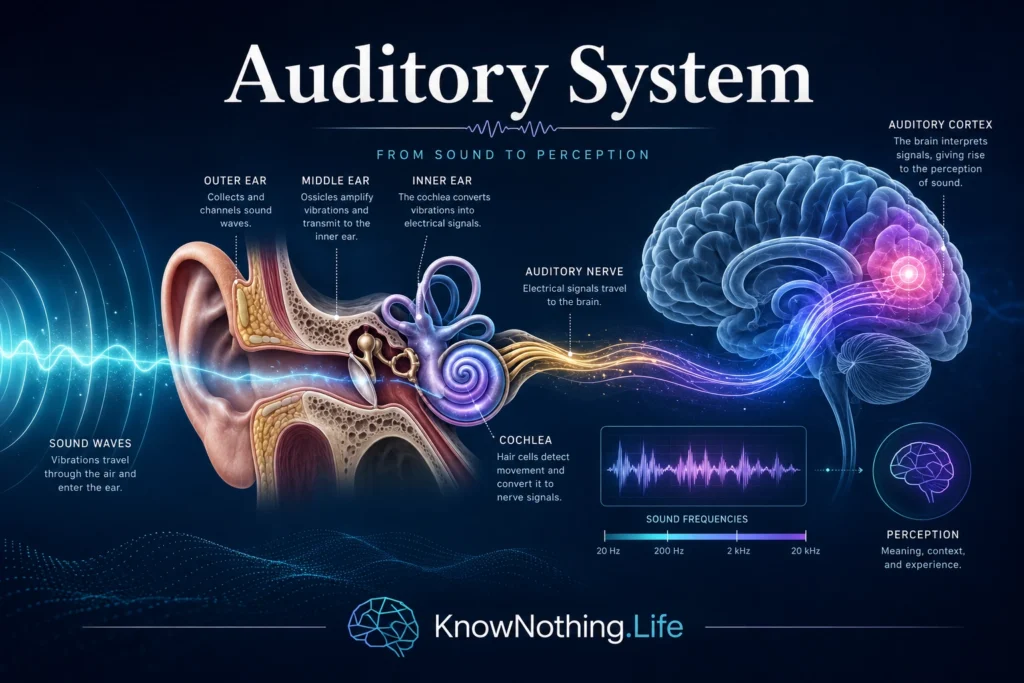
The auditory system is the biological network that allows the brain to detect sound, locate it in space, analyze its features, and transform vibration into meaningful experience. It includes the outer ear, middle ear, inner ear, cochlea, auditory nerve, brainstem nuclei, superior olivary complex, inferior colliculus, medial geniculate nucleus of the thalamus, auditory radiations, and auditory cortex in the temporal lobe. Through this system, pressure waves in the air become hearing. A voice becomes language, a siren becomes warning, a melody becomes music, and a sudden crack in the dark becomes a signal that something may require attention.
Hearing is not a passive recording of sound. The ear receives vibration, but the brain builds auditory perception. The auditory system must analyze frequency, loudness, rhythm, timing, direction, speech sounds, emotional tone, and background noise. It also has to work incredibly fast, because sound unfolds over time. Unlike a still image, which can be scanned visually, a spoken word or musical note exists as a sequence. The auditory system therefore depends on precision timing as much as it depends on sensitivity. It is one of the brain’s great systems for turning motion in the physical world into meaning in the mind.
The Outer and Middle Ear
Sound begins as vibration moving through air. The outer ear, including the pinna and ear canal, helps collect and shape incoming sound waves before they reach the eardrum. The shape of the outer ear also helps modify sounds depending on their direction, which contributes to sound localization. When sound waves strike the tympanic membrane, or eardrum, it vibrates. These vibrations pass through the middle ear bones, called the ossicles: the malleus, incus, and stapes. The stapes then transmits vibration to the oval window of the inner ear.
The middle ear is important because it helps transfer sound energy from air into the fluid-filled cochlea. Without this mechanical matching system, much sound energy would be reflected rather than transmitted. The ossicles amplify and focus vibration so that the inner ear can detect it efficiently. The middle ear also contains muscles that can reduce the transmission of very loud sounds, though this reflex is limited and does not fully protect against sudden noise damage. Hearing therefore begins with mechanical engineering: the body gathers, channels, amplifies, and transfers vibration before neural signaling begins.
The Cochlea and the Organ of Corti
The cochlea is the spiral-shaped inner-ear structure where mechanical vibration becomes neural information. Inside it are fluid-filled chambers and specialized membranes, including the basilar membrane. Resting on the basilar membrane is the organ of Corti, the sensory structure that contains auditory hair cells. StatPearls describes the basilar membrane as separating the scala tympani from the cochlear duct and notes that the organ of Corti plays a key role in auditory transduction.
The organ of Corti contains inner and outer hair cells. Inner hair cells are the main sensory receptors that transmit auditory information to the nervous system, while outer hair cells help amplify and sharpen cochlear responses. StatPearls describes the organ of Corti as containing three rows of outer hair cells and one row of inner hair cells, whose stereocilia bend in response to sound-related vibration and convert mechanical energy into electrical energy transmitted through the auditory nerve. This transformation is the heart of hearing. Sound is no longer only vibration; it becomes an electrochemical signal that the nervous system can process.
Frequency, Tonotopy, and the Traveling Wave
One of the cochlea’s most important features is tonotopic organization, meaning different sound frequencies are represented at different places along the basilar membrane. High-frequency sounds peak closer to the base of the cochlea, while lower-frequency sounds peak closer to the apex. This place-based coding allows the nervous system to preserve frequency information as sound travels inward. The auditory system begins building a map of pitch before signals even reach the brain.
Georg von Békésy’s work on cochlear mechanics was foundational for understanding this process. He showed that movement at the stapes produces a traveling wave along the basilar membrane, moving from the stiffer basal region toward the more flexible apical region, with the largest response occurring at different places depending on frequency. The Nobel Prize ceremony speech for his 1961 award emphasized his discovery of the traveling wave pattern in the cochlea. Later summaries from Harvard describe his work as the basis for tonotopic or place coding, in which the hair cells with the strongest response help code the fundamental frequency of sound.
The Auditory Nerve and Brainstem Pathways
Once hair cells convert vibration into neural activity, auditory information travels through spiral ganglion neurons into the cochlear branch of the vestibulocochlear nerve, also called cranial nerve VIII. These signals reach the cochlear nuclei in the brainstem, where auditory processing becomes more complex. From there, information travels through multiple pathways involving the superior olivary complex, lateral lemniscus, inferior colliculus, medial geniculate nucleus of the thalamus, and finally auditory cortex. A StatPearls overview of the auditory pathway describes this route from cochlear hair cells through the vestibulocochlear nerve, brainstem relays, thalamus, and auditory cortex.
The auditory brainstem is not simply a relay system. It begins analyzing timing, intensity, and spatial cues. The superior olivary complex is especially important because it receives input from both ears, allowing the brain to compare differences between them. These comparisons help determine where sounds come from. A sound arriving slightly earlier at one ear than the other creates an interaural time difference, while a sound being louder at one ear creates an interaural level difference. These tiny differences are essential for locating voices, approaching vehicles, footsteps, and environmental events.
Sound Localization and Timing
Sound localization is one of the auditory system’s most impressive abilities. The brain uses timing differences, loudness differences, and spectral changes caused by the outer ear to estimate where sound is located. Low-frequency sounds are often localized partly through interaural timing differences, while higher-frequency sounds are often localized partly through interaural level differences. Research on interaural time differences notes that they are used to localize sounds and improve detection in noise, and that the classic Jeffress model proposed coincidence-detection mechanisms for comparing input from the two ears.
Interaural level differences are especially important for high-frequency sound localization, because the head casts an acoustic shadow that makes sounds louder in the ear closer to the source. Research on the lateral superior olive emphasizes its role in encoding interaural level differences as cues to sound location. This ability matters in everyday life because hearing is spatial. A person does not merely hear a sound; they hear it as coming from behind, above, nearby, far away, left, right, threatening, familiar, or irrelevant. The auditory system helps place events in space before conscious attention fully interprets them.
Auditory Cortex, Speech, and Meaning
Auditory information eventually reaches the auditory cortex in the temporal lobe, especially regions on the superior temporal gyrus. The primary auditory cortex is organized tonotopically, preserving frequency relationships from the cochlea. NCBI’s neuroscience resources describe the primary auditory cortex as located on the superior temporal gyrus and organized with a precise tonotopic map. From there, sound information spreads into broader temporal, frontal, and parietal networks involved in speech perception, music, memory, attention, and emotional interpretation.
Speech perception shows how sophisticated auditory processing becomes. The brain must distinguish phonemes, track timing, separate a voice from background noise, infer words from incomplete signals, and connect sound patterns to meaning. Music requires analysis of pitch, rhythm, harmony, expectation, and emotion. A familiar voice carries identity, memory, and social significance. The auditory cortex does not simply detect frequencies; it helps turn acoustic patterns into human meaning. Hearing is therefore both sensory and cognitive.
Hearing Loss and Clinical Importance
Damage to the auditory system can occur at many levels. Conductive hearing loss involves problems transmitting sound through the outer or middle ear, such as eardrum damage, ossicle problems, or fluid in the middle ear. Sensorineural hearing loss often involves the cochlea, hair cells, auditory nerve, or central auditory pathways. Loud noise, aging, genetic conditions, infections, medications, trauma, and vascular problems can all affect hearing. Because mammalian hair cells have very limited regenerative ability, hair-cell loss can produce long-lasting or permanent hearing impairment.
Auditory disorders can also affect more than hearing sensitivity. Tinnitus can produce the perception of sound without an external source. Auditory processing disorders can make speech difficult to understand even when basic hearing thresholds are relatively normal. Central lesions can impair sound localization, speech comprehension, or auditory awareness. These conditions show that hearing depends not only on the ear, but on pathways and brain networks. The auditory system is a full nervous-system process, from vibration to meaning.
Why the Auditory System Matters
The auditory system matters because sound connects people to the world across distance and time. It allows humans to hear speech, music, danger, emotion, rhythm, location, and social presence. It keeps working even when the eyes are closed, and it can alert the brain to events outside the field of vision. Hearing is central to language, learning, communication, memory, safety, and culture.
The deeper lesson is that hearing is constructed. The world vibrates, but the nervous system hears. The ear converts mechanical energy into neural signals, the cochlea organizes frequency, the brainstem compares timing and intensity, the thalamus routes auditory information, and the cortex turns sound into recognition and meaning. To understand the auditory system is to understand how biology transforms pressure waves into voices, songs, warnings, and the felt presence of the world around us.