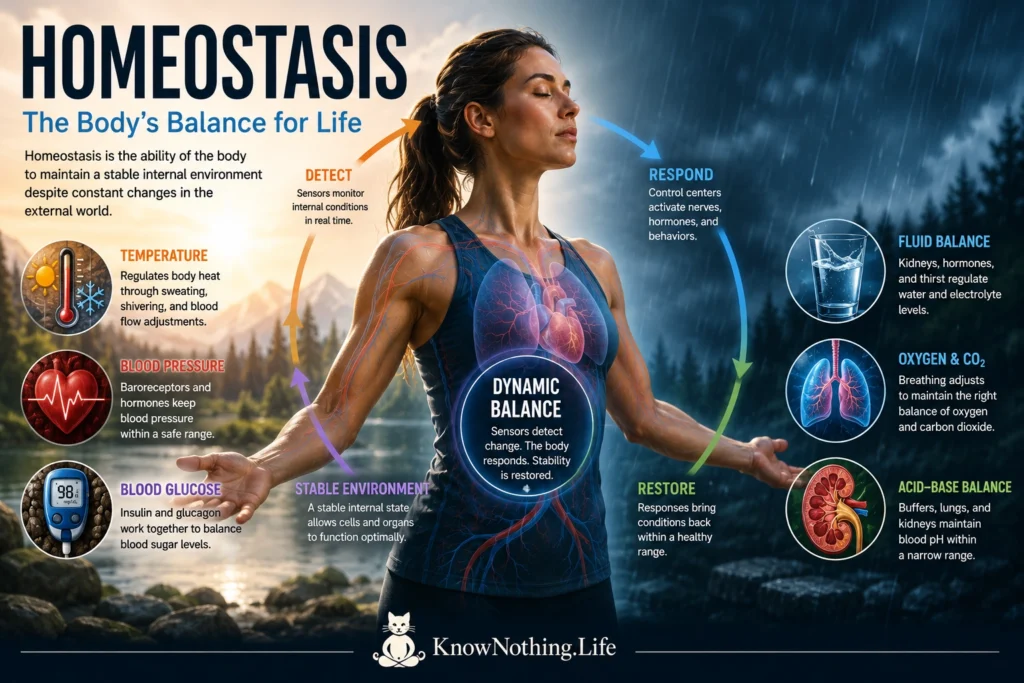
Homeostasis is the capacity of a living system to preserve conditions compatible with life while the environment, behavior, and metabolism continually change. It does not mean that the body remains motionless or that every physiological variable is held at one exact value. Body temperature rises and falls across the day, blood glucose changes after meals, blood pressure shifts with posture, and hormone concentrations move in pulses. What remains stable is the broader operating range within which cells and organs can function. Homeostasis is therefore a dynamic achievement produced by constant sensing, communication, and correction rather than a passive state of equilibrium.
The concept grew from Claude Bernard’s nineteenth-century description of the milieu intérieur, the internal environment surrounding the body’s cells. In An Introduction to the Study of Experimental Medicine, Bernard argued that the stability of this internal environment permits organisms to live with greater independence from external conditions. Walter B. Cannon later developed the idea in his 1929 paper “Organization for Physiological Homeostasis” and in The Wisdom of the Body. Cannon emphasized that biological constancy is approximate and maintained through coordinated mechanisms that resist disturbances. His formulation established homeostasis as a central organizing principle of physiology.
Feedback, Sensors, and Coordinated Control
A homeostatic system generally contains a regulated variable, sensors that detect relevant changes, integrating centers that interpret the information, and effectors that alter the variable or its causes. In negative feedback, a deviation produces responses that oppose the original disturbance. If arterial pressure falls after standing, pressure-sensitive receptors change their firing, brainstem circuits alter autonomic output, and the heart and blood vessels respond to preserve circulation. When the disturbance is corrected, the corrective response diminishes. This architecture prevents endless overreaction while allowing the system to respond again when conditions change.
Real physiology is more complicated than a thermostat connected to one heater. Many regulated variables are controlled by overlapping neural, endocrine, behavioral, and local mechanisms. The body also uses feedforward control, preparing for a disturbance before the regulated variable has changed substantially. Heart rate rises as exercise begins, and thirst may decline soon after drinking before absorbed water has corrected blood concentration. Redundancy makes regulation more resilient, while competing demands require prioritization. During exercise, temperature control, blood-pressure maintenance, oxygen delivery, and fluid conservation must be coordinated rather than managed as isolated systems.
Temperature and Cardiovascular Stability
Temperature regulation shows how homeostasis depends on physiology and behavior. Thermal receptors in the skin, internal tissues, and brain provide information about external and internal heat. Neural circuits centered in the hypothalamus coordinate sweating, skin blood flow, shivering, metabolic heat production, posture, and motivated behaviors such as seeking shade or warmth. Theodore Benzinger’s experimental work on human temperature regulation helped establish the importance of central temperature in controlling sweating and heat-loss responses. The result is not an unchanging temperature, but regulated variation within a range compatible with cellular function.
The cardiovascular system contributes by transporting heat and maintaining blood flow despite changes in posture, activity, and environment. When heat production rises during exercise, blood carries thermal energy from muscles and organs toward the skin, where vasodilation and sweating support heat loss. This creates a conflict because moving blood toward the skin can reduce the volume available to maintain central pressure, especially during dehydration. Baroreflex pathways, kidney function, hormones, and thirst help defend circulation. Core temperature and heart rate may rise during exertion, but coordinated adjustments keep them within tolerable limits and promote recovery afterward.
Glucose and Energy Regulation
Glucose homeostasis provides another example of coordinated negative feedback. After carbohydrate is absorbed, rising glucose stimulates pancreatic beta cells to release insulin. Insulin promotes glucose uptake in skeletal muscle and adipose tissue, supports glycogen formation, and suppresses hepatic glucose production. As blood glucose falls, insulin secretion decreases. During fasting, pancreatic alpha cells release glucagon, which stimulates the liver to release glucose through glycogen breakdown and gluconeogenesis. In a classic human experiment, John Gerich and colleagues suppressed glucagon with somatostatin and demonstrated that glucagon has an important physiological role in preventing fasting hypoglycemia.
This regulation is not controlled by insulin and glucagon alone. Autonomic nerves influence pancreatic and hepatic activity, while cortisol, growth hormone, and catecholamines help preserve fuel during stress or prolonged fasting. The brain also regulates hunger, satiety, and energy expenditure using signals related to nutrients, gastrointestinal activity, and stored energy. A person can therefore maintain glucose within a relatively narrow range despite alternating meals, sleep, exercise, and fasting. Diabetes develops when components of this network can no longer compensate adequately, showing how disease can emerge from the progressive failure of an entire regulatory system.
Water, Electrolytes, and Acid–Base Balance
Water balance depends on controlling both fluid intake and renal water loss. Osmoreceptors respond to changes in the concentration of dissolved substances in body fluids, while volume-sensitive pathways monitor circulation. When plasma becomes more concentrated, thirst increases and vasopressin promotes water reabsorption by the kidneys. In experiments with healthy volunteers, Robert Zerbe and Gary Robertson infused different hypertonic solutions and found that effective osmotic stimuli produced closely related increases in plasma osmolality, vasopressin release, and thirst. The results also showed that osmoregulation depends on the biological behavior of a solute, not merely on total measured osmolality.
The kidneys regulate sodium, potassium, bicarbonate, hydrogen ions, and other substances by adjusting filtration, reabsorption, secretion, and excretion. Acid–base balance also requires rapid chemical buffering, respiratory control of carbon dioxide, and slower renal handling of bicarbonate and acid. In foundational human studies, Robert Pitts and colleagues measured bicarbonate reabsorption and acid excretion, helping establish how the kidneys preserve the metabolic component of blood pH. Vomiting, diarrhea, kidney dysfunction, respiratory disease, or hormonal disturbances can disrupt several variables at once because homeostasis is a network of linked controls rather than a collection of independent dials.
Adaptation, Disease, and the Limits of Stability
Homeostatic ranges can change with age, sleep, pregnancy, training, infection, altitude, and circadian timing. Fever is not simply uncontrolled overheating; immune signals temporarily alter thermoregulatory control so the body generates and conserves heat at a higher operating level. Exercise training changes plasma volume, sweating responses, cardiac efficiency, and fuel use. Acclimatization to altitude increases ventilation and stimulates adjustments in oxygen transport. Such examples show that regulation includes plasticity: the body can recalibrate its responses when a changed environment persists.
Disease appears when disturbances exceed regulatory capacity, when sensors or effectors fail, or when compensation becomes damaging. Heart failure can provoke fluid retention and sympathetic activation that initially support circulation but later increase cardiac workload. Insulin resistance can be offset by greater insulin secretion until beta cells can no longer meet demand. Kidney disease impairs fluid, electrolyte, and acid–base control. Understanding illness through homeostasis shifts attention from one abnormal number to the system producing it: what is being sensed, which responses are activated, whether compensation is effective, and what long-term price the body is paying.
Homeostasis is not a promise of perfect balance. It is the continuous work of preserving life through flexible, coordinated regulation. Cannon’s insight remains powerful because it connects molecular events, organ function, behavior, and the environment within one framework. Every breath, heartbeat, meal, movement, and night of sleep challenges internal stability. The body survives not by preventing change, but by detecting it, responding proportionately, and repeatedly rebuilding a workable internal order.