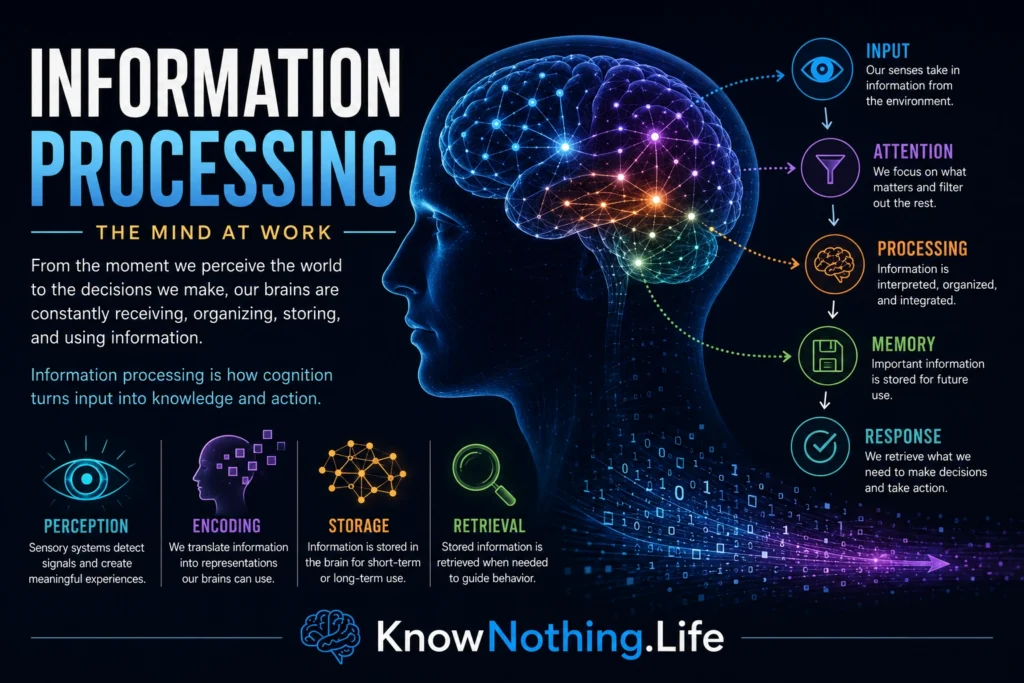
Information processing is a broad framework for explaining how humans and other cognitive systems receive input, transform it, store parts of it, retrieve prior knowledge, and produce responses. Rather than treating the mind as a passive recorder of experience, the approach describes cognition as an active sequence of operations. Sensory signals must be detected and interpreted, relevant information must be selected, temporary representations must be maintained, and stored knowledge must be used to guide decisions and behavior.
The framework does not claim that the human brain functions exactly like an ordinary computer. Biological cognition is shaped by emotion, bodily states, development, prior experience, motivation, and social context. Nevertheless, concepts such as input, coding, capacity, storage, retrieval, noise, and control have helped psychologists design precise experiments. By measuring accuracy, reaction time, recall, and patterns of error, researchers can infer processes that cannot be directly observed.
Information Theory and the Cognitive Revolution
A major intellectual foundation came from Claude Shannon’s 1948 paper “A Mathematical Theory of Communication.” Shannon developed a mathematical framework for measuring information and analyzing how signals could be transmitted through channels affected by noise. His theory was created for communication engineering rather than psychology, and it deliberately separated the technical transmission of a signal from its meaning. Even so, concepts such as channel capacity, uncertainty, coding, and signal-to-noise relationships strongly influenced later models of perception, attention, and memory.
George A. Miller applied the language of information processing to human performance in his influential 1956 paper “The Magical Number Seven, Plus or Minus Two.” Miller reviewed experiments on absolute judgment and immediate memory, emphasizing that human capacity is limited but can be expanded through chunking. A chunk is a meaningful unit that combines several smaller elements, such as remembering a familiar acronym rather than a series of unrelated letters. Later research, including Nelson Cowan’s reconsideration of short-term storage, argued that the capacity for separate, ungrouped items may often be closer to four than seven.
Attention as a Limited Selection System
The nervous system receives far more information than can be examined in equal depth. Attention allows certain signals, locations, objects, or goals to receive priority. Donald Broadbent’s 1958 book Perception and Communication proposed an early filter model in which information initially enters through parallel sensory channels before a selective mechanism permits part of it to receive further processing. The theory was influenced by studies of listening in noisy environments and helped establish attention as a problem of limited processing capacity.
Later research showed that attention is not a single gate operating at one fixed stage. It can prioritize spatial locations, objects, features, memories, or expected outcomes. Michael Posner’s studies of covert spatial attention demonstrated that people could direct attention toward a location without moving their eyes, improving the speed of detecting expected targets. This work helped separate attention from eye movement and connected cognitive experiments with neural systems involved in orienting, alertness, and control.
Memory Stores and Control Processes
Richard Atkinson and Richard Shiffrin’s 1968 model described memory through structural stores and flexible control processes. The framework distinguished sensory registers, a limited short-term store, and a more durable long-term store. Rehearsal, coding, search, and retrieval strategies were treated as control processes that people could apply differently depending on goals and circumstances. The model’s lasting influence came partly from this distinction between the relatively stable architecture of memory and the strategies used to manage information within it.
The model was sometimes simplified into the idea that information moves mechanically from sensory memory to short-term memory and then into long-term storage. In reality, memory depends on attention, organization, meaning, prior knowledge, retrieval cues, and repeated use. Information that receives deep semantic processing may be remembered better than material that is merely repeated, while knowledge stored in long-term memory can influence what is noticed and how new information is interpreted. Information processing is therefore interactive rather than a one-directional conveyor belt.
Working Memory and Active Thought
Alan Baddeley and Graham Hitch challenged the idea that short-term memory was simply a single temporary storage box. Their 1974 working-memory model proposed a system that supports both the maintenance and manipulation of information during reasoning, comprehension, learning, and problem-solving. The original framework included an attentional controller and specialized components for verbal and visuospatial material. Baddeley later added an episodic buffer to explain how information from different sources could be integrated into unified temporary representations.
Working memory helps a person follow a complicated sentence, calculate mentally, compare alternatives, or remember the beginning of a task while completing its later steps. Its capacity is limited, and performance declines when tasks compete for similar resources or place excessive demands on attention. Expertise can reduce this burden because familiar information is organized into meaningful structures retrieved from long-term memory. A skilled reader, musician, or chess player does not necessarily possess unlimited storage; experience allows information to be encoded and managed more efficiently.
Measuring Hidden Processing Stages
Information-processing theories became powerful because they generated measurable predictions. Reaction time can reveal how long particular mental operations require, especially when tasks are designed so that one component changes while others remain relatively stable. In his 1966 memory-scanning experiment, Saul Sternberg asked participants to decide whether a test item had appeared in a short memorized set. Response time increased approximately linearly as the set became larger, leading Sternberg to propose a rapid serial comparison process.
Mental chronometry does not provide a direct photograph of thought. The same reaction-time pattern can sometimes be explained by different models, and processes may overlap rather than occur as cleanly separated stages. Researchers therefore combine timing with accuracy, eye movements, brain activity, computational models, and patterns of impairment. The wider lesson remains important: internal cognitive operations can be studied scientifically when theories specify how changes in a task should change observable performance.
Representation, Algorithms, and the Brain
Information processing requires representations: internal states that preserve useful relationships from sensory input, memory, or current goals. A representation is not necessarily a literal picture stored inside the brain. It may consist of distributed neural activity, relationships among features, probabilities, motor plans, or patterns that allow one system to influence another. Different representations may be useful for recognizing an object, remembering its name, predicting its movement, or deciding how to interact with it.
David Marr’s posthumously published 1982 book Vision provided an influential framework for studying such systems at three levels. The computational level asks what problem is being solved and why; the algorithmic level asks which representations and procedures produce the solution; and the implementation level asks how the process is physically realized. Marr’s framework cautioned researchers against assuming that descriptions of neurons alone automatically explain cognition. A complete account must connect biological mechanisms with information-processing procedures and the goals those procedures accomplish.
Prediction and Modern Neuroscience
Contemporary neuroscience increasingly treats information processing as an active interaction between sensory evidence and prior expectations. In predictive-coding models, higher levels of a system generate predictions about activity at lower levels, while mismatches between prediction and incoming evidence are transmitted upward as prediction errors. Perception is therefore modeled not as the simple registration of sensory input but as a continuing attempt to determine which interpretation best explains that input.
Rajesh Rao and Dana Ballard’s 1999 model applied hierarchical predictive coding to visual cortex. Their simulations suggested that feedback connections could convey predictions while feedforward pathways carried differences between predictions and observed activity. The model offered a functional explanation for several response properties found in visual neurons. Predictive coding has since become influential in theories of perception and learning, although researchers continue to debate how broadly it applies and how its computations are implemented biologically.
Limits and Continuing Importance
The information-processing approach has sometimes been criticized for underestimating emotion, embodiment, culture, development, and the environment. Human cognition does not occur inside an isolated processor. Stress can narrow attention, goals can alter perception, social expectations can guide interpretation, and physical interaction with the world can reduce the need for internal calculation. People also change their environments by writing notes, using tools, asking others for help, and arranging information so that less must be held internally.
Despite these limitations, information processing remains one of the most productive frameworks in cognitive psychology and neuroscience. It offers a language for describing how information is selected, transformed, remembered, and used while encouraging theories that can be tested through measurable predictions. Its modern forms no longer portray cognition as a rigid series of boxes. They describe an adaptive system in which attention, memory, expectation, neural activity, action, and experience continually influence one another.