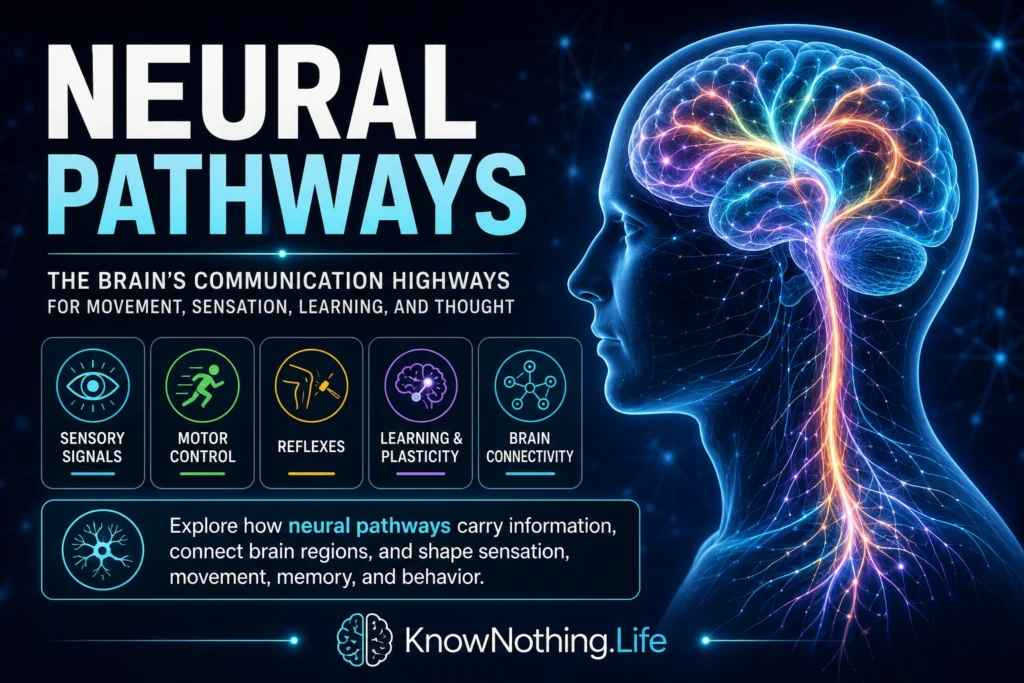
Neural pathways are organized routes of communication through the nervous system. They are made of neurons, axons, synapses, neurotransmitters, and larger tracts that carry information between the brain, spinal cord, body, and internal organs. Every sensation, movement, memory, reflex, emotion, and thought depends on signals moving through neural pathways. When a person feels heat on the skin, pulls a hand away, recognizes a face, speaks a sentence, remembers a place, or decides to act, the nervous system is using pathways to transmit, process, and coordinate information.
The term can refer to different levels of organization. At the microscopic level, a neural pathway may mean a chain of neurons communicating across synapses. At the anatomical level, it may refer to a major tract, such as the corticospinal tract for voluntary movement or the dorsal column-medial lemniscus pathway for touch and proprioception. At the network level, it may describe communication among brain regions, such as cortico-basal ganglia loops, thalamocortical circuits, or hippocampal memory pathways. Neural pathways are therefore not just “wires.” They are living communication systems that change with experience.
Neurons, Synapses, and Signal Transmission
Neurons communicate through electrical and chemical signaling. An electrical impulse, called an action potential, travels down a neuron’s axon. When it reaches the synapse, it can trigger the release of neurotransmitters that cross the synaptic gap and influence the next neuron. This is how information moves from cell to cell. The nervous system contains many types of neurons, including sensory neurons, motor neurons, interneurons, projection neurons, and modulatory neurons. Together, they form circuits that can be fast, precise, flexible, and adaptive.
Neural pathways are shaped by both structure and function. Some pathways are relatively direct, such as reflex circuits that allow the body to respond quickly to danger. Others are highly distributed, involving many brain regions and feedback loops. A simple movement may involve the motor cortex, basal ganglia, cerebellum, thalamus, brainstem, spinal cord, sensory feedback, and muscles. This shows that neural pathways are not one-way lines from command to action. They are loops of prediction, correction, feedback, and adjustment. The nervous system is constantly comparing what it intended to do with what actually happened.
Sensory Pathways: From Body to Brain
Sensory pathways carry information from the body and external world into the central nervous system. Signals from the skin, muscles, joints, eyes, ears, nose, and internal organs travel through specialized receptors and neural routes. In many somatosensory systems, information travels through first-, second-, and third-order neurons before reaching the cerebral cortex. A StatPearls overview of the central nervous system describes sensory information as traveling from the body to the spinal cord and then toward the brain through ordered neuronal relays.
These pathways do not simply deliver raw data. They transform information along the way. Touch, pain, temperature, vibration, and body position follow different routes and are processed differently. Visual signals pass through the retina, optic nerve, thalamus, and visual cortex. Auditory signals travel through the inner ear, brainstem nuclei, thalamus, and temporal cortex. By the time sensation reaches conscious awareness, it has already been filtered, amplified, inhibited, compared, and organized. Perception is therefore not the passive arrival of information. It is the result of pathways shaping signals into usable experience.
Motor Pathways: From Intention to Action
Motor pathways carry signals that allow the body to move. The corticospinal tract is one of the most important voluntary motor pathways. It begins in motor-related regions of the cerebral cortex, travels through the internal capsule and brainstem, crosses largely in the medulla, and continues through the spinal cord to influence motor neurons controlling muscles. The corticospinal tract is the major neuronal pathway for voluntary motor function, connecting the cortex to the spinal cord and enabling movement, especially of the distal extremities.
Movement also depends on many pathways beyond the corticospinal tract. The basal ganglia help select and initiate actions. The cerebellum helps refine timing, coordination, and error correction. Brainstem pathways help regulate posture, balance, eye movements, and automatic motor patterns. Spinal circuits help coordinate reflexes and rhythmic actions. A person reaching for a cup is not simply sending a single command from brain to hand. The nervous system must plan the movement, estimate distance, control force, adjust posture, process visual feedback, correct errors, and stop the movement at the right moment. Neural pathways make action possible by linking intention, body, and world.
Reflex Pathways and Fast Protection
Some neural pathways are designed for speed. Reflex pathways allow the body to respond quickly to potentially harmful stimuli, often before conscious awareness is fully formed. If a person touches something hot, sensory neurons can activate spinal interneurons and motor neurons that withdraw the hand rapidly. The brain may become aware of the pain a moment later, but the protective movement has already begun. This kind of pathway shows why the nervous system cannot rely only on conscious decision-making. Survival often requires fast automatic response.
Reflex pathways are not mindless in a dismissive sense. They are efficient biological solutions to urgent problems. Many reflexes involve the spinal cord and brainstem, including withdrawal reflexes, stretch reflexes, pupil responses, coughing, gagging, blinking, balance correction, and gaze stabilization. These pathways are constantly working in the background, keeping the body safe and functional. They allow conscious attention to focus on higher-level goals while the nervous system handles countless automatic adjustments.
Learning, Plasticity, and Hebbian Pathways
Neural pathways are not fixed like roads carved into stone. They change with use. This capacity is called neuroplasticity. Learning can strengthen some connections, weaken others, form new synapses, refine timing, and reorganize networks. Donald Hebb’s 1949 book The Organization of Behavior proposed one of the most influential ideas in neuroscience: when one neuron repeatedly contributes to firing another, the connection between them can strengthen. The popular phrase “neurons that fire together wire together” is a simplified version of this Hebbian principle, though Hebb’s original idea emphasized causal timing rather than mere simultaneous activity.
One of the strongest biological models of synaptic strengthening is long-term potentiation, or LTP. In 1973, Terje Lømo and Tim Bliss reported long-lasting potentiation of synaptic transmission in the hippocampus, suggesting that repeated activity can increase the efficiency of synaptic communication. Their work became central to memory neuroscience because it provided a physiological mechanism by which experience might alter neural pathways. Later research by Eric Kandel, Charles Bailey, and others connected synaptic plasticity with learning and memory, emphasizing that long-term memory involves structural and functional changes in synapses.
Neural Pathways and Memory
Memory depends on pathways that bind experience across time. The hippocampus helps form new declarative memories by linking information from many cortical regions. The amygdala helps mark emotionally important events. The basal ganglia support habit learning. The cerebellum contributes to motor learning and timing. The prefrontal cortex helps organize working memory, planning, and retrieval strategies. Memory is not stored in one pathway, but different pathways contribute to different kinds of memory.
When someone learns a piano piece, several systems are involved. The auditory cortex processes sound, the motor cortex controls finger movement, the cerebellum refines timing, the basal ganglia support practice-based habits, the hippocampus helps remember the learning context, and emotional systems may influence motivation. With repetition, the pathway becomes more efficient. The same action that once required effort can become fluent and automatic. This is one of the most important truths about neural pathways: practice changes the nervous system. Skill is not only something a person “knows.” It is something the brain and body become organized to perform.
White Matter Tracts and Brain Connectivity
Many long-distance neural pathways travel through white matter, which contains myelinated axons that connect different regions of the nervous system. Myelin acts as an insulating layer that helps signals travel faster and more efficiently. White matter tracts connect cortical regions to each other, connect the cortex with subcortical structures, and link the brain with the spinal cord. Major tracts include the corpus callosum, internal capsule, corticospinal tract, arcuate fasciculus, optic radiations, and cerebellar peduncles.
These tracts are essential because complex behavior depends on communication across regions. Language, for example, involves temporal regions for comprehension, frontal regions for speech production, and connecting pathways that allow these systems to cooperate. Movement depends on pathways between the cortex, basal ganglia, thalamus, cerebellum, brainstem, spinal cord, and muscles. Attention depends on communication between frontal and parietal systems. Damage to a pathway can disrupt a function even when the individual brain regions remain partly intact. In this sense, the brain is not only a collection of centers. It is a network of connections.
Clinical Importance of Neural Pathways
Damage to neural pathways can produce many neurological symptoms. A stroke affecting the corticospinal tract can cause weakness or paralysis. Damage to sensory pathways can cause numbness, pain, loss of proprioception, or abnormal sensations. Injury to visual pathways can produce blind spots or visual-field loss. Damage to language pathways can impair speech or comprehension. Diseases that affect myelin, such as multiple sclerosis, can disrupt signal conduction across many pathways. Spinal cord injury can interrupt communication between the brain and body. Neurodegenerative diseases can progressively damage specific circuits involved in movement, memory, or cognition.
Clinical neurology often depends on identifying which pathway has been disrupted. If a person has weakness on one side of the body, loss of vibration sense, abnormal reflexes, or a visual-field defect, the pattern can help localize the lesion. Pathways create maps for diagnosis. They also create possibilities for rehabilitation. Because the nervous system is plastic, therapy can sometimes strengthen remaining pathways, recruit alternative circuits, and improve function through practice. Recovery is not always complete, but the existence of plasticity means pathways can adapt.
Why Neural Pathways Matter
Neural pathways matter because they explain how the nervous system turns biology into experience and action. The brain does not work through isolated regions alone. It works through communication. Sensory pathways bring the world in. Motor pathways send action out. Reflex pathways protect the body. Memory pathways preserve experience. Emotional pathways mark significance. White matter tracts connect distant systems into coordinated networks. Thought, feeling, and behavior all depend on signals moving through organized routes.
Neural pathways also remind us that the brain is shaped by life. Repetition, learning, stress, injury, therapy, sleep, emotion, and practice can all influence how pathways function. The nervous system is structured, but it is not static. It is a living network that changes as a person learns, adapts, heals, remembers, and acts. To understand neural pathways is to understand one of the most basic principles of neuroscience: the mind is not located in one place. It emerges from communication across the brain, body, and world.