Neural signaling is the process by which neurons communicate within the nervous system. It includes the electrical signals that travel along neurons, the chemical signals that cross synapses, and the network-level activity that allows the brain and body to coordinate sensation, movement, memory, emotion, reflexes, attention, and thought. Every time a person feels pain, sees color, hears a voice, moves a hand, remembers a name, or makes a decision, neural signaling is involved. It is the basic language of the nervous system: a combination of voltage changes, ion flow, neurotransmitter release, receptor activation, and circuit coordination.
Neural signaling is not one single event. It happens across multiple scales. At the cellular level, neurons maintain electrical gradients across their membranes. At the axon level, action potentials carry signals over distance. At the synaptic level, neurotransmitters allow one neuron to influence another. At the circuit level, patterns of signaling create perception, movement, learning, and behavior. Voltage-gated cation channels are central to the generation and propagation of neuronal action potentials.
The Electrical Foundation of Neural Signaling
Neurons are electrically excitable cells. This means they can change the voltage across their membrane in response to stimulation. The resting membrane potential exists because ions such as sodium, potassium, chloride, and calcium are unevenly distributed across the cell membrane. Ion channels and pumps help maintain these gradients, giving the neuron the ability to respond quickly when the right input arrives. The neuron is not inactive at rest; it is actively maintaining a charged state that can be converted into a signal.
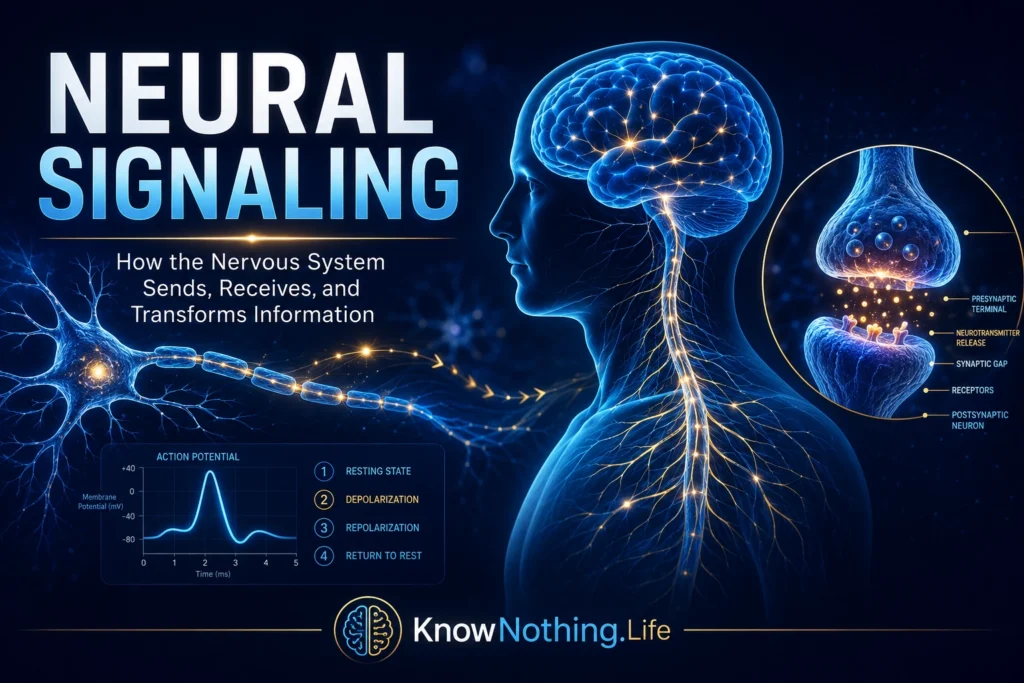
When a neuron receives enough excitatory input, it may reach threshold and fire an action potential. This begins when voltage-gated sodium channels open and sodium ions enter the cell, rapidly depolarizing the membrane. Potassium channels then help repolarize the membrane, allowing the neuron to return toward its resting state. This spike of electrical activity travels down the axon and allows the neuron to send information to distant targets. The action potential is one of the nervous system’s most important achievements because it allows signals to move quickly and reliably across long distances.
Hodgkin, Huxley, and the Action Potential
Modern neuroscience owes much of its understanding of neural signaling to Alan Hodgkin and Andrew Huxley. Working with the squid giant axon, they showed how changes in sodium and potassium conductance could explain the action potential. The squid giant axon was especially useful because its large size allowed researchers to insert electrodes and measure electrical activity directly. Later historical reviews describe Hodgkin and Huxley’s work as foundational because it turned nerve signaling into a measurable physiological and mathematical process.
Their discoveries changed how scientists understood the nervous system. A nerve impulse was no longer a vague spark of life or an invisible force. It could be explained through membrane voltage, ion channels, electrochemical gradients, and changing conductance. This remains central to neurophysiology today. Every discussion of neural signaling, from reflexes to consciousness, rests partly on the insight that neurons communicate through physical processes that can be measured and modeled.
Synaptic Signaling: From Electricity to Chemistry
Electrical signaling allows an impulse to travel within a neuron, but neurons must also communicate with other cells. This usually happens at synapses. When an action potential reaches the presynaptic terminal, it opens voltage-gated calcium channels. Calcium enters the terminal and triggers synaptic vesicles to fuse with the membrane, releasing neurotransmitters into the synaptic cleft. Thomas Südhof’s review of calcium control of neurotransmitter release describes this process clearly: an action potential invades the nerve terminal, calcium channels open, calcium rises locally, and synaptic vesicle exocytosis releases neurotransmitter.
This transformation from electrical signaling to chemical signaling is one of the nervous system’s defining features. The action potential carries information to the axon terminal, but neurotransmitters carry that influence across the gap to another cell. Once neurotransmitters bind to receptors on the postsynaptic membrane, they may make the next cell more likely to fire, less likely to fire, or modulate its future responsiveness. In this way, neural signaling is not simply electrical or chemical. It is electrochemical, switching forms as information moves through the nervous system.
Neurotransmitters and Receptors
Neurotransmitters are the chemical messengers of neural signaling. Major neurotransmitters include glutamate, GABA, glycine, acetylcholine, dopamine, serotonin, norepinephrine, and many neuropeptides. Glutamate is the main excitatory neurotransmitter in the brain, while GABA is the major inhibitory neurotransmitter. Acetylcholine helps control muscle activation and attention. Dopamine is involved in movement, reward learning, motivation, and prediction. Serotonin participates in mood, sleep, appetite, pain, and regulation. Norepinephrine helps shape arousal, vigilance, stress response, and attention.
The effect of a neurotransmitter depends on its receptor. Ionotropic receptors are fast ligand-gated ion channels that directly change ion flow across the membrane. Metabotropic receptors work more slowly through intracellular signaling pathways. This is why the same chemical can have different effects in different places. Dopamine in one circuit may support movement, while dopamine in another may shape motivation or reinforcement learning. Neurotransmitters are not simple labels for emotions. They are chemical signals whose meaning depends on receptor type, circuit location, timing, and network context.
Excitation, Inhibition, and Balance
Neural signaling depends on balance. Excitatory signaling increases the likelihood that neurons will fire, while inhibitory signaling decreases it. The brain needs both. Without excitation, circuits cannot activate. Without inhibition, neural activity can become unstable, noisy, or seizure-like. Inhibition is not a sign of reduced function. It is one of the main ways the nervous system creates precision. It allows the brain to suppress irrelevant signals, sharpen perception, regulate movement, and prevent runaway activity.
This balance is visible in nearly every brain function. Vision depends on contrast created partly through inhibitory circuits. Movement depends on activating the right muscles while suppressing competing patterns. Attention depends on enhancing some signals while filtering others. Emotional regulation depends on interactions between limbic activity and prefrontal control. Neural signaling is therefore not about maximum activation. It is about organized activation. The brain works because signals are shaped, limited, timed, and coordinated.
Myelin, Speed, and Long-Distance Communication
Neural signaling also depends on how quickly and efficiently signals travel. Many axons are wrapped in myelin, a fatty insulating sheath produced by oligodendrocytes in the central nervous system and Schwann cells in the peripheral nervous system. Myelin allows action potentials to move rapidly by jumping between nodes of Ranvier, the small gaps in the myelin sheath where ion channels are concentrated. This process is called saltatory conduction. Without myelin, many signals would travel too slowly for coordinated speech, movement, reflexes, and cognition.
White matter in the brain consists largely of myelinated axons, and it allows different regions to communicate. A decision may involve the frontal cortex, basal ganglia, thalamus, limbic system, and sensory cortex. A spoken sentence may involve hearing, language comprehension, speech planning, motor control, feedback, and attention. Myelinated pathways help these regions synchronize. Neural signaling is therefore not only about what one neuron does. It is also about how distant systems communicate fast enough to act as one coordinated brain.
Neural Signaling and Plasticity
The nervous system does not signal the same way forever. Neural signaling changes with experience. This capacity is called plasticity. Synapses can strengthen, weaken, form, or disappear. Circuits can become more efficient with practice. Repeated activity can alter receptor numbers, neurotransmitter release, dendritic spines, gene expression, and even myelination. This is how learning becomes biological. A skill is not only something a person understands consciously; it is something the nervous system becomes reorganized to perform.
Eric Kandel’s work on learning and memory helped show how changes in synaptic strength can support short-term and long-term memory. In his Nobel lecture, Kandel emphasized that synaptic plasticity can be brief or long-lasting depending on the pattern and repetition of learning stimuli. This insight is central to modern neuroscience. Memory is not stored as a single object in one place. It emerges from changes in signaling across networks. Neural signaling is therefore both communication and adaptation.
Neural Signaling in the Body
Neural signaling is not limited to the brain. The spinal cord, peripheral nerves, autonomic nervous system, sensory receptors, and muscles all depend on it. Sensory neurons carry information from the body to the central nervous system. Motor neurons carry commands from the nervous system to muscles. Autonomic neurons regulate organs, blood vessels, glands, digestion, heart rate, and many internal processes. Reflex pathways can trigger rapid protective responses before conscious awareness fully develops.
This body-wide signaling shows why the nervous system is not just a thinking organ. It is a communication network linking the organism to the world. A hot surface, a painful injury, a sudden sound, a falling body position, or a racing heartbeat all become meaningful because neural pathways carry and transform those signals. The brain interprets the body, and the body continuously informs the brain. Neural signaling is the bridge between external events, internal states, and coordinated action.
Clinical Importance of Neural Signaling
Many neurological and psychiatric conditions involve disrupted neural signaling. Epilepsy can involve excessive synchronized firing. Multiple sclerosis can impair signaling by damaging myelin. Parkinson’s disease involves altered dopamine signaling in motor circuits. Depression, anxiety, schizophrenia, addiction, migraine, chronic pain, and sleep disorders all involve changes in neurotransmitters, receptors, pathways, rhythms, or circuit regulation. These conditions are rarely explained by one chemical being simply too high or too low. They involve complex signaling systems across many brain and body networks.
Medications often work by changing neural signaling. Antidepressants can affect serotonin or norepinephrine systems. Antipsychotics often influence dopamine receptors. Benzodiazepines enhance GABA-related inhibition. Local anesthetics can block sodium channels. Antiseizure medications may affect ion channels, neurotransmitter release, or inhibitory signaling. These treatments show how central signaling is to medicine: changing how neurons communicate can change movement, mood, pain, sleep, attention, and consciousness.
Why Neural Signaling Matters
Neural signaling matters because it is the process that turns nervous tissue into a living communication system. Ion channels allow neurons to fire. Action potentials carry signals. Myelin speeds communication. Synapses connect cells. Neurotransmitters shape responses. Receptors interpret chemical messages. Circuits coordinate perception, movement, memory, and behavior. Without neural signaling, the brain would be anatomy without activity.
The deeper lesson is that the mind depends on communication. No single neuron contains a thought, memory, emotion, or decision by itself. These emerge from patterns of signaling across networks. Neural signaling allows the brain to receive the world, interpret the body, choose actions, adapt through learning, and maintain life. To understand neural signaling is to understand one of neuroscience’s most basic truths: human experience is built from billions of cells continuously sending, receiving, filtering, and transforming information.