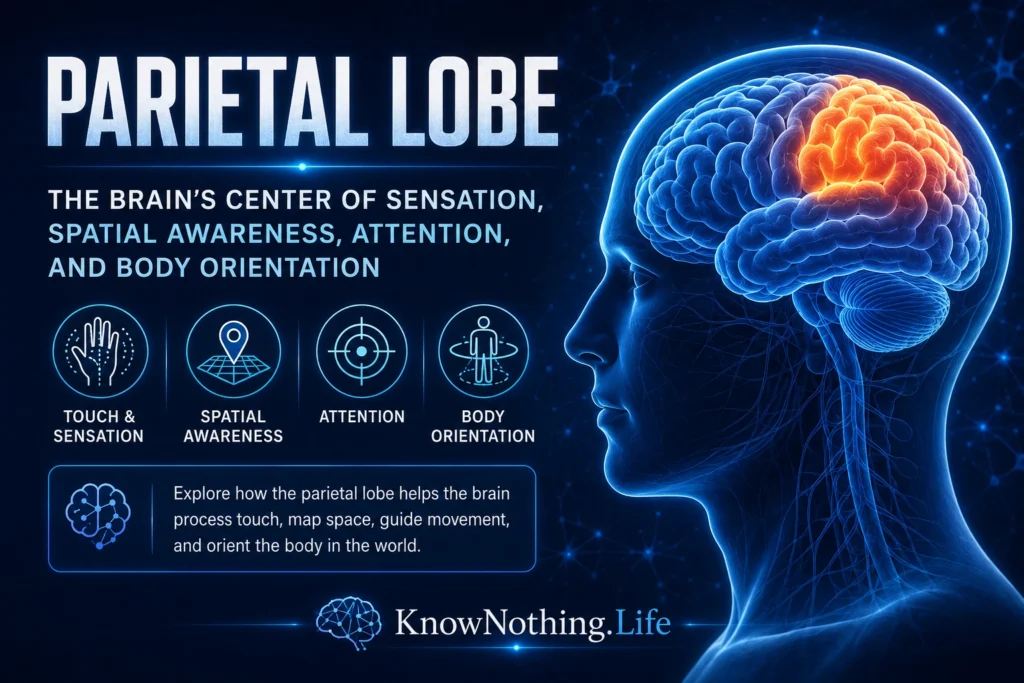
The parietal lobe is one of the four major lobes of the cerebral cortex, located behind the frontal lobe, above the temporal lobe, and in front of the occipital lobe. It is best known for processing bodily sensation, but that description only captures part of its importance. The parietal lobe helps the brain interpret touch, pressure, temperature, pain, body position, spatial relationships, attention, object location, and visually guided movement. It allows a person to know where the body is, where objects are, and how to act within surrounding space.
The parietal lobe is not simply a passive receiving station for sensory information. It is an integrative region that helps turn sensation into usable awareness. When a person reaches for a cup, buttons a shirt, walks through a doorway, reads a map, feels a phone vibrating in a pocket, or turns toward someone calling their name, parietal networks help coordinate the body with the world. The lobe’s deeper importance is that it helps answer a basic question the nervous system must solve constantly: where am I in relation to everything else? Without the parietal lobe, the brain would still receive sensory signals, but those signals would be much harder to organize into coherent action.
Anatomy and Major Regions
The parietal lobe contains several important regions, including the primary somatosensory cortex, superior parietal lobule, inferior parietal lobule, supramarginal gyrus, angular gyrus, and posterior parietal cortex. The primary somatosensory cortex sits in the postcentral gyrus, just behind the central sulcus. It receives sensory information from the body, including touch, vibration, pressure, pain, temperature, and proprioception. Different parts of this cortical strip correspond to different parts of the body, forming the famous sensory homunculus, in which body areas with especially fine sensation, such as the hands and lips, occupy proportionally large cortical regions.
Behind the primary somatosensory cortex, the posterior parietal cortex performs more complex integration. A recent review describes the parietal lobe as including the somatosensory cortex and posterior parietal cortex, with the former processing information from the body and external environment, and the latter contributing to higher cognitive functions. The superior parietal lobule is often associated with spatial processing and sensorimotor integration, while the inferior parietal lobule contributes to attention, language-related functions, body awareness, and symbolic processing. These areas work together so that sensation is not just felt, but placed into a larger map of space, movement, and meaning.
Touch, Body Awareness, and Somatosensation
The parietal lobe’s most direct role is somatosensation, the brain’s processing of information from the body. Through somatosensory pathways, signals from the skin, muscles, joints, and internal body surfaces travel through the spinal cord, brainstem, thalamus, and eventually into the somatosensory cortex. Once there, the brain can detect the location, intensity, and quality of bodily sensation. This is how a person knows whether something is sharp, warm, soft, heavy, painful, or pressing against the skin. It is also how the body knows where its limbs are without needing to look at them.
This sense of body position, called proprioception, is one of the most underappreciated functions of the nervous system. A person can close their eyes and touch their nose because the brain has an internal map of limb position. The parietal lobe helps maintain and update that map. When parietal function is disrupted, a person may struggle to locate touch, recognize objects by feel, coordinate the hand with vision, or understand the position of a limb. These problems show that bodily awareness is not automatic in the simple sense. It is constructed by neural systems that continuously combine sensory input into a working model of the body.
Spatial Awareness and the World Around Us
The parietal lobe is essential for spatial awareness. It helps the brain understand where objects are, how far away they are, how they relate to one another, and how the body should move through space. This role is especially important in the posterior parietal cortex, which integrates visual, tactile, vestibular, and proprioceptive information. A person walking through a crowded room is constantly using parietal processing to avoid obstacles, adjust posture, judge distance, and plan movements. These calculations are usually unconscious, but they are central to everyday life.
The parietal lobe is also strongly involved in the brain’s dorsal visual stream, sometimes called the “where” or “how” pathway. In a landmark 1992 paper, Melvyn Goodale and David Milner proposed that the ventral visual stream helps identify objects, while the dorsal stream projecting toward posterior parietal regions supports the sensorimotor transformations needed for visually guided action. This means the parietal lobe helps transform vision into movement. It does not merely ask “What am I looking at?” It also asks “Where is it, and how should I move toward it?” Reaching, grasping, pointing, navigating, and orienting all depend on this bridge between perception and action.
Attention and Hemispatial Neglect
One of the clearest demonstrations of parietal-lobe function comes from hemispatial neglect, a neurological syndrome often associated with right parietal damage. In neglect, a person may fail to attend to one side of space, usually the left side, even though the eyes themselves may be capable of seeing. Someone with neglect may eat food only from the right side of a plate, shave only the right side of the face, or copy only the right half of a drawing. A clinical review by Parton, Malhotra, and Husain describes neglect as a major disorder of spatial attention and discusses both bedside diagnosis and rehabilitation approaches.
Neglect shows that perception is not only about sensory input. The brain must also allocate attention. The world does not enter consciousness as a complete and equal field; attention organizes what becomes prominent, meaningful, and actionable. The right parietal lobe appears especially important for broad spatial attention, which is why right-sided lesions can produce dramatic left-sided neglect. This condition also reveals something profound about ordinary experience: the sense that the world is fully present is partly an achievement of the brain. When parietal attention systems fail, whole regions of space can effectively disappear from awareness.
Language, Numbers, and Symbolic Thought
Although the parietal lobe is often described in terms of sensation and space, parts of it also contribute to language, reading, calculation, and symbolic reasoning. The angular gyrus and supramarginal gyrus, especially in the dominant hemisphere, are involved in linking visual, auditory, spatial, and linguistic information. These regions help support reading, writing, phonological processing, semantic integration, and mathematical thinking. This is one reason left parietal damage may produce difficulties with calculation, writing, left-right discrimination, and finger recognition, a pattern historically associated with Gerstmann syndrome.
The connection between the parietal lobe and symbolic thought may seem surprising at first, but it makes sense when we consider how much abstract reasoning depends on spatial and bodily organization. Numbers are often imagined along mental lines. Reading requires mapping visual symbols onto sounds and meanings. Writing requires linking language to hand movement. Even concepts like left and right require the brain to coordinate body orientation with symbolic labels. The parietal lobe helps build these bridges. It turns body, space, symbol, and action into coordinated mental life.
Clinical Importance of the Parietal Lobe
Parietal-lobe injury can produce a wide range of symptoms depending on the side and location of damage. Problems may include numbness, altered sensation, poor coordination, impaired proprioception, difficulty recognizing objects by touch, spatial disorientation, neglect, apraxia, reading difficulty, calculation problems, and trouble with body awareness. Because the parietal lobe works closely with frontal, temporal, and occipital regions, its symptoms often overlap with movement, language, vision, and attention problems. A parietal stroke, tumor, traumatic injury, or degenerative condition may therefore change not only sensation, but the person’s ability to interact meaningfully with the environment.
Clinically, the parietal lobe is important because it reveals how deeply perception and action are connected. A person may have normal muscle strength but still struggle to use objects properly. Another person may see both sides of space but attend to only one. Another may feel touch but be unable to interpret what is being touched. These symptoms are not failures of simple sensation alone; they are failures of integration. The parietal lobe is a region where the body becomes organized, space becomes meaningful, and perception becomes action.
Why the Parietal Lobe Matters
The parietal lobe matters because it helps create the brain’s practical sense of reality. It tells the body where it is, helps attention find what matters, guides movement through space, and allows sensory information to become useful. Without it, the world would not simply feel less detailed; it would become harder to inhabit. The person might struggle to locate their own body, orient in a room, reach accurately, attend to one side of space, or connect symbols to actions.
The parietal lobe also reminds us that consciousness is embodied. Thinking does not happen in a detached mental vacuum. It depends on body maps, spatial awareness, touch, movement, attention, and orientation. The parietal lobe helps the brain construct the felt relationship between self and world. To understand it is to understand one of the brain’s most important bridges: the bridge between sensation and meaning, body and space, perception and action.