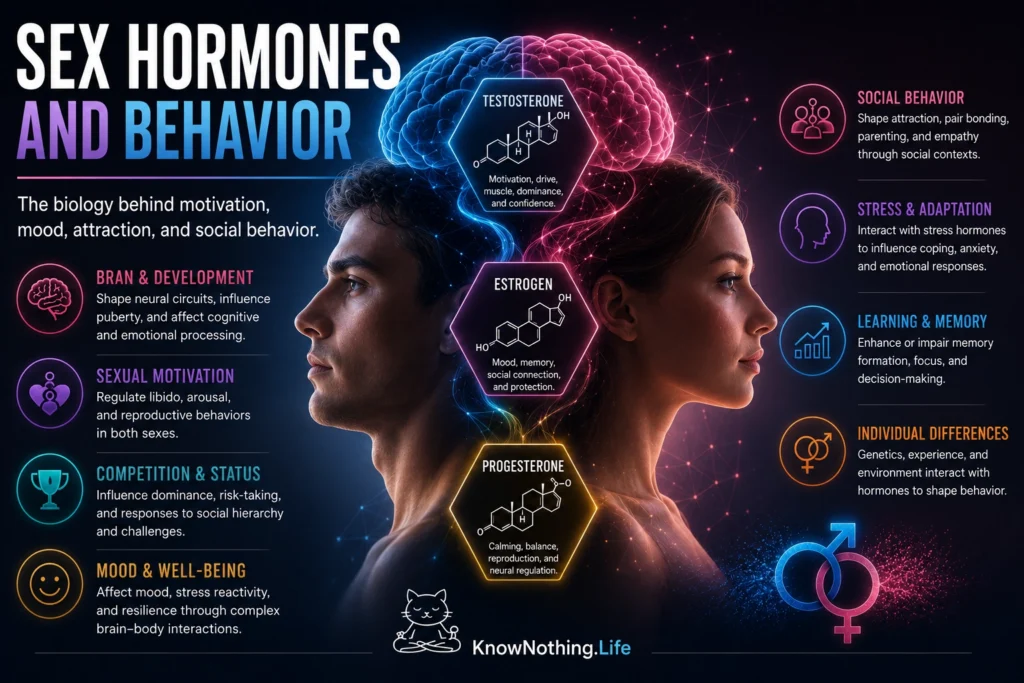
Sex hormones are chemical messengers involved in reproduction, physical development, and the regulation of neural activity. The principal groups are androgens, including testosterone; estrogens, especially estradiol; and progestogens, especially progesterone. Although their average concentrations differ between males and females, these hormones are present in every sex. Their behavioral effects depend on concentration, receptor sensitivity, developmental stage, metabolism within the brain, and the social conditions in which behavior occurs. A hormone does not create one fixed response; it changes the probability, intensity, or biological importance of particular responses.
Sex hormones act through receptors in the brain as well as throughout the body. Some effects develop gradually as steroid receptors alter gene expression, while others occur through faster signaling pathways that change neuronal activity. Studies have shown that estradiol can remodel hippocampal synapses, testosterone can be associated with cortical maturation, and experimentally administered hormones can alter social decision-making. These findings help explain why gonadal hormones can influence sexual motivation, memory, mood, threat processing, competition, and social behavior without operating as simple behavioral commands.
Organizing the Developing Brain
A foundational idea in behavioral endocrinology is that hormones can exert both organizational and activational effects. Organizational effects occur during sensitive developmental periods, when hormonal exposure helps shape the lasting structure and responsiveness of neural circuits. Activational effects occur when current hormone levels temporarily alter the activity of those circuits. Charles Phoenix, Robert Goy, Arnold Gerall, and William Young articulated this distinction in their 1959 study Organizing Action of Prenatally Administered Testosterone Propionate on the Tissues Mediating Mating Behavior in the Female Guinea Pig. Prenatal testosterone produced enduring changes in adult mating behavior and later hormone responsiveness.
The original organizational–activational model focused heavily on prenatal development, but later research indicates that puberty may represent another period of heightened hormonal influence. Longitudinal imaging studies have associated changing testosterone levels with age- and sex-dependent patterns of cortical development. Other research has linked pubertal testosterone with changing neural responses to social cues and emotional information. These findings do not mean that hormones independently determine adolescent behavior. Puberty simultaneously changes the body, social expectations, peer relationships, and opportunities, creating an ongoing interaction between endocrine development and experience.
Sexual Motivation and Reproductive Behavior
The relationship between gonadal hormones and sexual behavior is especially clear in animal research. In many mammals, estradiol prepares neural circuits for sexual receptivity, while progesterone can facilitate receptive behavior after appropriate estradiol exposure. The same progesterone signal may later inhibit receptivity, showing that timing and hormonal sequence matter. Androgens support sexual motivation and mating behavior in many male animals, but sensory cues, social position, prior experience, and access to potential partners continue to shape whether behavior occurs. Hormones increase responsiveness; they do not eliminate environmental control.
Human sexuality is influenced by relationships, health, identity, stress, medication, cultural expectations, and interpersonal circumstances, but controlled studies demonstrate a hormonal contribution. In the Testosterone Trials, older men with consistently low testosterone experienced moderate improvements in sexual desire and activity after testosterone treatment. Randomized trials have also found that carefully dosed transdermal testosterone can improve desire in some postmenopausal women experiencing clinically distressing low sexual interest. These results do not suggest that desire can be predicted from one hormone measurement; they show that hormones are one component of a larger motivational system.
Testosterone, Status, and Aggression
Testosterone is frequently described as an aggression hormone, but human evidence is more complicated. A large meta-analysis found only a small association between naturally measured testosterone and aggression, while the effects of experimentally administered testosterone varied across studies. Testosterone may be more consistently connected to status-related motivation—the effort to gain, defend, or display social standing. Aggression can serve that goal in some environments, but cooperation, generosity, persistence, risk-taking, or punishment of unfair behavior may be more effective in others.
Experiments reveal this contextual pattern. Christoph Eisenegger and colleagues found that testosterone administration increased fair bargaining behavior in women, while participants who merely believed they had received testosterone behaved more unfairly. Jean-Claude Dreher and colleagues later reported that testosterone increased both punishment of unfair offers and rewards for generous offers in men. Rather than producing indiscriminate hostility, the hormone intensified responses relevant to reputation and status. Personality, cortisol, perceived rank, and whether a person has recently won or lost can further modify the behavioral response.
Estradiol, Progesterone, Mood, and Cognition
Estradiol and progesterone influence neural plasticity as well as reproductive physiology. Catherine Woolley and Bruce McEwen showed that synapse density in the CA1 region of the adult rat hippocampus changed across the estrous cycle and increased with estradiol exposure. Later experiments found that estradiol increased dendritic spine density through mechanisms involving NMDA receptors and enhanced neuronal sensitivity to NMDA-mediated input. These studies established that ovarian hormones can rapidly remodel circuits associated with learning and memory, although animal findings should not be converted into simplistic claims that one menstrual phase universally improves human cognition.
Mood effects also depend more on individual sensitivity and hormonal transitions than on a universally “good” or “bad” hormone level. In an experiment by Meir Steiner Bloch and colleagues, women with a history of postpartum depression were more likely to develop mood symptoms when researchers simulated pregnancy-related estradiol and progesterone levels and then withdrew the hormones. Women without that history did not react in the same way. A later randomized trial found that transdermal estradiol combined with intermittent progesterone reduced the development of clinically significant depressive symptoms during the menopause transition.
Hormones Respond to Behavior
The relationship between hormones and behavior runs in both directions. Competitive experiences can alter testosterone, meaning that an elevated measurement may be partly a consequence of the situation rather than its original cause. Studies of athletic and laboratory competitions have found that winning and losing can produce different testosterone responses, although the size and direction of the effect depend on setting, personal interpretation, and individual characteristics. Testosterone changes can then influence willingness to compete again, take risks, or defend status.
Major social transitions can also reshape hormonal patterns. Longitudinal research has found that testosterone often declines as men become fathers, particularly among those investing more heavily in caregiving. This does not mean that lower testosterone automatically creates better parenting. Instead, it suggests that endocrine activity may adjust as behavioral priorities shift between mating effort, partnership, and parental investment. Hormones help allocate attention and energy, while social experience continually modifies the endocrine conditions under which future behavior occurs.
Beyond Biological Determinism
Research on sex hormones does not support the idea that males and females possess two completely separate behavioral systems. Average hormonal differences may contribute to average differences in some traits, but the distributions overlap and individuals vary substantially. Hormonal effects are often modest, dependent on context, and influenced by developmental history. Genes, family relationships, culture, education, social opportunity, stress, and personal experience help determine how biological tendencies are expressed. Hormones can influence motivation and neural responsiveness without dictating intelligence, personality, morality, identity, or occupation.
The most accurate conclusion is that sex hormones act as modulators. They help organize developing circuits, activate reproductive systems, alter sensitivity to reward and threat, and influence the significance assigned to social information. Their effects are real but conditional. Testosterone may support aggression or cooperation depending on which behavior protects status. Estradiol can reshape hippocampal synapses without guaranteeing a particular memory outcome. Progesterone can facilitate reproductive behavior or contribute to mood symptoms in susceptible individuals. Behavior emerges from hormones acting within a brain already shaped by development, experience, and the surrounding social world.