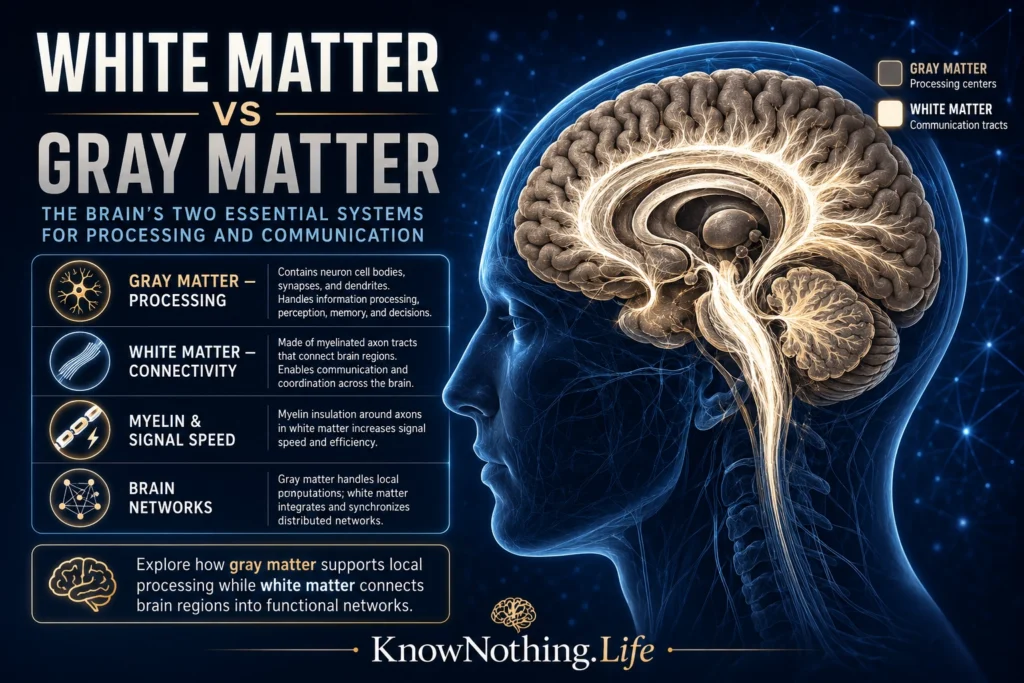
White matter and gray matter are two major types of tissue in the central nervous system. Gray matter is made mostly of neuronal cell bodies, dendrites, synapses, and unmyelinated fibers, while white matter is made mostly of myelinated axons that connect different brain and spinal-cord regions. In simple terms, gray matter is where much local processing happens, and white matter is what allows distant regions to communicate efficiently. Both are essential. A brain made only of gray matter would have processing units but poor long-distance communication; a brain made only of white matter would have communication routes without enough local computational machinery. Gray matter contains a high concentration of neuronal cell bodies and both gray and white matter are essential parts of the brain and spinal cord.
The distinction is visible because myelin, the fatty insulating sheath around many axons, gives white matter its pale appearance. Gray matter appears darker because it contains many cell bodies, synapses, capillaries, and less myelin. In the brain, gray matter forms the outer cerebral cortex and many deep nuclei, while white matter lies heavily beneath the cortex as connecting tracts. In the spinal cord, the arrangement is partly reversed: gray matter lies more centrally, while white matter surrounds it. This organization reveals a major principle of nervous-system design: the brain needs both specialized processing centers and fast communication routes linking them into networks.
Gray Matter: The Brain’s Processing Tissue
Gray matter is often associated with thinking, perception, memory, decision-making, emotion, and voluntary movement because the cerebral cortex is largely gray matter. The cortex contains layers of neurons that receive, process, and transmit information. Different cortical regions specialize in different functions. The occipital cortex processes visual information, the temporal cortex contributes to hearing and memory, the parietal cortex supports sensation and spatial awareness, and the frontal cortex helps with movement, planning, language, judgment, and self-control. Gray matter is also found in deep structures such as the thalamus, basal ganglia, hypothalamus, amygdala, and hippocampus.
But gray matter should not be reduced to “thinking tissue” in a simplistic way. It includes local circuits that process sensory input, regulate movement, evaluate emotion, shape motivation, and coordinate reflexive and cognitive functions. Synapses in gray matter allow neurons to influence one another through chemical and electrical signaling. These local networks are where information is transformed: light becomes visual form, sound becomes speech, sensation becomes body awareness, and memory cues become remembered experience. Gray matter is therefore central to what the brain does with information once it arrives.
White Matter: The Brain’s Communication System
White matter is made primarily of axons, many of which are wrapped in myelin. Axons are the long fibers that carry electrical signals away from neuron cell bodies toward other neurons, muscles, or glands. In the brain, bundles of axons form white-matter tracts that connect cortical regions to one another, connect the cortex with subcortical structures, and connect the brain with the spinal cord. Major white-matter pathways include the corpus callosum, internal capsule, corticospinal tract, arcuate fasciculus, optic radiations, and cerebellar peduncles. These tracts allow the brain to function as a coordinated whole rather than a collection of isolated islands.
White matter is crucial for speed, timing, and integration. A person reading aloud, for example, must coordinate visual processing, language comprehension, speech planning, motor control, hearing, attention, and working memory. These functions involve multiple gray-matter regions, but white matter allows them to communicate. Diffusion tensor imaging, or DTI, is commonly used to study white-matter tracts because it measures patterns of water diffusion that reflect fiber organization. A review of diffusion tensor imaging describes DTI as a major method for visualizing cerebral white-matter anatomy and tract organization.
Myelin and the Speed of Brain Communication
Myelin is one of the major reasons white matter matters. It is a fatty insulating layer produced by specialized glial cells: oligodendrocytes in the central nervous system and Schwann cells in the peripheral nervous system. Myelin helps electrical impulses travel faster and more efficiently along axons. Rather than moving continuously down the entire axon surface, signals jump between small gaps in the myelin sheath called nodes of Ranvier. This process, called saltatory conduction, greatly increases speed while conserving energy. A StatPearls review describes myelin as a fatty product made by neuroglial cells that increases signal transmission and provides vital support functions.
Myelin also helps explain why the brain develops over time. Many white-matter pathways continue maturing from childhood through adolescence and into early adulthood. This prolonged development affects attention, impulse control, language, motor skill, emotional regulation, and executive function. The prefrontal cortex and its connections, for example, mature relatively late, which helps explain why self-control and planning continue developing through adolescence. White matter is not merely passive wiring installed at birth. It is a living system that changes with growth, experience, learning, and disease.
Processing vs Connectivity
A useful way to compare gray and white matter is to think in terms of processing and connectivity. Gray matter contains many of the local circuits that perform computations. White matter contains many of the long-distance fibers that allow those computations to be shared across brain systems. However, this distinction should not be taken too rigidly. Gray matter contains axons, and white matter contains glial cells, blood vessels, and some signaling activity. The two systems are intertwined. The brain does not process first and communicate later; processing and communication happen continuously.
Modern neuroscience increasingly emphasizes brain networks rather than isolated regions. A function like language depends not only on gray-matter regions in the frontal and temporal lobes, but also on white-matter pathways connecting them. A function like memory depends not only on the hippocampus and cortex, but also on the tracts that allow these structures to exchange information. A function like movement depends on cortical motor areas, basal ganglia, cerebellum, thalamus, brainstem, spinal pathways, and white-matter tracts linking them. White matter and gray matter are therefore not rivals. They are complementary parts of one integrated system.
White Matter, Brain Networks, and the Connectome
The human brain is often described as a connectome: a network of nodes and connections. In this framework, gray-matter regions can be understood partly as nodes, while white-matter tracts help form the edges that connect them. This network perspective has become important because many brain functions depend on distributed communication. Attention depends on frontal and parietal systems. Memory depends on hippocampal, temporal, prefrontal, and thalamic systems. Vision depends on occipital regions and pathways into temporal and parietal cortex. Personality, emotion, and decision-making depend on connections among frontal, limbic, subcortical, and autonomic systems.
Diffusion-weighted MRI has become a major noninvasive tool for studying structural connectivity. A review on estimating brain connectivity with diffusion-weighted MRI notes that dMRI is widely used to assess white-matter properties and to estimate anatomical connectivity through tractography, while also warning that these estimates require careful interpretation. This caution matters because brain imaging is powerful but imperfect. White-matter tractography can reveal likely pathways, but it is not the same as directly tracing every axon. Still, it has transformed neuroscience by making large-scale human brain connectivity visible in living people.
Plasticity, Learning, and Experience
Gray matter has long been associated with plasticity because synapses can strengthen, weaken, form, and disappear with experience. Learning a language, practicing music, studying mathematics, or recovering after injury can all involve changes in gray-matter circuits. But modern research has shown that white matter is also plastic. Experience can influence myelination, axon structure, and white-matter organization. A major review of adult white-matter plasticity states that mounting evidence shows white-matter change plays an important role in learning and plasticity throughout life, including activity-dependent myelination.
This means practice does not only change what neurons “know.” It can change how efficiently brain regions communicate. Skilled action depends on timing. A pianist, athlete, surgeon, or dancer does not only need strong local processing; they need fast, coordinated signaling across sensory, motor, cognitive, and emotional systems. White-matter plasticity helps explain how repeated experience can make behavior smoother, faster, and more automatic. Gray matter may help refine the processing, while white matter helps refine the communication.
Gray Matter, White Matter, and Disease
Many neurological and psychiatric conditions involve gray matter, white matter, or both. Gray-matter loss is often discussed in relation to neurodegenerative conditions such as Alzheimer’s disease, frontotemporal dementia, Parkinson’s disease, and some forms of epilepsy. Damage to gray matter can impair memory, language, perception, movement, judgment, or emotion depending on the region involved. A stroke damaging gray matter in the motor cortex may cause weakness; damage in the occipital cortex may impair vision; damage in the temporal lobe may affect memory or language.
White-matter damage can be just as serious, though it may be less familiar to the public. Multiple sclerosis damages myelin in the central nervous system, disrupting signal transmission. Small-vessel disease can produce white-matter lesions associated with slowed thinking, gait problems, mood changes, and cognitive decline. Traumatic brain injury can damage axons through shearing forces. Developmental white-matter abnormalities can affect motor, cognitive, and behavioral development. Because white matter connects regions, damage to it can cause disconnection syndromes, where a function fails not because one processing center is destroyed, but because communication between regions is impaired.
Aging and Development
Gray and white matter change across the lifespan. During childhood and adolescence, gray matter often shows patterns of growth followed by pruning, while white matter generally increases as myelination and connectivity mature. These changes support developing abilities such as language, self-control, reasoning, coordination, and social judgment. The brain becomes more efficient not simply by adding more tissue, but by refining networks. Some connections are strengthened, others are pruned, and communication becomes faster and better organized.
In aging, both gray and white matter can change. Gray-matter volume may decline in some regions, while white-matter integrity may be affected by vascular health, inflammation, metabolic disease, and neurodegeneration. White-matter changes are especially important because they can slow communication across brain systems, contributing to reduced processing speed, balance problems, executive dysfunction, and vulnerability to cognitive decline. Maintaining brain health therefore means supporting both processing tissue and communication tissue. Sleep, exercise, cardiovascular health, learning, social engagement, and stress regulation may all matter because the brain is a whole network, not a single isolated organ.
Why the Difference Matters
The difference between white matter and gray matter matters because it helps explain how the brain is built. Gray matter processes information through dense local networks of neurons and synapses. White matter connects those processing centers through long-range axonal pathways. One gives the brain local computational power; the other gives it communication, speed, and integration. Neither is more important in a simple sense. A healthy brain depends on both.
This distinction also helps move beyond the myth that intelligence or personality lives in one brain region. Human experience emerges from both specialized regions and the pathways that connect them. A memory requires gray-matter structures that encode and retrieve information, but also white-matter routes that coordinate hippocampus, cortex, thalamus, and prefrontal systems. A decision requires frontal processing, emotional input, reward signals, memory, body state, and communication among them. To understand white matter vs gray matter is to understand one of neuroscience’s core truths: the mind depends not only on what the brain processes, but on how the brain connects.