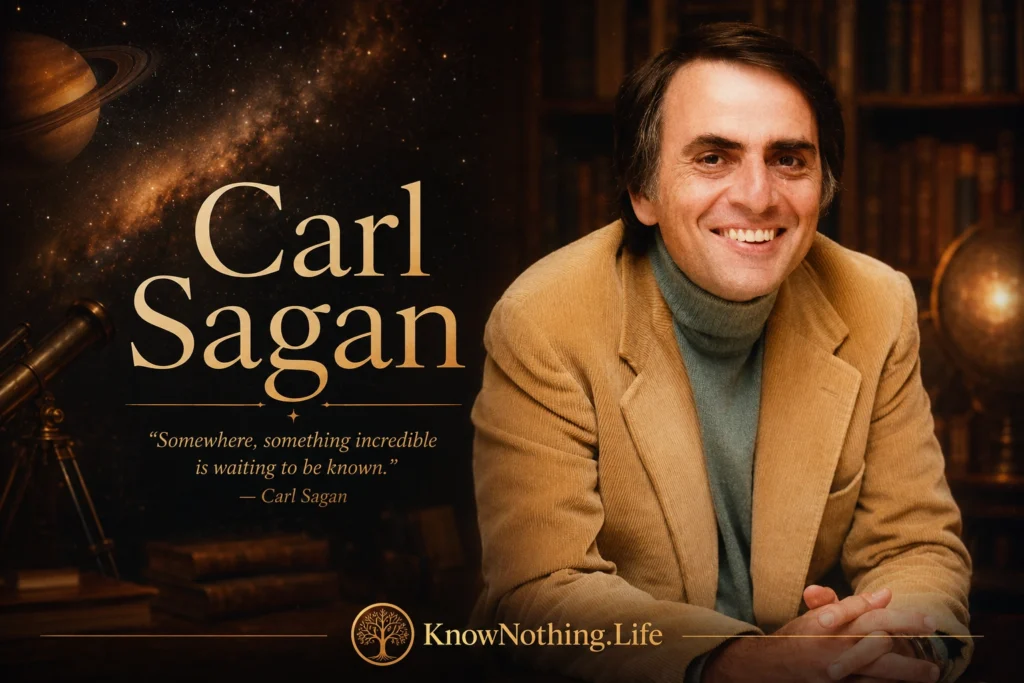
Carl Edward Sagan was born on November 9, 1934, in Brooklyn, New York, and grew up in a working-class Jewish family whose life was far removed from observatories, spacecraft, and academic fame. His father, Samuel Sagan, had immigrated from Ukraine as a child, and his mother, Rachel Molly Gruber Sagan, encouraged his curiosity with an intensity that shaped his whole life. As a boy, Sagan was fascinated by science fiction, the 1939 New York World’s Fair, and the question that first opened the universe for him: what are the stars?
That childhood question became a lifelong vocation. Sagan later remembered going to the library and discovering that stars were not little lights stuck in the sky, but suns at immense distances. The realization changed the scale of reality for him. It joined wonder to evidence, imagination to measurement. This became the signature of his mind: he could feel awe before the cosmos without surrendering to fantasy. He wanted the universe to be astonishing, but he also wanted it to be true.
Education and Scientific Formation
Sagan entered the University of Chicago in 1951 on scholarship, a decisive step that gave him both a liberal education and rigorous scientific training. He earned undergraduate degrees, a master’s degree in physics, and a doctorate in astronomy and astrophysics. His doctoral work was supervised by Gerard Kuiper, one of the major figures in planetary science. Even as a student, Sagan resisted narrow specialization. He was drawn to astronomy, biology, chemistry, planetary atmospheres, and the possibility of life beyond Earth.
This breadth made him unusual. Many astronomers of the time treated planetary studies as secondary to stars and galaxies, and exobiology was often regarded as speculative. Sagan believed otherwise. Planets were worlds, not just moving points of light. Their atmospheres, surfaces, chemistry, and histories mattered. His early work on Venus helped explain its extreme heat through a powerful greenhouse effect, while his studies of Mars and Titan helped connect planetary science to atmospheric chemistry and the search for life. From the beginning, he stood at the meeting point of hard science and cosmic possibility.
Harvard, Cornell, and Planetary Science
After postdoctoral work, Sagan taught and researched at Harvard, then moved to Cornell University in 1968. Cornell became his intellectual home. He eventually became David Duncan Professor of Astronomy and Space Sciences and director of the Laboratory for Planetary Studies. There he trained students, produced research, wrote, lectured, and built one of the most recognizable scientific voices of the twentieth century. He was a scientist with unusual public energy, but he was not merely a popularizer. His public work grew from a serious research career.
Sagan contributed to major NASA missions, including Mariner, Viking, Voyager, and Galileo. He briefed Apollo astronauts before their lunar flights and advised NASA from the early years of the American space program. His work helped explain the high temperature of Venus, seasonal changes on Mars, and the reddish haze of Titan. He also helped design messages for possible extraterrestrial recipients, including the Pioneer plaques and the Voyager Golden Record. These projects expressed one of his deepest beliefs: science is not only a way to study the universe, but a way for humanity to introduce itself to the universe.
The Search for Life Beyond Earth
Few themes defined Sagan more strongly than the search for life elsewhere. He was one of the pioneers of exobiology, now more commonly called astrobiology, the study of the possibility of life beyond Earth. To Sagan, the question was scientifically serious even when evidence remained incomplete. Mars, Venus, Titan, Europa, and distant worlds all invited disciplined speculation. He did not claim aliens were visiting Earth, but he insisted that the universe was vast enough, old enough, and chemically rich enough to make the search for life a rational scientific enterprise.
His position required both openness and skepticism. Sagan became famous for the standard “extraordinary claims require extraordinary evidence,” a phrase associated with his approach to UFOs, paranormal claims, and unsupported speculation. He was willing to imagine extraterrestrial civilizations, but he refused to confuse desire with evidence. This balance made him powerful: he could defend the search for alien life while criticizing sloppy belief in alien visitation. He taught that skepticism is not the enemy of wonder. It is what protects wonder from self-deception.
Cosmos and the Public Imagination
In 1980, Sagan became internationally famous through Cosmos: A Personal Voyage, the television series he co-wrote and hosted. The series combined astronomy, biology, history, philosophy, art, music, and storytelling in a way that changed science communication. Sagan did not speak down to viewers. He invited them into the grandest questions: where did the universe come from, what is life, how did intelligence evolve, and what responsibilities come with knowledge? Cosmos reached hundreds of millions of people and made Sagan a cultural figure far beyond academia.
The companion book Cosmos became one of the best-known science books of its era. In it and in the series, Sagan gave one of his most memorable formulations: “The Cosmos is within us. We are made of star-stuff. We are a way for the Universe to know itself.” The sentence works because it is both poetic and scientifically grounded. The atoms in human bodies really were forged in stars and cosmic events. Sagan’s genius was to turn that fact into a spiritual insight without leaving science behind.
Books, Skepticism, and the Defense of Reason
Sagan wrote or co-wrote many books, including Intelligent Life in the Universe, The Cosmic Connection, Broca’s Brain, The Dragons of Eden, Cosmos, Contact, Pale Blue Dot, The Demon-Haunted World, and Billions and Billions. The Dragons of Eden, his book on the evolution of human intelligence, won the Pulitzer Prize for General Nonfiction. His novel Contact imagined the scientific, political, religious, and emotional consequences of receiving a message from an extraterrestrial civilization. Even in fiction, Sagan’s subject remained contact between evidence and longing.
His late book The Demon-Haunted World: Science as a Candle in the Dark may be his most urgent defense of scientific thinking. It warned that democratic societies are endangered when citizens lose the ability to distinguish evidence from wish, claim from proof, and authority from truth. Sagan argued that science is more than a body of facts. It is a discipline of humility: a way of checking ourselves because we are so easily fooled. His skepticism was moral as well as intellectual. A society that cannot think clearly becomes vulnerable to manipulation, superstition, and fear.
Pale Blue Dot and Cosmic Humility
One of Sagan’s most enduring legacies came from a photograph. As a member of the Voyager imaging team, he argued that Voyager 1 should turn its camera back toward Earth before leaving the planetary neighborhood. On February 14, 1990, the spacecraft captured Earth from billions of miles away as a tiny point of light. Sagan later called it the “Pale Blue Dot,” and the phrase became one of the most famous images of cosmic humility.
In Pale Blue Dot, he wrote, “Look again at that dot. That’s here. That’s home. That’s us.” The meaning of the image was not merely astronomical. It was ethical. Earth appeared as a speck suspended in sunlight, the only known home of every human conflict, love, empire, religion, injustice, hope, and memory. For Sagan, astronomy did not make human life meaningless. It made human responsibility more urgent. If no help is coming from elsewhere, then people must preserve and cherish the only world known to harbor life.
Activism, Nuclear Winter, and Responsibility
Sagan believed scientists had public duties. He spoke against nuclear weapons, warned about nuclear winter, criticized pseudoscience, supported space exploration, and urged attention to environmental danger. His planetary perspective made national vanity seem small. From space, borders vanish; atmosphere becomes fragile; civilization appears temporary. This did not make politics irrelevant. It made politics more serious because human decisions could damage the only biosphere humanity possesses.
His activism was not always popular among scientists who preferred public restraint, and his celebrity sometimes caused resentment within academic circles. Yet Sagan accepted that science communication carried risks. He believed public understanding mattered more than professional discomfort. To him, science belonged not only to laboratories, agencies, and universities, but to citizens. A technological civilization that does not understand science is, in his view, dangerously unstable.
Final Years and Lasting Legacy
Sagan suffered from myelodysplasia, a rare bone marrow disease, and died of pneumonia related to complications from the illness on December 20, 1996, at age sixty-two. His death came too early, but his influence had already become immense. He helped build planetary science, strengthened the search for extraterrestrial life, inspired support for space exploration, and gave modern science one of its most beloved public voices.
Carl Sagan remains essential because he joined skepticism, wonder, science, and moral responsibility in a way few public thinkers have matched. He taught that the universe is not diminished when explained; it becomes more astonishing. He showed that critical thinking can be beautiful, that humility can be cosmic, and that humanity’s smallness is not a reason for despair but a reason for care. His legacy is not only what he discovered, but how he taught millions to look up, ask better questions, and think more clearly about our fragile place among the stars.