
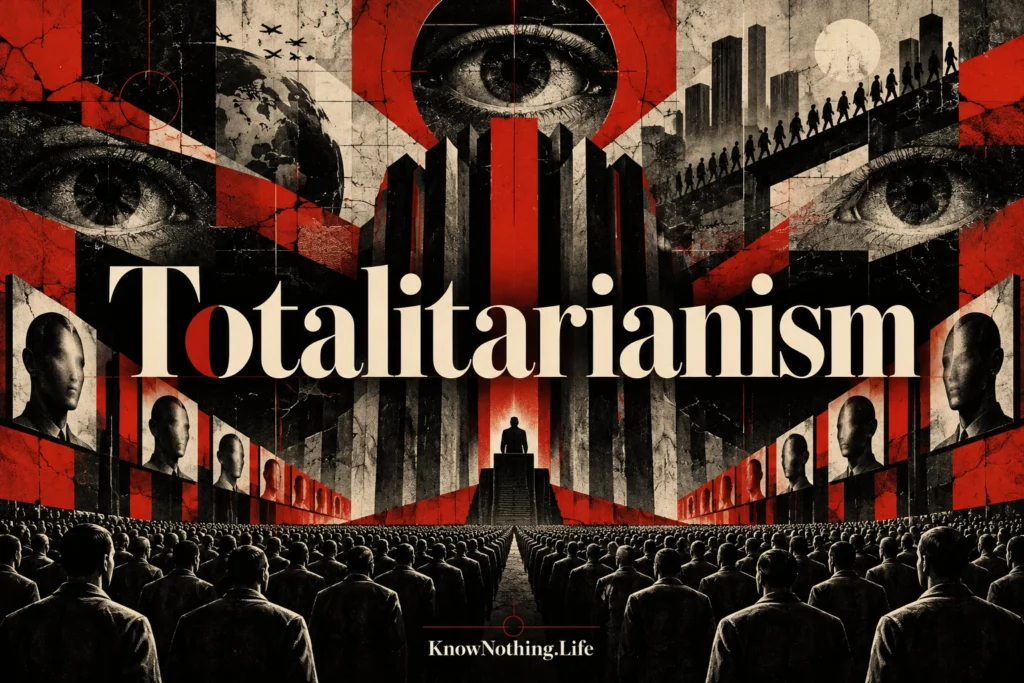
Totalitarianism represents one of the most extreme forms of political domination in human history. Unlike governments that merely restrict political opposition or concentrate authority within a ruling elite, totalitarian systems seek to transform society itself. Their ambitions extend beyond legislation, military power, and economic administration into education, culture, personal relationships, and even individual consciousness. At its most extreme, totalitarianism attempts to eliminate the distinction between public authority and private existence, making every dimension of human life subordinate to an all-encompassing political ideology.
The twentieth century revealed the devastating consequences of such ambitions through regimes that combined mass propaganda, systematic persecution, political terror, and unprecedented mechanisms of social control. Philosophers and political theorists, including Hannah Arendt, Karl Popper, George Orwell, and Isaiah Berlin, examined the intellectual foundations and moral consequences of systems that demanded obedience not only in outward behavior but also in belief. Their writings raise questions that remain central to political philosophy: Why do societies surrender freedom? How can political authority gain control over individual thought? And what happens when a government claims the exclusive right to determine truth, morality, and the meaning of human existence?
What Is Totalitarianism?
Totalitarianism is a political system characterized by an ambition to exercise comprehensive control over society through centralized leadership, ideological conformity, organized coercion, and the suppression of independent institutions. While traditional dictatorships often focus primarily on maintaining political power, totalitarian movements seek to reorganize society according to a supposedly universal explanation of history, human nature, or national destiny. Political authority becomes inseparable from an ideological mission, and individuals are evaluated according to their conformity to that mission. Independent judgment, competing loyalties, and alternative interpretations of reality may consequently become threats to the political order.
Political scientists Carl Friedrich and Zbigniew Brzezinski offered one of the most influential systematic accounts in Totalitarian Dictatorship and Autocracy (1956). They identified recurring characteristics, including an official ideology, a dominant mass party, political terror, centralized control of communication and weapons, and extensive direction of economic organizations. Their framework emphasized that totalitarianism involves more than severe repression; it depends upon interconnected institutions capable of penetrating social life. Although later scholars criticized the model for treating different historical regimes too uniformly, it established an important distinction between governments that restrict freedom and political systems that aspire to control the entire organization of human existence.
The Historical Origins of Totalitarianism
The modern concept of totalitarianism emerged during the political upheavals following the First World War. The collapse of empires, economic instability, revolutionary movements, and widespread disillusionment with established political institutions created conditions in which radical ideologies could acquire extraordinary appeal. The term became associated with Italian Fascism during the 1920s, initially appearing in criticism of Benito Mussolini’s movement before being incorporated into fascist political language. Fascist theorists presented the state as an organizing authority whose interests transcended those of individuals and independent social groups. This conception rejected the liberal understanding of society as a collection of persons possessing rights that political authority must respect.
The rise of Nazi Germany and the consolidation of Stalinist rule in the Soviet Union subsequently transformed totalitarianism into a major category of political analysis. Although National Socialism and Stalinism emerged from profoundly different ideological traditions, both developed systems involving concentrated leadership, political persecution, mass mobilization, and extensive efforts to reshape society. Historian Enzo Traverso, in his 2017 study Totalitarianism Between History and Theory, examines how the concept evolved from a political accusation into a framework for interpreting twentieth-century dictatorship. His analysis also emphasizes the need to distinguish genuine historical similarities from comparisons that overlook important differences in ideology, social structure, and political objectives.
Hannah Arendt and the Origins of Totalitarian Rule
Hannah Arendt (1906–1975) provided one of the most influential philosophical interpretations in The Origins of Totalitarianism (1951). Having experienced the rise of Nazism and fled persecution in Europe, Arendt sought to explain why totalitarian government represented something more radical than traditional tyranny. She argued that its defining ambition was not simply to command obedience but to undermine human spontaneity, individuality, and the possibility of independent political action. For Arendt, totalitarianism attempted to destroy the conditions under which people could form autonomous judgments and participate in a shared political world.
Arendt connected the emergence of totalitarian movements with mass loneliness, social fragmentation, and the collapse of established political relationships. Individuals who feel disconnected from meaningful communities may become especially susceptible to movements offering certainty, belonging, and an all-encompassing explanation of existence. Her observation that totalitarianism undermines “the distinction between fact and fiction” captures the importance of epistemic domination: when political authority determines what counts as reality, independent thinking becomes increasingly difficult. In The Human Condition (1958), Arendt further developed her defense of human plurality, arguing that genuine political life depends upon the ability of different individuals to speak, act, and appear before one another as distinct persons.
Ideology, Leadership, and the Machinery of Control
Totalitarian ideology offers followers a comprehensive interpretation of reality that claims to explain historical developments, political conflicts, and humanity’s ultimate purpose. Such systems frequently organize the world into opposing categories, presenting one group as the legitimate embodiment of history or national destiny while identifying others as obstacles to collective fulfillment. Political disagreement becomes more than an ordinary difference of opinion; it may be portrayed as betrayal of an allegedly unquestionable truth. Ideology therefore provides both a justification for extraordinary political authority and a framework through which repression can be presented as necessary, moral, or historically inevitable.
The concentration of authority around a leader often strengthens this process. Political institutions become organized around personal loyalty, while legal procedures and administrative responsibilities lose their independence. Max Weber’s discussion of charismatic authority in Economy and Society, published posthumously in 1922, provides a useful theoretical framework for understanding how extraordinary devotion to a political figure can displace institutional accountability. Yet totalitarian leadership does not depend on personal charisma alone. Party organizations, bureaucracies, police institutions, and networks of informants transform ideological commands into practical mechanisms of control. These structures can also compete internally, producing uncertainty that reinforces dependence upon the supreme leadership.
Political Terror and the Destruction of Individual Freedom
Political terror serves a distinctive function within totalitarian systems because its purpose extends beyond punishing identifiable opponents. It can create an environment in which individuals no longer know what behavior will expose them to persecution. Arbitrary arrests, forced confessions, collective punishment, imprisonment, and executions communicate that personal security depends upon forces outside ordinary legal protections. Under such conditions, citizens may begin regulating their own behavior in anticipation of possible punishment. The resulting atmosphere of uncertainty can undermine trust even among relatives, friends, and colleagues.
In The Origins of Totalitarianism, Arendt examined concentration camps as extreme institutions through which regimes attempted to reduce human beings to powerless objects of administration. The Nazi concentration and extermination camp system was central to persecution and genocide, most devastatingly the Holocaust. Stalin’s Soviet Union likewise employed extensive political repression, including forced labor camps, deportations, and mass arrests, particularly during the Great Terror of 1937–1938. Historian Robert Conquest examined Stalinist repression in The Great Terror (1968), while later archival studies by J. Arch Getty and Oleg Naumov, including The Road to Terror (1999), provided further insight into the political decisions and institutional processes behind Soviet mass violence.
Propaganda and the Manipulation of Reality
Propaganda occupies a central position in totalitarian systems because controlling public information helps determine how individuals understand political events, historical developments, and their own experiences. State-directed newspapers, radio, education, literature, and cultural organizations can construct an official narrative in which the government appears infallible and its enemies become responsible for collective suffering. Repetition gradually normalizes ideological assumptions, while censorship restricts the availability of competing explanations. The ultimate ambition is not necessarily to persuade every individual of every official claim, but to weaken the social foundations upon which independent verification and public disagreement depend.
George Orwell explored these mechanisms in his dystopian novel Nineteen Eighty-Four (1949), in which the ruling Party systematically alters historical records to maintain its authority. Its slogan, “Who controls the past controls the future,” illustrates the connection between political domination and control over collective memory. Although Orwell’s fictional society should not be treated as a literal description of every totalitarian regime, the novel remains an influential philosophical exploration of manufactured reality. Arendt’s analysis provides a related warning: political domination becomes especially dangerous when individuals lose confidence in the possibility of distinguishing truthful accounts from deliberate falsehoods.
Nazi Germany and the Soviet Union Under Stalin
Nazi Germany under Adolf Hitler represents one of the clearest historical examples of totalitarian ambition. Following Hitler’s appointment as chancellor in January 1933, the Nazi movement systematically dismantled democratic institutions and established a one-party dictatorship. Through Gleichschaltung, meaning coordination or synchronization, political organizations, professional associations, cultural institutions, and educational systems were brought into alignment with Nazi objectives. The regime combined propaganda and political terror with racial legislation, expansionist warfare, and systematic mass murder. Its ideology organized society around an exclusionary racial hierarchy, ultimately culminating in the Holocaust and other campaigns of persecution and extermination.
The Soviet Union under Joseph Stalin exhibited different ideological purposes and institutional arrangements while developing comparable methods of political domination. Forced collectivization, centralized economic planning, pervasive censorship, ideological education, and extensive political policing were integral to Stalinist rule. However, the histories of the two regimes cannot be reduced to a single interchangeable pattern. In Beyond Totalitarianism: Stalinism and Nazism Compared (2009), historians Michael Geyer and Sheila Fitzpatrick brought together comparative research examining both similarities and fundamental differences. Their approach demonstrates why totalitarianism is most useful when it illuminates mechanisms of power without obscuring the distinctive historical origins, social structures, and consequences of individual regimes.
Totalitarianism vs. Authoritarianism
Although totalitarianism and authoritarianism are often treated as interchangeable terms, political theory identifies important differences between them. Authoritarian governments restrict political competition, concentrate power, and frequently suppress opposition, but they may permit certain religious, economic, cultural, or social institutions to operate with limited independence. Their primary objective is often the preservation of political authority rather than the complete transformation of society. Totalitarian systems, by contrast, characteristically aspire to eliminate competing sources of legitimacy and mobilize the population around an official ideological project.
Political scientist Juan Linz developed this distinction in Totalitarian and Authoritarian Regimes (1975). He emphasized differences involving political pluralism, ideological organization, popular mobilization, and the predictability of leadership. His framework remains important because it prevents every repressive government from being classified as totalitarian. The distinction also reveals that regimes can change over time, moving toward or away from more comprehensive forms of control. Fascist Italy under Mussolini, for example, possessed totalitarian ambitions, yet scholars disagree about whether it achieved the degree of social transformation and institutional penetration associated with Nazi Germany or Stalin’s Soviet Union.
Psychology, Conformity, and Everyday Life Under Totalitarianism
The persistence of totalitarian power cannot be explained solely through violence or institutional organization. It also involves ordinary psychological processes, including conformity, fear of exclusion, obedience to authority, and the desire for social acceptance. Stanley Milgram’s obedience experiments, first reported in 1963, demonstrated how situational authority could influence participants to administer what they believed were painful electric shocks. Solomon Asch‘s conformity experiments during the 1950s likewise revealed how group pressure could influence judgments about relatively simple perceptual questions. These studies do not explain totalitarian atrocities by themselves, and their experimental conditions differ substantially from political repression, but they illuminate mechanisms through which authority and collective expectations may affect individual behavior.
Václav Havel approached the problem from another perspective in his essay The Power of the Powerless (1978). His example of a greengrocer displaying an ideological slogan illustrates how political systems can reproduce themselves through everyday rituals of public compliance. Individuals may participate without sincerely believing official doctrine, choosing conformity because resistance carries personal consequences. Havel described this condition through the idea of “living within a lie,” emphasizing how routine participation can maintain political structures even when private belief has weakened. His analysis also suggests that resistance begins when individuals refuse to reproduce official falsehoods and reclaim responsibility for their own judgments.
Philosophical Criticisms and the Limits of Totalitarian Theory
The concept of totalitarianism has generated significant debate among historians and political philosophers. One concern is that comparing regimes with radically different ideological foundations may obscure their distinct historical circumstances. Another is that descriptions of totalitarian power can exaggerate the actual effectiveness of political control. Even highly repressive governments encounter bureaucratic conflict, informal resistance, corruption, competing interests, and practical limitations. Historian Sheila Fitzpatrick’s Everyday Stalinism (1999), for example, examines how Soviet citizens navigated the contradictions between official ideology and daily survival, revealing a social reality more complicated than uninterrupted obedience.
Philosophical criticism also addresses whether totalitarianism should be understood primarily as an institutional arrangement, an ideological phenomenon, or a broader threat emerging from modern political organization. Karl Popper’s The Open Society and Its Enemies (1945) challenged political philosophies that claim privileged knowledge of historical destiny, arguing that such claims can encourage hostility toward criticism and democratic accountability. Isaiah Berlin’s Two Concepts of Liberty (1958) similarly examined how particular conceptions of freedom can become distorted when political authorities claim to know people’s true interests better than individuals themselves. Neither thinker offered a complete explanation of totalitarianism, but their arguments illuminate the philosophical dangers associated with political certainty and the suppression of pluralism.
Why Totalitarianism Still Matters
Totalitarianism remains relevant because the underlying questions concern permanent tensions within organized political life. Governments require authority, societies depend upon shared institutions, and collective action often demands coordination. Yet these legitimate needs can become dangerous when power escapes accountability and political leaders claim exclusive authority over truth, morality, and public identity. Historical examples demonstrate that the destruction of liberty rarely depends upon a single mechanism. It emerges through interactions among weakened institutions, ideological radicalization, organized coercion, and the gradual narrowing of opportunities for independent thought and action.
Modern communication technologies introduce additional questions about surveillance, information control, and political manipulation. Digital monitoring, automated censorship, and large-scale collection of personal information can potentially expand the capabilities of repressive governments, although technological capacity alone does not establish that a political system is totalitarian. Careful analysis must distinguish authoritarian practices, democratic failures, and genuinely totalizing ambitions. Preserving this distinction allows the concept to remain analytically meaningful rather than becoming a general label for governments, ideologies, or political movements that observers strongly oppose.
Final Thoughts on Totalitarianism
Totalitarianism reveals the extraordinary consequences of political power when authority attempts to eliminate every independent sphere of human existence. Its historical development demonstrates that domination can operate through ideology, fear, bureaucracy, propaganda, and the systematic destruction of social relationships. Hannah Arendt’s investigations of political terror, Orwell’s warnings about manufactured reality, and Havel’s reflections on everyday conformity each illuminate different dimensions of a system that seeks not merely obedience but control over the conditions of human judgment itself.
The deepest philosophical lesson of totalitarianism concerns the relationship between political freedom and human plurality. Societies capable of protecting individual dignity require more than the absence of overt persecution. They depend upon independent institutions, reliable public knowledge, meaningful disagreement, and the recognition that no political authority possesses an unquestionable monopoly on truth. Ultimately, the study of totalitarianism confronts humanity with a fundamental question: How can societies preserve the freedom to think, question, and dissent when political power seeks to determine not only what people must do, but what they are permitted to believe?