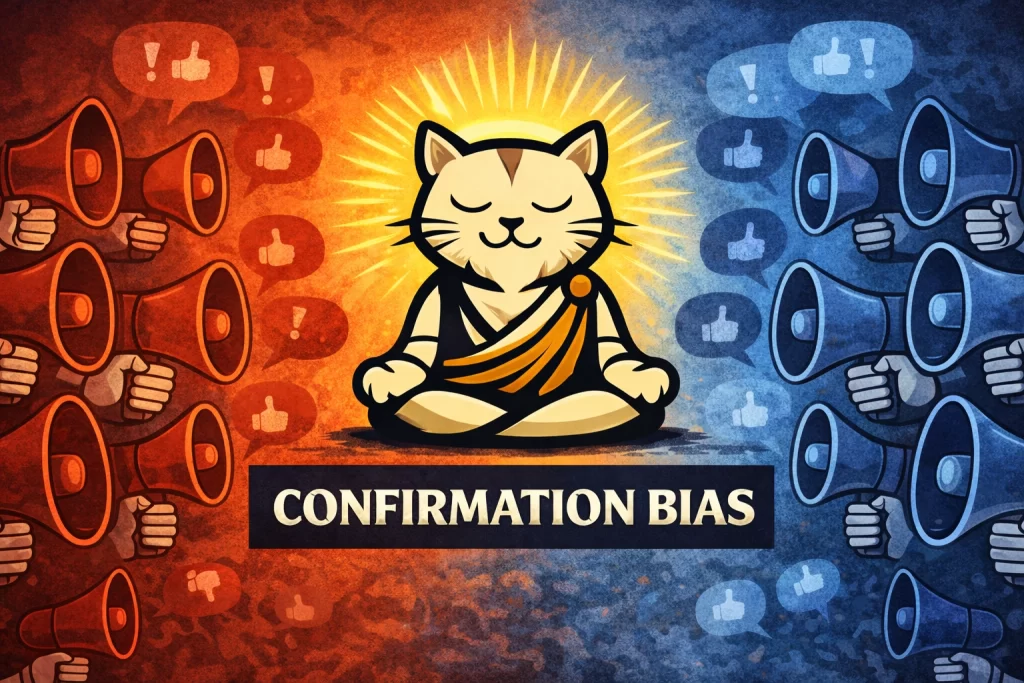
Confirmation bias is the tendency to seek, interpret, and remember information in ways that affirm what we already believe. It operates quietly and persistently, shaping perception long before conscious reasoning begins. Rather than approaching the world as neutral observers, we filter it through expectations, loyalties, and prior commitments. What confirms feels convincing; what contradicts feels suspect.
At its core, confirmation bias is not simply intellectual laziness—it is psychological economy. The human brain evolved to process vast amounts of information quickly. Preexisting beliefs act as shortcuts, allowing us to make rapid judgments without reevaluating everything from scratch. In many everyday situations, this efficiency is useful. But when it comes to complex issues—politics, science, relationships, morality—these shortcuts can distort reality.
Confirmation bias influences how we gather information. We are more likely to read articles, follow commentators, and spend time with people who reinforce our views. We may phrase online searches in ways that presuppose an answer. Even neutral evidence can be interpreted in a direction that favors what we already think. Two individuals can look at the same data and walk away more entrenched in opposing conclusions.
Memory, too, is selective. We recall examples that support our case more easily than those that undermine it. If we believe someone is unreliable, we notice and remember each late arrival while overlooking instances of punctuality. If we see ourselves as competent, we highlight successes and minimize failures. Over time, this selective recall strengthens confidence, making beliefs feel not only justified but obvious.
Social environments amplify confirmation bias. Algorithms often deliver content aligned with past preferences, creating echo chambers in which dissenting views rarely appear. Within such spaces, agreement becomes the norm, and opposing perspectives can seem irrational or malicious rather than simply different. Group identity reinforces belief, and challenges to ideas feel like threats to belonging.
Yet confirmation bias is not inherently malicious. It reflects a deeper human need for coherence. Changing beliefs can be unsettling; it disrupts identity and demands uncertainty. Confirmation bias protects stability. It keeps our worldview intact. The problem arises when stability hardens into rigidity—when comfort outweighs truth.
Recognizing confirmation bias is the first step toward countering it. This requires intellectual humility: an awareness that our perspective is partial. It involves deliberately seeking disconfirming evidence, asking how we might be wrong, and engaging respectfully with opposing viewpoints. It means separating identity from opinion, allowing beliefs to evolve without feeling that the self is under attack.
In the end, confirmation bias reveals that knowing is never purely objective. It is entangled with desire, fear, loyalty, and habit. To think well is not to eliminate bias entirely—that may be impossible—but to remain alert to its influence. The pursuit of truth demands not only intelligence, but courage: the courage to confront evidence that unsettles us and to revise our beliefs when reality requires it.