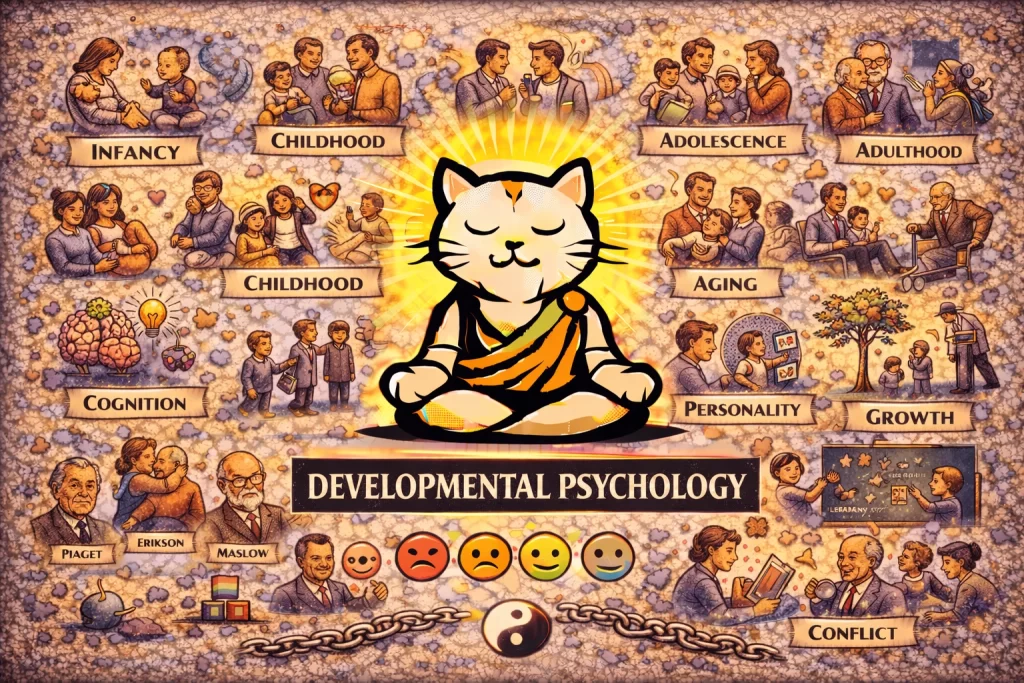
Developmental psychology is the scientific study of how humans grow and change across the lifespan. It examines physical, cognitive, emotional, and social development from infancy through old age. Rather than viewing development as limited to childhood, modern research emphasizes lifelong change shaped by biology, environment, and experience.
Developmental psychologists investigate both universal patterns and individual differences. Through longitudinal studies, laboratory experiments, and cross-cultural research, the field seeks to understand how people acquire language, form attachments, develop moral reasoning, and adapt to aging.
Cognitive Development
One of the most influential figures in developmental psychology was Jean Piaget. Piaget proposed that children move through stages of cognitive development, including the sensorimotor, preoperational, concrete operational, and formal operational stages. In classic conservation experiments, children were shown equal amounts of liquid poured into different-shaped containers. Younger children often believed the taller container held more liquid, demonstrating stage-based reasoning differences.
While later research has refined Piaget’s stage model, his work established the idea that children actively construct knowledge rather than passively absorb information.
Another influential theorist, Lev Vygotsky, emphasized the role of social interaction and language in development. His concept of the “zone of proximal development” suggests that children learn best when guided slightly beyond their current ability by more knowledgeable others. Studies in educational settings support this idea, showing that structured support enhances learning outcomes.
Social and Emotional Development
Attachment theory, developed by John Bowlby and expanded by Mary Ainsworth, highlights the importance of early caregiver relationships. In Ainsworth’s “Strange Situation” experiment, infants were observed during separations and reunions with caregivers. Patterns of secure, anxious, and avoidant attachment emerged, with long-term implications for emotional regulation and relationship stability.
Research shows that securely attached children tend to exhibit greater social competence and resilience. However, attachment patterns can change with new experiences and supportive environments.
Erik Erikson proposed a psychosocial stage theory, suggesting that individuals face developmental crises across the lifespan, such as trust versus mistrust in infancy and identity versus role confusion in adolescence. Though not always empirically precise, Erikson’s framework emphasized that emotional and identity development continues into adulthood.
Moral and Identity Development
Moral reasoning evolves alongside cognitive growth. Lawrence Kohlberg proposed stages of moral development, ranging from obedience-based reasoning to principled ethical thinking. In moral dilemma studies, such as the famous “Heinz dilemma,” participants’ reasoning reflected increasingly complex justifications as they matured.
Identity formation, particularly during adolescence, has been studied extensively. Research shows that exploration and commitment to values, career goals, and beliefs are central to psychological well-being. Longitudinal studies suggest that adolescents who successfully navigate identity exploration demonstrate greater life satisfaction in adulthood.
Lifespan and Aging
Developmental psychology also examines adulthood and aging. Cognitive research indicates that while certain abilities, such as processing speed, may decline with age, others—such as vocabulary and emotional regulation—often remain stable or improve.
Long-term studies, including the Harvard Study of Adult Development, have shown that strong social relationships are among the most consistent predictors of happiness and health across the lifespan.
Neuroscientific research reveals that the brain remains plastic into older adulthood. Learning new skills and maintaining social engagement are associated with healthier cognitive aging.
Conclusion
Developmental psychology reveals that human growth is dynamic and multifaceted. Study examples—from Piaget’s conservation tasks to Ainsworth’s attachment research and Kohlberg’s moral dilemmas—demonstrate how cognitive, emotional, and social capacities evolve over time.
Rather than a linear progression, development reflects interaction between biological maturation and environmental experience. By understanding these processes, developmental psychology offers insight into how individuals become who they are—and how growth continues throughout life.