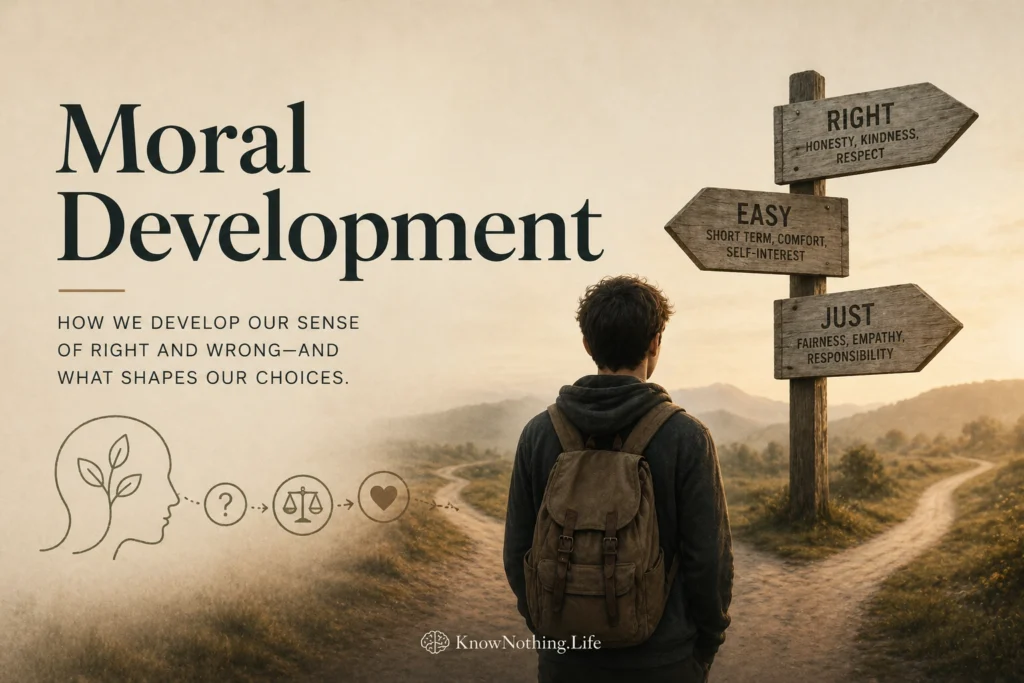
Moral development is the process through which individuals learn to distinguish right from wrong, form ethical values, and regulate behavior in accordance with social and personal standards. It is not simply the acquisition of rules but the gradual construction of a moral framework that guides judgment, decision-making, and action. From early childhood through adulthood, individuals develop increasingly complex understandings of fairness, responsibility, justice, and empathy.
What makes moral development particularly significant is its role in shaping both individual behavior and social life. Moral reasoning influences how people resolve conflicts, cooperate with others, and contribute to society. It is deeply intertwined with cognitive, emotional, and social development, reflecting the interaction between internal processes and external influences. By studying moral development, psychology seeks to understand not only how moral thinking emerges but also how it evolves across the lifespan.
Historical Foundations and Key Theorists
The study of moral development has been shaped by several influential thinkers who sought to explain how moral reasoning progresses over time. One of the most prominent figures is Jean Piaget, who examined how children’s understanding of rules and justice changes with age. Piaget proposed that young children view rules as fixed and unchangeable, while older children begin to understand them as flexible and based on mutual agreement.
Building on Piaget’s work, Lawrence Kohlberg developed a stage theory of moral reasoning that describes how individuals progress through levels of moral understanding. Kohlberg’s model includes preconventional, conventional, and postconventional stages, each representing a different basis for moral judgment. His research emphasized reasoning rather than behavior, focusing on how individuals justify their decisions.
Another important perspective comes from Carol Gilligan, who critiqued Kohlberg’s model for its emphasis on justice and argued for the inclusion of care and relationships in moral reasoning. Gilligan’s work highlighted the importance of empathy, responsibility, and interpersonal connection, expanding the understanding of moral development beyond abstract principles. Together, these theorists provide a comprehensive foundation for studying how moral thought evolves.
Early Moral Development
Moral development begins in early childhood, where it is closely tied to social interaction and emotional experience. Young children learn about right and wrong primarily through guidance from caregivers and responses to their behavior. Concepts such as fairness, sharing, and obedience emerge through everyday interactions, as children begin to understand the consequences of their actions.
At this stage, moral reasoning is often based on external authority and immediate outcomes. Children may view actions as wrong because they lead to punishment or disapproval, rather than because of underlying principles. This aligns with the early stages described by Kohlberg, where moral judgments are based on avoiding punishment or seeking rewards. Although this reasoning is limited, it provides a foundation for more complex understanding.
Emotional development plays a crucial role in early moral learning. Feelings such as empathy, guilt, and pride begin to emerge, influencing behavior and decision-making. For example, a child who sees another child in distress may feel empathy and act to help. These emotional responses support the development of moral behavior, illustrating the interplay between cognition and emotion in early development.
Cognitive Development and Moral Reasoning
As cognitive abilities develop, individuals become capable of more sophisticated moral reasoning. During middle childhood and adolescence, children begin to consider intentions, fairness, and social norms when making moral judgments. They move beyond a focus on consequences to consider the reasons behind actions, reflecting a deeper understanding of moral principles.
Kohlberg’s theory describes this progression as a shift from preconventional to conventional reasoning. In the conventional stage, individuals base their judgments on social expectations and the desire to maintain relationships and social order. They consider what others think and strive to conform to accepted norms, reflecting the growing importance of social context in moral development.
In adolescence and adulthood, some individuals reach the postconventional level, where moral reasoning is guided by abstract principles such as justice, equality, and human rights. At this stage, individuals may question societal norms and develop their own ethical frameworks. This capacity for critical reflection and principled reasoning represents a significant advancement in moral development, though not all individuals reach this level.
The Role of Social and Cultural Influences
Moral development does not occur in isolation but is deeply influenced by social and cultural contexts. Family, peers, education, and cultural norms all shape how individuals understand and apply moral principles. Caregivers play a particularly important role in early development, providing guidance, modeling behavior, and reinforcing values.
Peer interactions become increasingly influential during childhood and adolescence, providing opportunities for cooperation, conflict resolution, and perspective-taking. Through these interactions, individuals learn to negotiate rules, consider others’ viewpoints, and develop a sense of fairness. Social experiences thus contribute to the refinement of moral reasoning and behavior.
Cultural differences also play a significant role in moral development. Different societies emphasize different values, such as individual rights, community responsibility, or respect for authority. These cultural frameworks influence how moral issues are interpreted and resolved. Understanding these variations highlights the diversity of moral development and the importance of context in shaping ethical perspectives.
Emotion and Moral Development
Emotion is a central component of moral development, influencing both judgment and behavior. While cognitive processes provide the structure for reasoning, emotions such as empathy, guilt, and compassion motivate individuals to act in morally appropriate ways. These emotional responses help bridge the gap between knowing what is right and actually doing it.
Empathy, the ability to understand and share the feelings of others, is particularly important. It allows individuals to recognize the impact of their actions on others and to respond with care and concern. The development of empathy begins early in life and continues to evolve, supported by social interaction and emotional experience.
Guilt and shame also play roles in moral regulation, signaling when behavior has violated internal or social standards. These emotions can motivate individuals to correct their actions and avoid future transgressions. However, their impact depends on how they are experienced and interpreted. Healthy emotional development supports constructive moral behavior, while excessive or poorly managed emotions can lead to difficulties.
Moral Development Across the Lifespan
Moral development continues throughout adulthood, reflecting ongoing changes in perspective, experience, and social roles. As individuals encounter new challenges and responsibilities, they may refine their moral beliefs and adapt their reasoning. Life experiences, such as parenting, career decisions, and social involvement, provide opportunities for moral growth.
In adulthood, moral reasoning often becomes more integrated with practical concerns. Individuals must balance abstract principles with real-world constraints, leading to more nuanced and context-sensitive judgments. This integration reflects the complexity of adult life, where moral decisions are rarely clear-cut.
Later in life, individuals may engage in reflection on their moral values and life choices. This process can lead to a deeper understanding of ethical principles and a greater sense of coherence. Moral development in adulthood thus involves both continuity and change, shaped by the interplay of experience, reflection, and social context.
Applications and Implications
The study of moral development has important applications in education, parenting, and social policy. In educational settings, promoting moral reasoning and ethical behavior is a key goal. Programs that encourage discussion, perspective-taking, and critical thinking can support the development of moral understanding.
In parenting, understanding moral development can help caregivers provide appropriate guidance and support. Encouraging empathy, modeling ethical behavior, and fostering open communication contribute to the development of moral values. These practices create an environment in which children can explore and refine their understanding of right and wrong.
At a societal level, insights from moral development inform efforts to promote social responsibility, justice, and cooperation. By understanding how moral reasoning evolves, it is possible to design interventions and policies that support ethical behavior and social well-being. The study of moral development thus has far-reaching implications for both individuals and communities.
Conclusion
Moral development is a complex and dynamic process that shapes how individuals understand and act upon ethical principles. From early childhood through adulthood, moral reasoning evolves through the interaction of cognitive, emotional, and social factors. The contributions of thinkers such as Jean Piaget, Lawrence Kohlberg, and Carol Gilligan have provided valuable frameworks for understanding this process.
By examining moral development, psychology offers insight into the foundations of ethical behavior and social life. It highlights the importance of relationships, culture, and experience in shaping moral understanding. Ultimately, moral development reflects the human capacity to learn, adapt, and strive toward principles that guide behavior and contribute to a just and cooperative society.