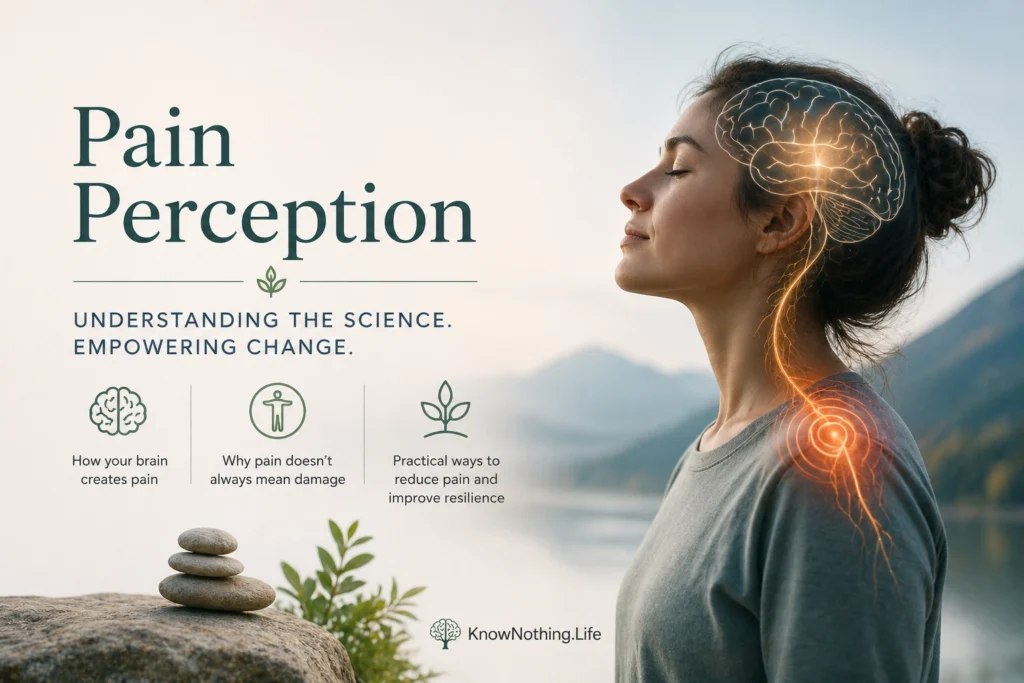
Pain perception is a complex and multifaceted process through which the brain interprets signals from the body as discomfort, distress, or threat. Far from being a simple sensory experience, pain is shaped by an intricate interaction of biological, psychological, and social factors. It serves an essential adaptive function—alerting the organism to potential harm—but it can also become maladaptive when it persists beyond its protective role. Understanding pain perception requires moving beyond the idea of pain as a direct reflection of tissue damage and toward a more integrated model that accounts for cognition, emotion, and context.
Historically, pain was often treated as a purely physiological phenomenon, but modern research has fundamentally reshaped this view. The work of Ronald Melzack and Patrick Wall, particularly their Gate Control Theory of Pain proposed in 1965, marked a turning point in pain science. They argued that pain signals are modulated by neural “gates” in the spinal cord that can either amplify or dampen incoming information. As Melzack later noted, “Pain is not just a sensation but a perception,” emphasizing that the brain actively constructs the experience of pain rather than passively receiving it.
Biological Foundations of Pain
At the biological level, pain begins with nociception—the detection of potentially harmful stimuli by specialized sensory receptors called nociceptors. These receptors respond to mechanical, thermal, and chemical signals, transmitting information through peripheral nerves to the spinal cord and ultimately to the brain. The brain then processes these signals in multiple regions, including the thalamus, somatosensory cortex, and limbic system, integrating sensory input with emotional and cognitive context.
However, the relationship between nociception and pain is not straightforward. Individuals can experience significant tissue damage with little pain, or intense pain without clear physical injury. Neuroscientist Clifford Woolf has shown that changes in the nervous system, such as central sensitization, can amplify pain signals, making the system more responsive to stimuli. This phenomenon helps explain chronic pain conditions in which the nervous system becomes hypersensitive. As Woolf observed, “Pain is a disease of the nervous system as much as it is a symptom,” highlighting the complexity of its biological underpinnings.
Psychological Influences on Pain
Psychological factors play a critical role in shaping how pain is experienced and interpreted. Attention, expectation, mood, and prior experience can all influence the intensity and quality of pain. For example, focusing on pain tends to increase its perceived intensity, while distraction can reduce it. Similarly, anxiety and depression are associated with heightened pain sensitivity, whereas positive emotional states can mitigate discomfort.
The work of Daniel Kahneman on perception and subjective experience provides valuable insight into how pain is evaluated. Kahneman’s distinction between the “experiencing self” and the “remembering self” suggests that how pain is remembered may differ from how it is felt in the moment, influencing future expectations and behavior. Cognitive processes such as catastrophizing—anticipating the worst possible outcome—have been shown to exacerbate pain and impair coping. These findings underscore that pain is not merely a physical sensation but a psychological experience shaped by interpretation and meaning.
The Role of Emotion and the Brain
Pain is deeply intertwined with emotion, as both processes share overlapping neural pathways. The limbic system, particularly structures such as the amygdala and anterior cingulate cortex, plays a central role in the emotional dimension of pain. This explains why pain is often accompanied by feelings of distress, fear, or frustration, and why emotional states can intensify or alleviate the experience.
Research by Antonio Damasio has emphasized the role of emotion in bodily awareness, arguing that feelings are integral to how the brain represents the state of the body. In The Feeling of What Happens, Damasio suggests that “feelings are the mental expression of homeostasis,” linking emotional experience to physiological regulation. This perspective helps explain why chronic pain is often associated with emotional disorders and why treating emotional factors can lead to improvements in pain. The integration of emotion and sensation highlights the inseparability of mind and body in the experience of pain.
Social and Cultural Contexts of Pain
Pain perception is also shaped by social and cultural factors, which influence how pain is expressed, interpreted, and managed. Cultural norms can determine whether individuals openly express pain or suppress it, as well as how they seek treatment. For example, some cultures encourage stoicism, while others validate expressive responses to discomfort. These differences demonstrate that pain is not only a biological and psychological phenomenon but also a social one.
The presence of others can also affect pain perception. Studies have shown that social support can reduce pain intensity, while social isolation can exacerbate it. Psychologist Naomi Eisenberger has demonstrated that social rejection activates brain regions similar to those involved in physical pain, suggesting a shared neural basis. As Eisenberger noted, “The pain of social rejection is not just a metaphor,” highlighting the deep connection between social experience and physical sensation. These findings underscore the importance of considering the social environment in understanding and treating pain.
Chronic Pain and Its Challenges
Chronic pain, defined as pain that persists beyond normal healing time, presents unique challenges for both patients and healthcare providers. Unlike acute pain, which serves a protective function, chronic pain often lacks a clear biological purpose and can become a condition in its own right. It is associated with significant physical, emotional, and social burdens, affecting quality of life and functional ability.
One of the key challenges in chronic pain is that it is often invisible, leading to misunderstanding and stigma. Patients may struggle to have their experiences validated, particularly when objective measures of injury are absent. Pain researcher Lorimer Moseley has emphasized the importance of reconceptualizing pain, stating, “Pain is an output of the brain, not an input from the tissues.” This perspective shifts the focus from finding a physical cause to understanding the processes that generate pain. Approaches such as pain education, cognitive-behavioral therapy, and graded activity have been developed to help individuals manage chronic pain more effectively.
Placebo, Expectation, and Modulation
The placebo effect provides one of the most compelling demonstrations of the brain’s role in pain perception. When individuals expect relief, their brains can activate endogenous pain-relief mechanisms, reducing the experience of pain even in the absence of active treatment. This effect has been linked to the release of endorphins and changes in brain activity, illustrating the power of expectation and belief.
Research by Fabrizio Benedetti has shown that placebo analgesia involves specific neurobiological processes, including the activation of opioid pathways. Conversely, negative expectations can produce a nocebo effect, increasing pain and discomfort. These findings highlight the importance of context, communication, and patient expectations in clinical settings. As Benedetti observed, “The brain can turn expectation into reality,” a statement that captures the profound influence of cognition on pain.
Treatment and Management Approaches
Effective pain management requires a multidimensional approach that addresses biological, psychological, and social factors. Pharmacological treatments, such as analgesics and anti-inflammatory drugs, remain important, but they are often insufficient on their own, particularly for chronic pain. Integrative approaches that include psychological therapies, physical rehabilitation, and lifestyle changes have been shown to produce better outcomes.
Cognitive-behavioral therapy (CBT) is one of the most widely used psychological interventions for pain, helping individuals modify maladaptive thought patterns and develop coping strategies. Mindfulness-based approaches, such as those developed by Jon Kabat-Zinn, have also been effective in reducing pain-related distress. These approaches do not necessarily eliminate pain but change the relationship individuals have with it, reducing suffering and improving quality of life. This shift reflects a broader understanding of pain as an experience that can be influenced, even when it cannot be fully removed.
Conclusion
Pain perception is a complex and dynamic process that extends far beyond the detection of physical injury. It is shaped by biological mechanisms, psychological processes, emotional states, and social contexts, making it one of the most intricate aspects of human experience. Advances in pain science have challenged traditional views, revealing that pain is not simply a signal from the body but a construction of the brain influenced by multiple factors.
Understanding pain in this broader context has important implications for treatment and care. By addressing the full range of influences on pain, it is possible to develop more effective and compassionate approaches to management. Ultimately, the study of pain perception not only deepens our understanding of the body and mind but also offers pathways to reduce suffering and improve well-being.