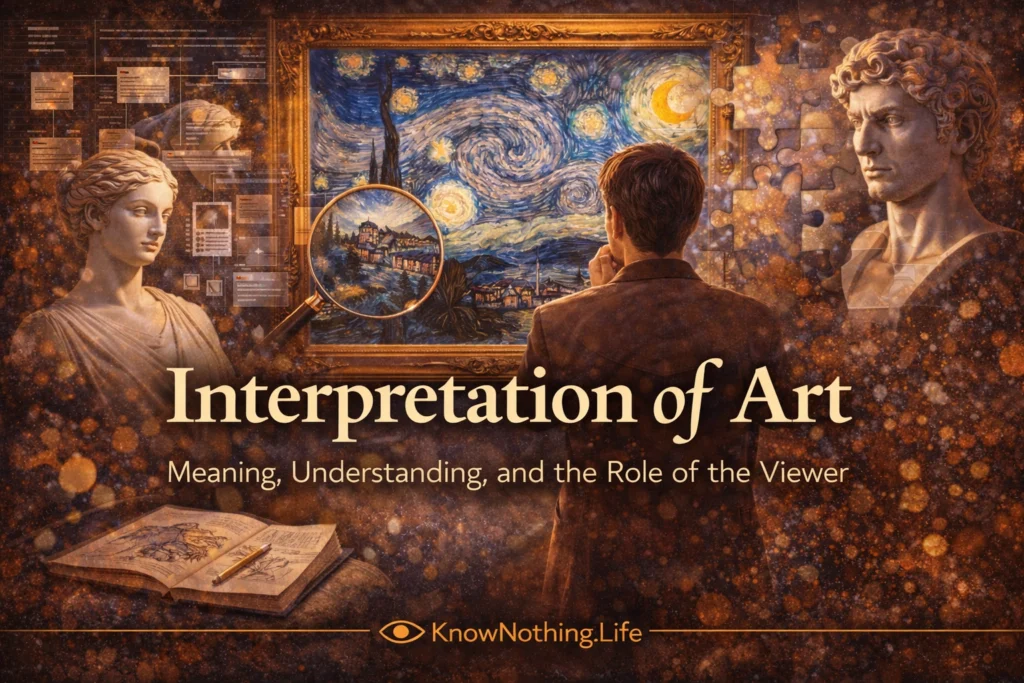
The interpretation of art lies at the center of aesthetic philosophy, raising fundamental questions about how meaning is created, discovered, and understood. When we encounter a painting, a novel, or a piece of music, we do more than perceive it—we interpret it. We ask what it means, what it expresses, and how it should be understood. Yet interpretation is not a straightforward process. Different viewers often arrive at different conclusions, leading to debates about whether artworks have fixed meanings or whether meaning is shaped by the audience.
Philosophers have long grappled with the nature of interpretation, exploring whether meaning resides in the artwork itself, in the intentions of the artist, or in the experience of the viewer. These competing perspectives reflect broader questions about language, representation, and understanding. Interpretation is not merely a technical exercise but a deeply human activity, shaped by perception, context, and imagination.
From classical hermeneutics to contemporary aesthetic theory, interpretation has been examined as both a philosophical problem and a practical activity. It reveals the dynamic relationship between art and audience, showing that meaning is not static but emerges through engagement. To interpret art is to participate in its meaning, bringing one’s own perspective into dialogue with the work.
Authorial Intent and Meaning
One of the most enduring debates in the interpretation of art concerns the role of the artist’s intention. Should we interpret a work based on what the artist intended to convey, or should the meaning of the work be considered independent of its creator? This question has shaped much of modern aesthetic theory.
E. D. Hirsch Jr. argues in Validity in Interpretation that the meaning of a text is determined by the author’s intention. According to Hirsch, interpretation should aim to recover what the author meant, rather than impose new meanings onto the work. He distinguishes between “meaning,” which is fixed, and “significance,” which can vary depending on the reader’s context. This view emphasizes stability and objectivity, suggesting that interpretation can be correct or incorrect based on fidelity to the author’s intent.
However, this approach has been challenged by critics who argue that the author’s intention is not always accessible or even relevant. Roland Barthes famously declared the “death of the author,” arguing that meaning is not determined by the creator but by the reader. In his essay of the same name, Barthes writes, “The birth of the reader must be at the cost of the death of the author.” This provocative claim shifts the focus from authorial control to interpretive freedom, suggesting that artworks generate meaning through their reception rather than their origin.
Hermeneutics and the Process of Understanding
The philosophical study of interpretation is often associated with hermeneutics, a tradition that examines how understanding occurs. Hans-Georg Gadamer offers one of the most influential accounts in Truth and Method, where he argues that interpretation is not a methodical procedure but a dialogical process. Understanding, for Gadamer, involves a “fusion of horizons” between the interpreter and the work, where past and present perspectives interact.
Gadamer emphasizes that interpretation is shaped by historical and cultural contexts. We do not approach artworks as neutral observers; we bring our own assumptions, experiences, and prejudices. Rather than eliminating these influences, Gadamer suggests that they are essential to understanding. Interpretation becomes a conversation, in which the artwork and the viewer continually inform one another.
This perspective challenges the idea of a single, definitive interpretation. Instead, meaning is seen as something that unfolds over time, enriched by different perspectives. Hermeneutics thus highlights the openness of art, suggesting that its significance cannot be exhausted by any one reading.
Interpretation and the Role of the Viewer
Modern aesthetic theory increasingly emphasizes the role of the viewer in shaping the meaning of art. Rather than treating interpretation as the discovery of a pre-existing message, many philosophers view it as an active process of engagement. The viewer is not a passive recipient but a participant in the creation of meaning.
Stanley Fish develops this idea through his concept of interpretive communities. According to Fish, meaning is not inherent in the text but arises from the practices and assumptions shared by groups of readers. Different communities may interpret the same work in different ways, reflecting their distinct perspectives and values. This view underscores the social dimension of interpretation, suggesting that meaning is shaped collectively rather than individually.
At the same time, the emphasis on the viewer raises questions about relativism. If interpretation depends on the audience, does this mean that all interpretations are equally valid? Some philosophers argue that while multiple interpretations are possible, they must still be grounded in the features of the artwork. Interpretation is not arbitrary but constrained by the structure, context, and content of the work itself.
Interpretation, Symbolism, and Depth
Art often invites interpretation because it operates on multiple levels of meaning. Symbols, metaphors, and ambiguities encourage viewers to look beyond the surface, searching for deeper significance. This layered nature of art has been a central focus of philosophical analysis.
Paul Ricoeur explores the idea of interpretation as the uncovering of hidden meanings. In his work on symbolism, Ricoeur argues that symbols “give rise to thought,” inviting reflection and interpretation. He sees interpretation as a process of moving from the literal to the figurative, revealing dimensions of meaning that are not immediately apparent.
This approach highlights the richness of artistic meaning, suggesting that artworks are not exhausted by their initial appearance. Interpretation becomes a way of engaging with this depth, uncovering layers of significance that emerge through careful analysis and reflection. At the same time, it raises questions about limits: how far can interpretation go before it becomes disconnected from the work itself?
Contemporary Debates and Challenges
In contemporary philosophy, the interpretation of art is influenced by a wide range of perspectives, including postmodernism, critical theory, and cognitive science. These approaches challenge traditional assumptions about meaning, emphasizing plurality, context, and the role of power in shaping interpretation.
Postmodern thinkers often reject the idea of stable or universal meanings, arguing that interpretation is inherently open-ended. This view aligns with the emphasis on diversity and multiplicity in contemporary culture, where artworks are understood in relation to a variety of perspectives and experiences. At the same time, critics have raised concerns about the potential for interpretive relativism, questioning whether meaning can be sustained without some form of constraint.
Other approaches focus on the cognitive and psychological aspects of interpretation, examining how perception, memory, and emotion influence understanding. These perspectives highlight the interplay between mental processes and cultural context, suggesting that interpretation is both a personal and a social activity.
Conclusion
The interpretation of art is a complex and dynamic process that lies at the heart of aesthetic experience. It involves the interaction of artist, artwork, and audience, each contributing to the creation of meaning. From the emphasis on authorial intent in E. D. Hirsch Jr. to the reader-centered approach of Roland Barthes and the dialogical framework of Hans-Georg Gadamer, philosophical theories of interpretation reveal its richness and diversity.
What emerges from these perspectives is not a single answer but a deeper appreciation of interpretation as an essential aspect of human engagement with art. Meaning is not simply given or discovered—it is created through interaction, shaped by context, and open to revision. This openness is not a weakness but a strength, allowing art to remain relevant and meaningful across different times and cultures.
To interpret art is to enter into a dialogue with it, bringing one’s own perspective while remaining attentive to its structure and context. It is an activity that requires sensitivity, imagination, and critical reflection. In this sense, interpretation is not only about understanding art but about understanding ourselves, revealing how we perceive, think, and find meaning in the world.