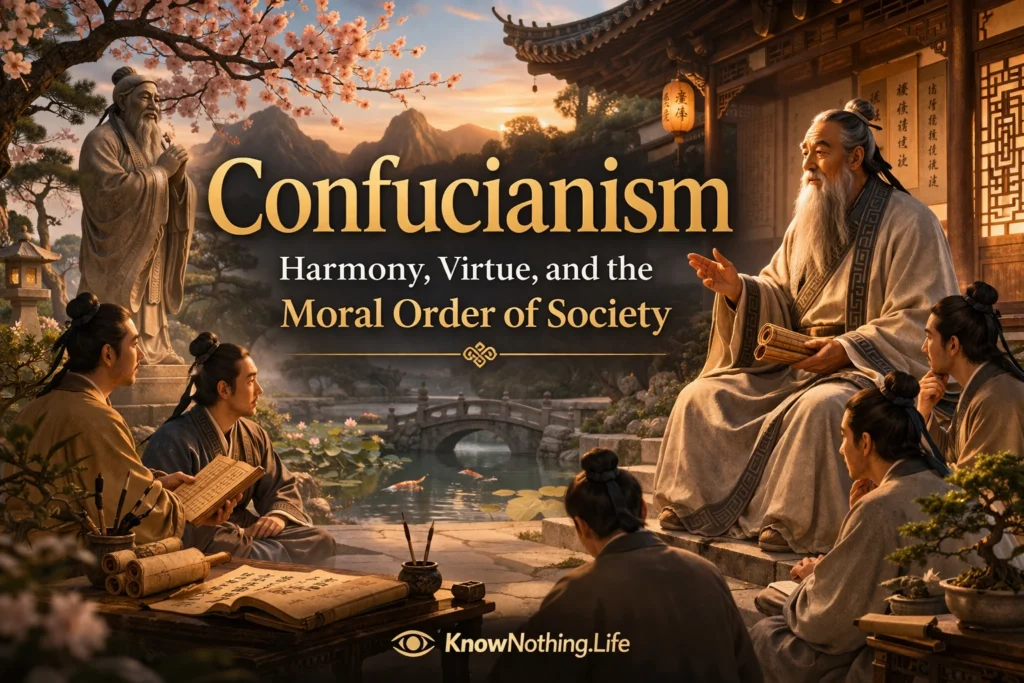
Confucianism is one of the most enduring philosophical traditions in human history, rooted in the teachings of Confucius (Kong Fuzi, 551–479 BCE). More than a system of abstract thought, it is a practical philosophy concerned with how human beings ought to live together—how they cultivate virtue, organize society, and align themselves with a deeper moral order. Emerging during the political turmoil of the late Zhou Dynasty, Confucianism sought to restore harmony through ethical conduct, proper relationships, and the cultivation of character. Its influence has shaped East Asian civilization for over two millennia, informing political systems, educational traditions, family structures, and moral philosophy.
At its core, Confucianism is not a religion in the conventional sense, but a moral and social philosophy grounded in human relationships and ethical behavior. The teachings of Confucius were preserved by his disciples in the Analects, a collection of sayings and dialogues that articulate his vision of virtue, leadership, and social harmony. Later thinkers such as Mencius and Xunzi expanded and debated his ideas, ensuring that Confucianism remained a dynamic and evolving tradition. Through its emphasis on moral cultivation and social responsibility, Confucianism continues to offer a profound framework for understanding both personal development and collective life.
Foundations of Confucian Thought
The philosophical foundation of Confucianism rests on a set of interrelated concepts that define the ideal human being and the structure of a harmonious society. Among these, ren (humaneness or benevolence) stands as the central virtue, representing the capacity for empathy, compassion, and moral sensitivity. Confucius described ren not as an abstract ideal but as something expressed through everyday actions—how one treats others, fulfills obligations, and cultivates sincerity. As recorded in the Analects, he states, “The virtuous man, wishing to establish himself, also establishes others,” highlighting the relational nature of moral life.
Closely linked to ren is li, often translated as ritual propriety or appropriate conduct. While li includes formal rituals and ceremonies, it also encompasses everyday etiquette and social norms that guide behavior. For Confucius, li provides the structure through which ren is expressed, ensuring that moral intentions are translated into consistent and meaningful action. Without li, virtue lacks form; without ren, ritual becomes empty. This interplay between inner character and outward behavior is essential to the Confucian vision of ethical life.
Another key concept is xiao, or filial piety, which emphasizes respect and devotion to one’s parents and ancestors. Filial piety is not merely a private virtue but the foundation of social order, as it extends outward to relationships within the family, community, and state. Confucius saw the family as the primary site of moral education, where individuals learn respect, responsibility, and care. As he observed, “Filial piety and fraternal respect are the root of humanity,” underscoring the belief that a well-ordered society begins with well-ordered relationships at home.
The Role of the Junzi and Moral Cultivation
Central to Confucian ethics is the ideal of the junzi, often translated as the “noble person” or “exemplary individual.” Unlike aristocratic notions of nobility based on birth, the Confucian junzi is defined by moral character and self-cultivation. Anyone, regardless of social status, can become a junzi through disciplined effort, ethical reflection, and commitment to virtue. This democratization of moral excellence was one of Confucius’s most transformative contributions, shifting the focus from inherited privilege to cultivated character.
The process of becoming a junzi involves continuous self-improvement and a deep awareness of one’s conduct. Confucius emphasized introspection and learning as essential tools for moral growth. “At fifteen, I set my heart upon learning,” he famously remarked, describing a lifelong journey of intellectual and ethical development. Education, in this sense, is not merely the acquisition of knowledge but the cultivation of wisdom and virtue. It requires humility, perseverance, and a willingness to correct one’s mistakes.
Later Confucian thinkers elaborated on this process of moral cultivation. Mencius argued that human nature is inherently good, possessing innate tendencies toward compassion and righteousness that must be nurtured. He wrote, “The feeling of compassion is the beginning of humanity,” suggesting that moral development involves cultivating these natural inclinations. In contrast, Xunzi maintained that human nature is fundamentally self-interested and requires conscious effort and social discipline to achieve virtue. Despite their differences, both thinkers agreed that moral excellence is the result of sustained practice and education, reinforcing the Confucian commitment to self-cultivation as the foundation of ethical life.
Confucianism and Social Harmony
Confucianism is deeply concerned with the organization of society and the maintenance of harmony among its members. Rather than relying on coercive laws or punitive systems, Confucius advocated for governance through moral example and virtuous leadership. The ruler, in this framework, serves as a model for the people, embodying the virtues that sustain social order. “If the ruler is righteous,” Confucius observed, “all will be righteous,” emphasizing the transformative power of ethical leadership.
This vision of society is structured around a network of relationships, often described through the “Five Relationships”: ruler and subject, father and son, husband and wife, elder and younger sibling, and friend and friend. Each relationship carries specific duties and expectations, creating a system of mutual responsibility. Harmony arises not from equality in a modern sense, but from the proper fulfillment of these roles. When individuals act with sincerity and respect, the entire social fabric is strengthened.
Confucianism also introduces the concept of the “Mandate of Heaven” (tianming), which legitimizes political authority based on moral virtue rather than divine right. A ruler who governs unjustly loses this mandate, justifying resistance or replacement. This idea reflects a moralized view of politics, where power is contingent upon ethical conduct. It also underscores the broader Confucian belief that human affairs are aligned with a cosmic order, and that harmony in society reflects harmony in the universe.
Texts and the Confucian Canon
The teachings of Confucianism are preserved in a rich body of classical texts that have shaped Chinese intellectual history. The most important of these include the Four Books and the Five Classics, which became the foundation of education and civil service examinations in imperial China. Among the Four Books, the Analects, the Mencius, the Great Learning, and the Doctrine of the Mean articulate the core principles of Confucian thought and moral cultivation.
The Great Learning outlines a progression from personal cultivation to social harmony, famously stating, “From the cultivation of the person comes the regulation of the family; from the regulation of the family comes the governance of the state.” This text emphasizes the interconnectedness of individual and collective life, reinforcing the idea that moral development at the personal level is the foundation of political order. The Doctrine of the Mean, attributed to Confucius’s grandson Zisi, explores the concept of balance and moderation, advocating a harmonious alignment between human conduct and the natural order.
The Five Classics, including the Book of Changes, the Book of Rites, and the Spring and Autumn Annals, provide historical, poetic, and ritual foundations for Confucian learning. Together, these texts form a comprehensive intellectual tradition that integrates ethics, politics, cosmology, and culture. Their study was not merely academic but deeply practical, aimed at shaping individuals who could contribute to a harmonious and well-ordered society.
Confucianism in History and Modern Thought
Confucianism became the dominant ideological framework of China during the Han Dynasty and remained central to Chinese governance and education for centuries. It influenced neighboring cultures, including Korea, Japan, and Vietnam, where it was adapted to local contexts while retaining its core emphasis on hierarchy, education, and moral cultivation. The civil service examination system, based on Confucian texts, institutionalized the tradition’s values and ensured its continuity across generations.
In the modern era, Confucianism has undergone significant reinterpretation. During the early twentieth century, it was criticized by reformers who associated it with conservatism and social rigidity. However, contemporary scholars have revisited Confucian thought as a resource for addressing modern ethical and political challenges. Thinkers such as Tu Weiming have argued for a “New Confucianism” that emphasizes human dignity, ecological responsibility, and global ethics. This revival reflects the enduring relevance of Confucian ideas in a rapidly changing world.
Confucianism’s emphasis on education, moral responsibility, and social harmony continues to resonate in contemporary discussions of ethics and governance. Its focus on relationships and community offers an alternative to purely individualistic frameworks, while its commitment to self-cultivation provides a path toward personal and collective flourishing. As globalization brings diverse cultures into closer contact, Confucianism offers valuable insights into how societies can balance tradition and innovation, authority and compassion, individuality and community.
Final Reflections on Confucianism
Confucianism is ultimately a philosophy of balance—between self and society, intention and action, tradition and change. It challenges individuals to cultivate virtue not in isolation but within the context of relationships, recognizing that personal development and social harmony are inseparable. Through its emphasis on ren, li, and xiao, it provides a comprehensive framework for ethical life that remains both practical and profound.
The enduring power of Confucianism lies in its ability to speak to fundamental human concerns: how to live well, how to treat others, and how to create a just and harmonious society. Its teachings, preserved and expanded over centuries, continue to inspire reflection and dialogue across cultures and disciplines. As Confucius himself remarked, “To learn and at due times to repeat what one has learned, is that not after all a pleasure?” This spirit of continuous learning and moral growth remains at the heart of the Confucian tradition, inviting each generation to rediscover and reinterpret its wisdom.