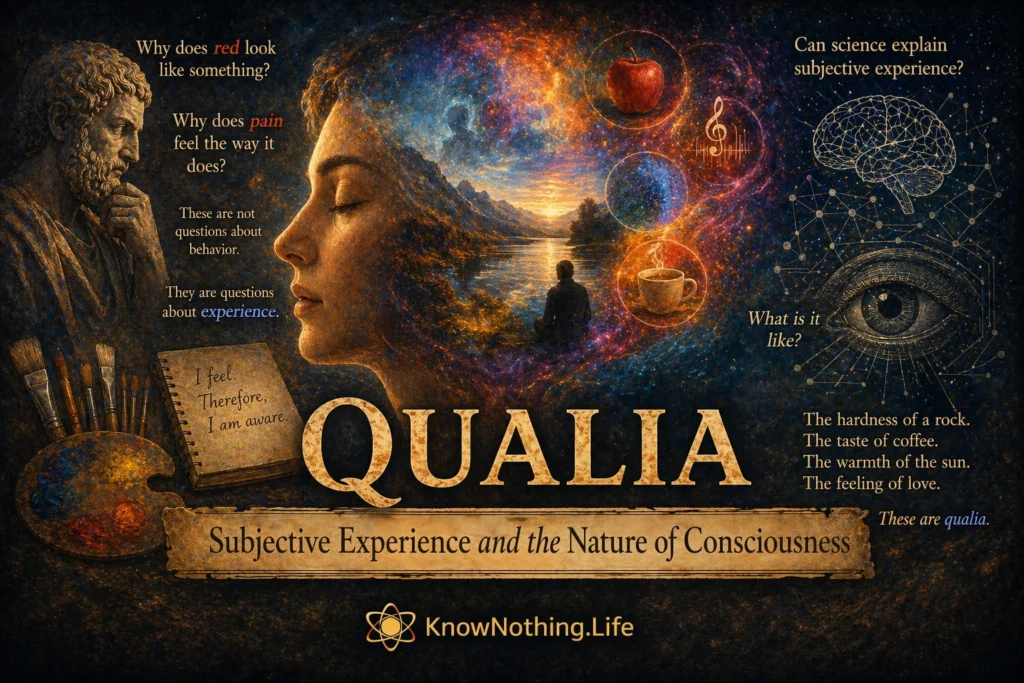
Qualia refer to the subjective, first-person qualities of experience—the “what it is like” aspect of consciousness. When you see a vivid red sunset, taste a bitter cup of coffee, or feel a sharp pain, there is something it is like to have those experiences. These qualitative aspects of mental life are what philosophers call qualia. Though seemingly familiar and immediate, qualia present one of the deepest challenges in understanding the mind and its relationship to the physical world.
The concept of qualia lies at the heart of debates in the philosophy of mind. While science can describe the neural processes associated with perception, it remains unclear how or why those processes give rise to subjective experience. This gap between objective explanation and subjective awareness has led many philosophers to question whether physical accounts of the mind are sufficient. Qualia thus serve as a focal point for broader questions about consciousness, knowledge, and reality.
Defining Qualia
Qualia are often characterized as intrinsic, ineffable, and directly accessible only to the subject experiencing them. Unlike physical properties, which can be measured and observed from an external perspective, qualia are private and cannot be fully captured in objective terms. This distinction highlights the challenge of explaining consciousness within a scientific framework.
Philosophers have proposed various ways of understanding qualia, but there is no universally accepted definition. Some view them as the basic building blocks of conscious experience, while others question whether they exist as distinct entities at all. Despite these disagreements, the concept remains central to discussions about the nature of mind.
The difficulty of defining qualia reflects their elusive nature. They are not objects in the world, nor are they easily reducible to physical processes. Instead, they represent the subjective dimension of experience, raising questions about how such experiences arise and how they relate to the physical world.
Qualia and the Mind-Body Problem
Qualia play a crucial role in the mind-body problem, particularly in debates between physicalism and dualism. Physicalists argue that all mental phenomena, including qualia, can be explained in terms of physical processes. However, critics contend that subjective experience cannot be fully reduced to objective descriptions of the brain.
David Chalmers has argued that qualia highlight the limitations of physicalist explanations. His formulation of the “hard problem” of consciousness emphasizes the difficulty of explaining why physical processes are accompanied by subjective experience. Even a complete account of brain function may leave unanswered the question of why there is something it is like to be a conscious being.
Dualists, on the other hand, see qualia as evidence that the mind cannot be entirely physical. If subjective experience cannot be reduced to physical processes, then it may require a fundamentally different kind of explanation. This perspective reinforces the idea that the mind and body are distinct, though it raises its own challenges regarding interaction and causation.
Thought Experiments and the Limits of Knowledge
Philosophers have used thought experiments to illustrate the challenges posed by qualia. One of the most famous is the “knowledge argument” proposed by Frank Jackson. In this scenario, a scientist named Mary knows everything there is to know about the physical aspects of color vision but has lived her entire life in a black-and-white environment. When she finally sees color, she appears to learn something new—what it is like to experience color—suggesting that physical knowledge is incomplete.
Another influential thought experiment is the idea of philosophical zombies—beings that are physically identical to humans but lack conscious experience. These hypothetical entities behave exactly like humans but have no qualia. The possibility of such beings, argued by philosophers like David Chalmers, suggests that consciousness is not logically entailed by physical processes, challenging physicalist accounts of the mind.
These thought experiments are not empirical claims but conceptual tools designed to test our intuitions about consciousness. They highlight the gap between objective knowledge and subjective experience, raising questions about the limits of scientific explanation.
Physicalist Responses
In response to challenges posed by qualia, physicalists have developed various strategies to defend their position. Some argue that qualia can be explained in terms of neural processes, even if we do not yet fully understand how. Others suggest that the apparent gap between physical and subjective descriptions is due to limitations in our conceptual framework rather than a fundamental difference in reality.
One approach is to reinterpret qualia in functional terms, focusing on their role in behavior and cognition rather than their intrinsic qualities. This perspective aligns with functionalism, which defines mental states by their causal relationships rather than their internal nature. By emphasizing what mental states do rather than what they feel like, functionalists aim to integrate qualia into a broader scientific framework.
Another response is eliminativism, which denies the existence of qualia as traditionally conceived. Proponents of this view argue that our intuitions about subjective experience may be misleading and that a more accurate understanding of the mind will not include qualia as distinct entities. While controversial, this approach highlights the extent to which the concept of qualia is open to debate.
Qualia and Language
The study of qualia also intersects with the philosophy of language, particularly in questions about how subjective experience can be expressed and communicated. If qualia are inherently private, how can we talk about them meaningfully? Words like “red” or “pain” refer to experiences, but they do not fully capture what those experiences are like.
Ludwig Wittgenstein explored this issue through his discussion of private language. He argued that language is fundamentally social, relying on shared practices and public criteria for meaning. If qualia were entirely private and inaccessible to others, it would be difficult to establish meaningful communication about them. This raises questions about whether qualia can be coherently discussed at all.
Despite these challenges, everyday language allows us to communicate about experiences with a reasonable degree of success. This suggests that while qualia may be private in some sense, they are not entirely beyond the reach of shared understanding. The tension between privacy and communicability remains a central issue in the philosophy of mind.
The Role of Qualia in Science and AI
Qualia also play a significant role in discussions about artificial intelligence and the possibility of machine consciousness. While AI systems can process information and simulate human behavior, it is unclear whether they can have subjective experiences. Do machines merely manipulate data, or could they one day possess qualia?
Philosophers such as John Searle have argued that computational processes alone are insufficient for consciousness. His “Chinese Room” argument suggests that a system can appear to understand language without having any subjective experience. This raises doubts about whether AI could ever truly replicate human consciousness.
At the same time, advances in AI continue to challenge our assumptions about the nature of mind. If machines become increasingly sophisticated, the line between simulation and genuine experience may become harder to draw. The question of whether qualia can exist in artificial systems remains open, with implications for both philosophy and technology.
Conclusion
Qualia represent one of the most profound and challenging aspects of human experience. They highlight the gap between objective descriptions of the world and the subjective reality of consciousness, raising questions that extend across philosophy, science, and technology. From the thought experiments of Frank Jackson to the arguments of David Chalmers, the study of qualia continues to push the boundaries of our understanding.
Despite centuries of inquiry, the nature of qualia remains elusive. Whether they can be fully explained within a physicalist framework or require a fundamentally different approach is still a matter of debate. What is clear, however, is that qualia lie at the heart of what it means to be conscious, making them an essential topic in the ongoing exploration of the mind.