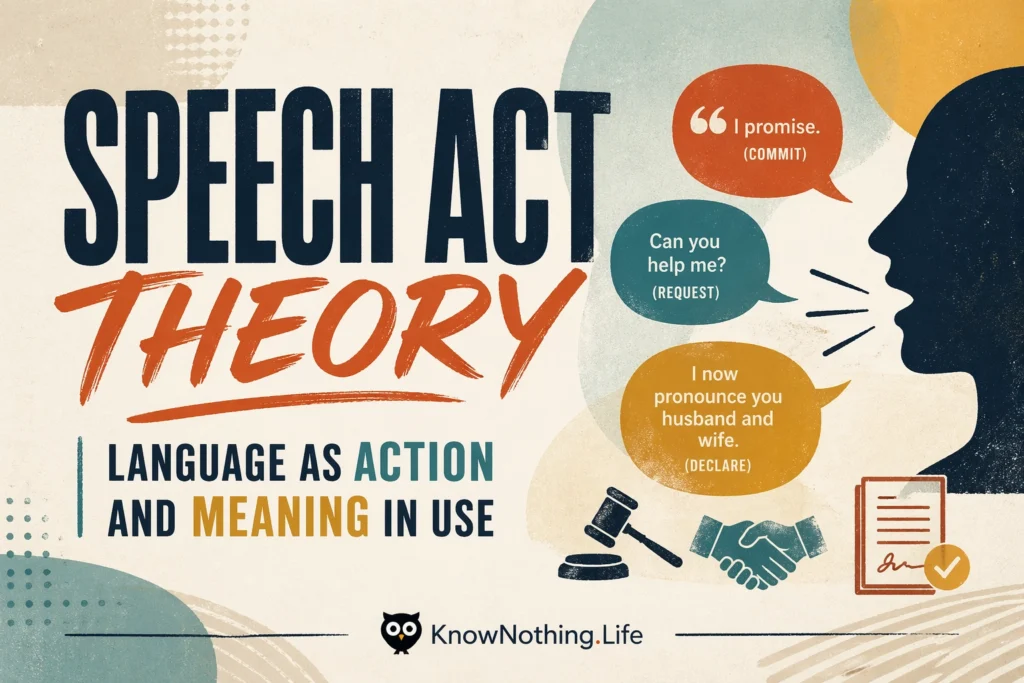
Speech Act Theory is a central development in the philosophy of language that shifts the focus from what language describes to what language does. Rather than treating sentences as mere carriers of information, this approach emphasizes that speaking is a form of action. When we make a promise, issue a command, ask a question, or offer an apology, we are not simply stating facts—we are performing acts. This insight transforms our understanding of meaning, showing that communication is deeply embedded in intention, context, and social practice.
The theory emerged in the mid-twentieth century as a response to earlier approaches that emphasized logic and semantics. While those approaches sought to analyze the truth conditions of statements, Speech Act Theory highlights the performative dimension of language. Thinkers such as J. L. Austin and John Searle developed frameworks for understanding how utterances function as actions, laying the groundwork for contemporary studies in linguistics, philosophy, and communication.
The Origins of Speech Act Theory
Speech Act Theory begins with the work of J. L. Austin, who challenged the traditional view that the primary function of language is to describe reality. In his lectures, later published as How to Do Things with Words, Austin introduced the idea that many utterances are performative—they do not merely report facts but bring about actions. For example, saying “I apologize” is not a description of an apology; it is the act of apologizing itself.
Austin distinguished between different types of utterances, initially contrasting performative statements with constative ones, which describe states of affairs and can be evaluated as true or false. However, he later recognized that this distinction is not absolute, as even seemingly descriptive statements can function as actions in certain contexts. This realization led to a more nuanced understanding of language as inherently active.
The significance of Austin’s work lies in its emphasis on the practical use of language. By focusing on how utterances function in real-world contexts, Speech Act Theory moves beyond abstract analysis and engages with the social and interactive nature of communication.
The Three Levels of Speech Acts
A key contribution of Speech Act Theory is the distinction between three levels of speech acts: locutionary, illocutionary, and perlocutionary acts. These categories help clarify how a single utterance can perform multiple functions simultaneously.
The locutionary act refers to the act of producing a meaningful linguistic expression—the words themselves and their literal meaning. For example, saying “The door is open” involves uttering a sentence with a specific semantic content. This level corresponds to the traditional focus of semantics, concerned with meaning and reference.
The illocutionary act is the central focus of Speech Act Theory. It refers to what the speaker is doing in saying something, such as asserting, questioning, commanding, or promising. In the example above, the speaker might be making a statement, giving a warning, or issuing a suggestion, depending on the context. The illocutionary force of an utterance determines its function as an action.
The perlocutionary act concerns the effects of an utterance on the listener, such as persuading, frightening, or inspiring. These effects are not always under the speaker’s control and can vary depending on the audience and context. Together, these three levels illustrate the complexity of communication, showing that meaning involves not only what is said but also what is done and what is achieved through language.
Illocutionary Force and Intentions
The concept of illocutionary force is central to understanding how speech acts function. It captures the speaker’s intention in making an utterance and determines the type of act being performed. For instance, the sentence “Can you pass the salt?” may appear to be a question about ability, but in most contexts it functions as a request.
John Searle expanded on Austin’s work by developing a systematic classification of speech acts based on their illocutionary force. He identified categories such as assertives (statements of fact), directives (requests or commands), commissives (promises or commitments), expressives (expressions of emotion), and declarations (acts that bring about changes in the world, such as naming or pronouncing).
Searle also emphasized the role of intention and convention in speech acts. For an utterance to function as a particular type of act, it must be made with the appropriate intention and recognized as such by the listener. This interplay between intention and recognition highlights the cooperative nature of communication, where meaning is jointly constructed by speaker and listener.
Context and Social Rules
Speech acts do not occur in isolation; they are embedded in social contexts governed by rules and conventions. The success of a speech act depends on certain conditions being met, which Austin referred to as “felicity conditions.” For example, a promise is only valid if the speaker intends to fulfill it, has the ability to do so, and is recognized as making a commitment.
These conditions illustrate that language is not merely a system of symbols but a set of practices embedded in social life. The meaning of an utterance depends on factors such as the roles of the participants, the context of the interaction, and the norms governing communication. This perspective aligns with broader philosophical views that emphasize the importance of context and use in understanding language.
Ludwig Wittgenstein anticipated this approach with his concept of language games, suggesting that meaning arises from participation in shared practices. Speech Act Theory builds on this idea by providing a framework for analyzing how these practices operate in specific communicative acts.
Indirect Speech Acts
One of the most intriguing aspects of Speech Act Theory is the phenomenon of indirect speech acts, where the intended meaning of an utterance differs from its literal form. For example, saying “It’s cold in here” might function as a request to close a window rather than a mere observation about temperature.
Indirect speech acts rely heavily on context and shared understanding. The listener must infer the speaker’s intention based on background knowledge, social norms, and the specific situation. This process highlights the role of pragmatics in communication, showing that meaning often extends beyond what is explicitly stated.
John Searle analyzed indirect speech acts as involving two layers of meaning: a literal meaning and an intended illocutionary force. Understanding such acts requires the ability to recognize both levels and to interpret the speaker’s intention. This ability is a fundamental aspect of linguistic competence, reflecting the complexity of human communication.
Applications and Contemporary Significance
Speech Act Theory has had a wide-ranging impact beyond philosophy, influencing fields such as linguistics, psychology, law, and artificial intelligence. In linguistics, it has contributed to the study of pragmatics and discourse analysis, providing tools for understanding how language functions in real-world contexts.
In law, speech acts play a crucial role in determining the force and validity of statements, such as contracts, promises, and declarations. The concept of performative language is particularly relevant in legal contexts, where the act of saying something can have immediate and binding consequences.
In artificial intelligence, Speech Act Theory informs the development of systems that interact with humans through natural language. Understanding how to interpret and generate speech acts is essential for creating effective communication between humans and machines. However, capturing the full complexity of human speech acts remains a significant challenge, highlighting the depth of the issues involved.
Conclusion
Speech Act Theory offers a powerful framework for understanding language as a form of action. By focusing on what speakers do with words, it reveals the dynamic and interactive nature of communication. From the foundational insights of J. L. Austin to the systematic analysis of John Searle, the theory has reshaped the study of language and its role in human life.
Ultimately, Speech Act Theory shows that meaning is not confined to words themselves but emerges through their use in social contexts. It highlights the importance of intention, context, and shared understanding, offering a richer and more nuanced account of how language functions in the world.