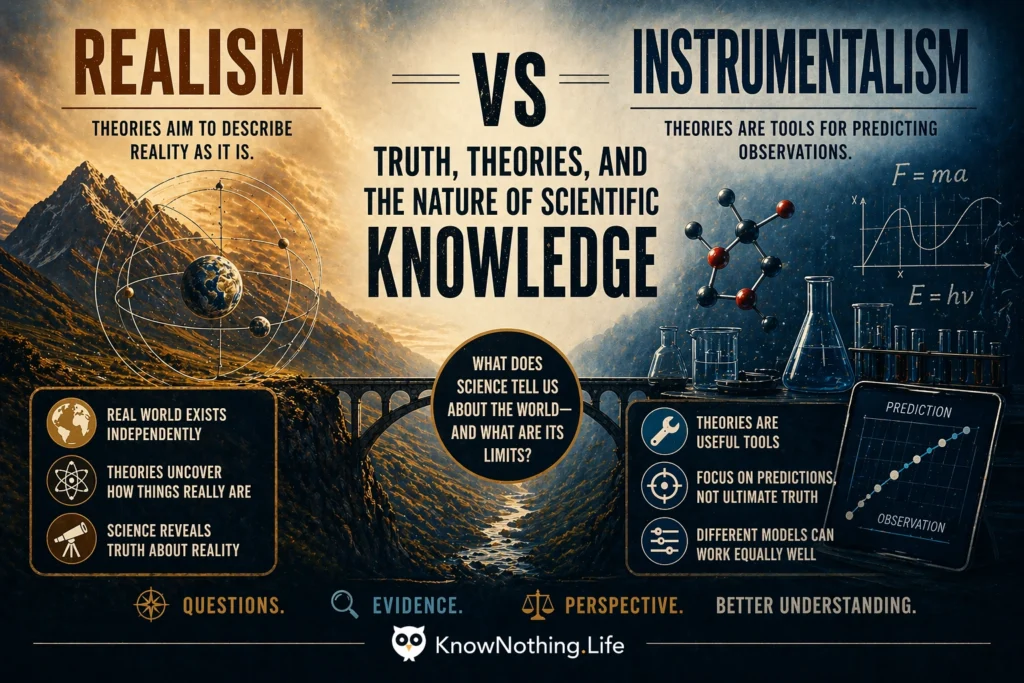
The debate between realism and instrumentalism lies at the heart of the philosophy of science. It concerns a fundamental question: do scientific theories describe reality as it truly is, or are they merely useful tools for predicting and organizing observations? This distinction shapes how we interpret the success of science and the status of the entities it posits, from electrons and black holes to genes and fields.
Scientific realism holds that the aim of science is truth, and that successful theories are likely to provide approximately accurate descriptions of a mind-independent world. Instrumentalism, by contrast, treats theories as instruments—practical devices for prediction and control—without committing to their literal truth. This tension reflects deeper philosophical questions about knowledge, representation, and the relationship between theory and reality.
The Core of Scientific Realism
Scientific realism is grounded in the belief that the world exists independently of our perceptions and that science progressively uncovers its structure. Realists argue that the success of scientific theories would be miraculous if they did not at least approximately reflect reality. This argument, often called the “no miracles argument,” suggests that the predictive and explanatory power of science is best explained by its truth or near-truth.
Philosophers such as Hilary Putnam have defended this position, emphasizing that scientific practice presupposes a commitment to the reality of theoretical entities. When scientists speak of electrons or gravitational waves, they are not merely using convenient fictions but referring to entities that genuinely exist.
Realism also involves a commitment to the continuity of scientific progress. Even when theories are revised or replaced, realists argue that they retain elements of truth, building toward a more accurate understanding of the world. This perspective highlights the cumulative nature of scientific knowledge, despite the changes that occur over time.
Instrumentalism and the Utility of Theories
Instrumentalism offers a contrasting view, focusing on the practical function of scientific theories rather than their truth. According to this perspective, theories are tools for organizing observations and making predictions, and their value lies in their usefulness rather than their correspondence to reality.
This approach has roots in the work of philosophers such as Pierre Duhem, who emphasized the role of theories as instruments for calculation and prediction. Instrumentalists argue that we need not assume the existence of unobservable entities to benefit from scientific theories. As long as a theory works, it serves its purpose.
Instrumentalism avoids some of the metaphysical commitments of realism, making it appealing to those who are skeptical about claims concerning unobservable aspects of the world. It also aligns with the pragmatic aspects of scientific practice, where the focus is often on solving problems and making accurate predictions rather than on uncovering ultimate truths.
The Challenge of Unobservable Entities
A central issue in the realism vs instrumentalism debate is the status of unobservable entities. Scientific theories frequently posit entities that cannot be directly observed, such as subatomic particles or distant cosmic phenomena. Realists argue that these entities are real, as their existence is supported by the success of the theories that describe them.
Instrumentalists, however, remain cautious. They contend that reference to unobservable entities may be useful for calculation and prediction, but it does not necessarily imply their existence. From this perspective, theoretical terms are part of a model that helps us navigate experience, not a literal description of the world.
This debate raises broader questions about the limits of observation and the role of inference in scientific reasoning. It challenges us to consider what it means to know something about the world and whether knowledge must be grounded in direct experience or can extend to theoretical constructs.
Theory Change and Scientific Progress
The history of science provides a rich context for evaluating realism and instrumentalism. Scientific theories are often replaced or revised, sometimes dramatically. For example, the transition from Newtonian mechanics to Einstein’s theory of relativity involved significant changes in our understanding of space and time.
Realists interpret such changes as part of a progressive refinement of knowledge. Even when theories are replaced, they may retain elements of truth or provide approximations that remain useful in certain contexts. This continuity supports the idea that science moves closer to an accurate description of reality over time.
Instrumentalists, on the other hand, see theory change as evidence that scientific theories are not true descriptions of the world. If past theories were successful yet ultimately replaced, this suggests that success does not guarantee truth. Instead, theories may be viewed as temporary tools that are replaced when more effective ones are developed.
Underdetermination and Evidence
Another important issue in the debate is underdetermination—the idea that empirical evidence alone may not be sufficient to determine which of several competing theories is correct. Different theories can often account for the same set of observations, making it difficult to choose between them based solely on data.
Philosophers such as Willard Van Orman Quine have emphasized this problem, arguing that our beliefs form a network in which multiple hypotheses can be adjusted to accommodate new evidence. This suggests that theoretical choices may involve factors beyond empirical data, such as simplicity, coherence, or explanatory power.
Underdetermination poses a challenge for realism, as it undermines the idea that evidence uniquely supports a true theory. Instrumentalists can accommodate this by focusing on the practical effectiveness of theories rather than their truth. However, realists may respond by arguing that additional criteria can guide theory choice, preserving a commitment to truth.
Structural Realism and Middle Positions
In response to the challenges faced by both realism and instrumentalism, some philosophers have proposed intermediate positions. One such approach is structural realism, which holds that while we may not know the nature of unobservable entities, we can know the structure of their relationships. This view preserves a form of realism while acknowledging the limitations of our knowledge.
Structural realism suggests that scientific progress involves uncovering the mathematical and relational structure of the world, even if the underlying entities remain partially unknown. This perspective bridges the gap between realism and instrumentalism, offering a way to account for the success of science without making overly strong metaphysical claims.
Other middle positions emphasize the role of models and representations, viewing theories as tools that can both describe and organize reality. These approaches reflect the complexity of the debate, showing that the dichotomy between realism and instrumentalism may be too simplistic.
Implications for Science and Philosophy
The realism vs instrumentalism debate has significant implications for how we understand science and its role in society. Realism supports the idea that science provides genuine knowledge about the world, reinforcing its authority and credibility. Instrumentalism, by contrast, emphasizes the practical and provisional nature of scientific theories, encouraging a more cautious interpretation of their claims.
This debate also influences how we approach scientific research and education. A realist perspective may inspire a search for deeper truths, while an instrumentalist approach may prioritize practical outcomes and applications. Both perspectives offer valuable insights, highlighting different aspects of scientific practice.
Philosophically, the debate touches on broader issues about truth, knowledge, and representation. It raises questions about how we can know the world and what it means for a theory to be true or useful. These questions extend beyond science, influencing our understanding of knowledge in general.
Conclusion
The debate between realism and instrumentalism reflects a fundamental tension in the philosophy of science: whether theories should be understood as true descriptions of reality or as practical tools for navigating experience. From the realist arguments of Hilary Putnam to the instrumentalist insights of Pierre Duhem, this discussion has shaped our understanding of scientific knowledge.
While no single position has resolved all the issues, the ongoing dialogue between realism and instrumentalism continues to enrich philosophical inquiry. By examining the nature of theories and their relationship to reality, we gain a deeper appreciation of the power and limitations of science as a means of understanding the world.