The debate between Platonism and nominalism is one of the most enduring and foundational disputes in philosophy. At its core lies a deceptively simple question: do abstract entities—such as numbers, properties, or universals—exist independently of the physical world, or are they merely names we use to organize our experience? This question reaches far beyond metaphysics, shaping how we understand mathematics, language, science, and even reality itself.
Platonism affirms the existence of abstract objects, proposing that entities like numbers or concepts such as “redness” exist in a non-physical realm. Nominalism, by contrast, denies such existence, arguing that only particular, concrete things are real, and that universals are linguistic or conceptual conveniences. The tension between these views reflects a deeper divide about the nature of reality: whether it is fundamentally structured by abstract truths or grounded entirely in the tangible and particular. Exploring this debate reveals not only competing theories of existence but also differing visions of knowledge and meaning.
The Origins of the Debate
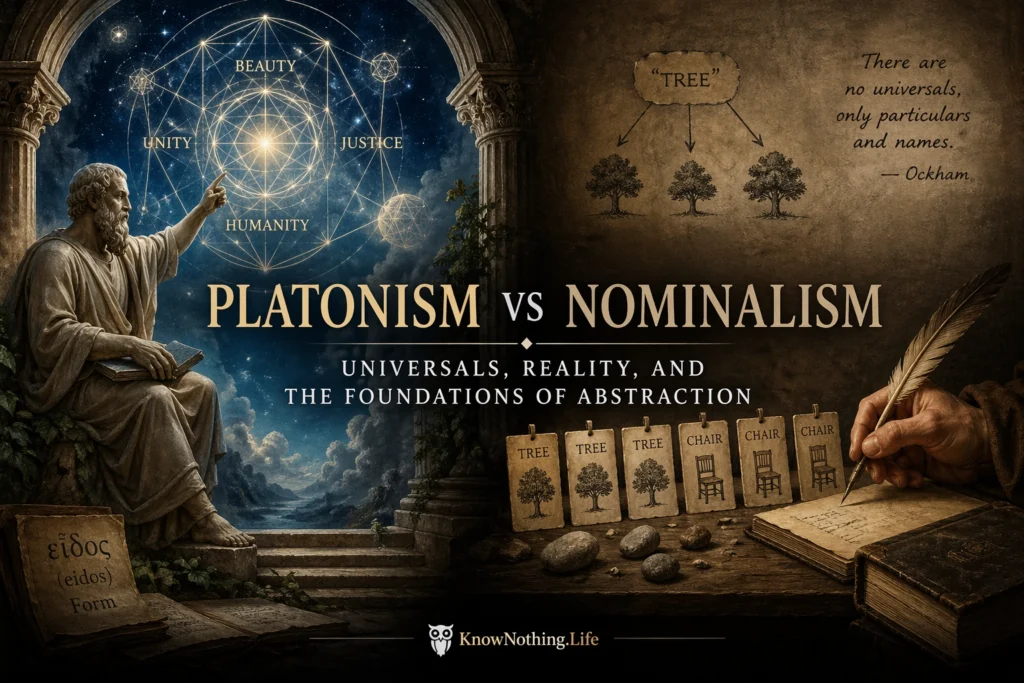
The roots of Platonism can be traced to Plato, who argued that the world we perceive is only a shadow of a higher, more perfect reality composed of abstract Forms. According to Plato, these Forms—such as beauty, justice, or equality—exist independently of the physical world and provide the basis for our understanding of it. Particular objects are what they are because they participate in or resemble these universal Forms.
Nominalism, in its earliest forms, emerged as a reaction against this metaphysical commitment. While it did not fully crystallize until the medieval period, its core intuition—that only individual things exist—can be seen as a counterpoint to Platonic thought. Medieval philosophers such as William of Ockham developed nominalism into a systematic position, arguing that universals are not real entities but merely names (nomina) we assign to groups of similar objects. This historical development set the stage for a long-standing philosophical divide that continues to influence contemporary debates.
Platonism: The Reality of Universals
Platonism asserts that universals and abstract objects are real and exist independently of human thought and language. According to this view, when we speak of properties like “redness” or mathematical entities like “the number 2,” we are referring to something that exists beyond the physical instances we encounter. These abstract entities are timeless, immutable, and not located in space or time, yet they are essential for explaining the regularities and patterns we observe in the world.
This perspective offers a compelling account of objectivity. If universals exist independently, then our statements about them can be true or false regardless of human opinion. For example, mathematical truths appear to hold universally, suggesting that they are grounded in something more stable than human convention. Platonism thus provides a foundation for the apparent necessity and universality of knowledge in domains like mathematics and logic. However, it also raises significant challenges, particularly regarding how we, as physical beings, can have knowledge of non-physical entities.
Nominalism: The Primacy of Particulars
Nominalism rejects the existence of universals as independent entities, maintaining that only particular objects exist. According to this view, when we use general terms like “red” or “triangle,” we are not referring to abstract objects but simply grouping together similar things under a common label. Universals, therefore, are not features of reality but products of language and thought.
This approach has the advantage of ontological simplicity. By denying the existence of abstract entities, nominalism avoids the metaphysical complications associated with Platonism. It aligns closely with empirical approaches to knowledge, emphasizing observation and concrete experience over abstract speculation. However, nominalism faces its own difficulties. It must explain how we can meaningfully talk about general properties and how scientific laws, which rely on generalization, can be justified without appealing to universals. The challenge is to account for the apparent regularity and structure of the world without invoking abstract entities.
Universals and Language
The debate between Platonism and nominalism is closely tied to questions about language and meaning. For Platonists, language refers to a reality that includes both concrete and abstract entities. Words like “beauty” or “justice” are meaningful because they correspond to real universals. This correspondence gives language its capacity to describe not just individual objects but also general truths.
Nominalists, on the other hand, view language as a system of conventions. Words do not point to abstract entities but serve as tools for organizing and communicating our experiences. The meaning of a term arises from its use rather than from any underlying reality it represents. This perspective has influenced modern theories of language, emphasizing the role of context, usage, and social practice in determining meaning. Yet it also raises questions about how language can capture general truths if it is not grounded in real universals.
Mathematics as a Battleground
Mathematics provides one of the most vivid arenas for the clash between Platonism and nominalism. Platonists argue that mathematical objects, such as numbers and sets, exist independently of human thought. This explains the apparent objectivity and necessity of mathematical truths. When mathematicians discover a theorem, they are uncovering a fact about an abstract realm that exists regardless of human activity.
Nominalists, however, interpret mathematics as a human construct. Mathematical objects are not real entities but elements of a symbolic system. Truth in mathematics is not about correspondence to an abstract reality but about consistency within a system of rules. This view aligns with formalist approaches, which treat mathematics as a manipulation of symbols rather than a description of a separate domain. The challenge for nominalism is to explain why mathematics is so effective in describing the physical world if it is merely a human invention.
Epistemological Challenges
Both Platonism and nominalism face significant epistemological challenges. For Platonism, the central problem is explaining how we can have knowledge of abstract entities that are not accessible through the senses. If universals exist in a non-physical realm, what kind of cognitive process allows us to grasp them? Various answers have been proposed, ranging from intellectual intuition to indirect inference, but none has achieved universal acceptance.
Nominalism, by contrast, must explain how knowledge of general truths is possible without appealing to universals. If only particular objects exist, how can we justify statements that apply universally? For example, scientific laws describe patterns that hold across many instances, suggesting a level of generality that is difficult to account for without some notion of universals. This tension highlights the difficulty of reconciling empirical observation with the need for generalization in knowledge.
Contemporary Perspectives
In modern philosophy, the debate between Platonism and nominalism has evolved into a more nuanced set of positions. Some philosophers adopt moderate forms of realism, accepting the existence of certain abstract entities while rejecting others. Others develop sophisticated nominalist frameworks that attempt to account for generality without invoking universals. Structuralism, for example, shifts the focus from individual objects to the relationships between them, offering a potential middle ground.
The influence of this debate extends beyond philosophy into fields such as mathematics, linguistics, and computer science. Questions about the nature of abstraction, the role of language, and the structure of knowledge continue to reflect the tension between these two perspectives. While no consensus has been reached, the ongoing dialogue has deepened our understanding of the conceptual foundations of many disciplines.
Final Thoughts
The conflict between Platonism and nominalism is more than a technical dispute; it is a reflection of two fundamentally different ways of understanding reality. Platonism emphasizes the existence of abstract structures that underpin the world, offering a vision of reality that is rich, ordered, and independent of human thought. Nominalism, by contrast, grounds reality in the concrete and particular, highlighting the role of language and cognition in shaping our understanding.
Each perspective captures an important aspect of our experience. The apparent objectivity and universality of mathematics and logic suggest that something like abstract reality may exist. At the same time, the variability of language and the importance of context remind us that our understanding is shaped by human practices. The enduring appeal of this debate lies in its ability to illuminate these tensions, encouraging us to question not only what exists, but how we come to know it.