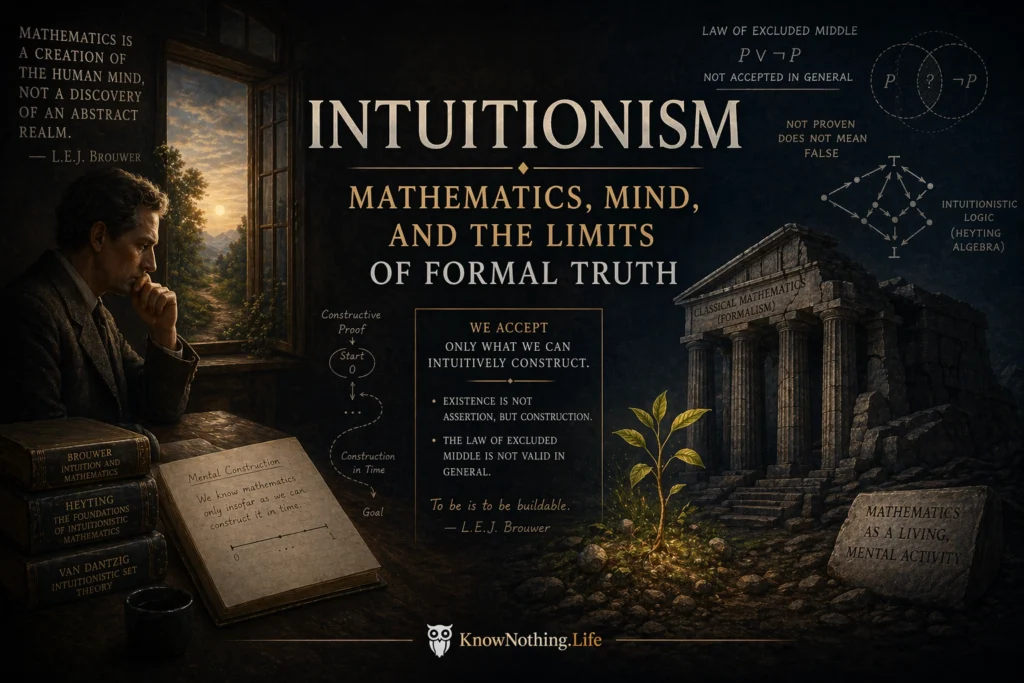
Intuitionism stands as one of the most radical and philosophically rich responses to the question of what mathematics is. Where other schools—such as logicism and formalism—seek to ground mathematics in logic or symbolic systems, intuitionism locates its foundation in the human mind. According to this view, mathematics is not discovered in an external realm nor merely manipulated through symbols; it is constructed through mental activity. Mathematical objects exist only insofar as they can be explicitly formed in thought, and mathematical truth depends on our ability to demonstrate or construct it.
This perspective fundamentally reorients the nature of mathematical inquiry. It challenges the idea that mathematical statements possess an objective truth independent of human cognition and instead emphasizes the role of the mathematician as an active creator. In doing so, intuitionism raises profound questions about knowledge, proof, and reality itself. It invites us to reconsider whether certainty in mathematics arises from external truths or from the internal coherence of our constructions.
Historical Origins
Intuitionism is most closely associated with L. E. J. Brouwer, who developed the theory in the early twentieth century. Brouwer’s work emerged as a response to the foundational crises in mathematics, particularly the paradoxes of set theory and the growing reliance on abstract, non-constructive methods. He argued that much of classical mathematics had strayed too far from its intuitive roots, relying on assumptions that could not be justified through direct mental construction.
Brouwer’s critique was not merely technical but philosophical. He rejected the idea that mathematics could be grounded in logic alone, as proposed by logicists, or reduced to symbolic manipulation, as suggested by formalists. Instead, he placed human intuition—specifically, the intuitive awareness of time and sequence—at the center of mathematics. This emphasis on intuition as the source of mathematical knowledge marked a significant departure from other foundational approaches and established intuitionism as a distinct and influential school of thought.
Mathematics as Mental Construction
At the heart of intuitionism is the idea that mathematics is a constructive activity. Mathematical objects do not exist independently of us; they are brought into being through acts of mental construction. For example, the natural numbers arise from the intuitive process of counting, where each number is generated by adding one to the previous one. This process is not merely descriptive but generative, creating the objects it studies.
This view has significant implications for the nature of mathematical truth. A statement is considered true only if there is a method for constructing a proof of it. This contrasts sharply with classical mathematics, where a statement may be regarded as true even if no explicit proof is known. For intuitionists, truth is inseparable from proof, and proof must be constructive. This emphasis on construction ensures that mathematical statements are grounded in concrete mental processes rather than abstract assumptions.
Rejection of the Law of the Excluded Middle
One of the most distinctive features of intuitionism is its rejection of the classical law of the excluded middle, which states that every proposition is either true or false. In classical logic, this principle allows for proofs by contradiction, where a statement is proven true by showing that its negation leads to a contradiction. Intuitionists, however, argue that such proofs do not provide genuine knowledge unless they result in a constructive demonstration.
For intuitionism, a statement is only true if it can be explicitly constructed, and false if its negation can be constructed. If neither is possible, the statement remains undetermined. This position introduces a more nuanced understanding of truth, one that reflects the limitations of human knowledge and the centrality of construction. While this approach restricts the scope of acceptable proofs, it also ensures that mathematical claims are directly tied to verifiable processes.
Intuitionistic Logic
The rejection of classical principles leads to the development of intuitionistic logic, a system of reasoning that differs significantly from classical logic. In intuitionistic logic, the meaning of logical connectives is defined in terms of constructive procedures. For example, to assert that “A or B” is true, one must provide a construction of either A or B, rather than simply ruling out the possibility that both are false.
This redefinition of logic has far-reaching consequences. It alters the structure of proofs, the interpretation of statements, and the overall framework of mathematical reasoning. Intuitionistic logic is not merely a restriction of classical logic but a fundamentally different system, reflecting the intuitionist commitment to construction and verification. It has found applications in areas such as computer science, where constructive proofs correspond to algorithms and executable procedures.
Infinity and Continuity
Intuitionism offers a distinctive approach to concepts such as infinity and continuity. In classical mathematics, infinite sets are often treated as completed entities, existing in their entirety. Intuitionists reject this notion, arguing that infinity should be understood as a potential process rather than an actual completed totality. Infinite structures are seen as indefinitely extendable constructions rather than fixed objects.
This perspective leads to a reexamination of the continuum, the mathematical concept underlying real numbers and continuous quantities. Intuitionists often interpret the continuum not as a set of points but as a dynamic process of approximation. This view aligns with the constructive nature of intuitionism, emphasizing the ongoing generation of mathematical objects rather than their static existence. While this approach diverges from classical treatments, it provides a coherent framework consistent with intuitionist principles.
Critiques and Challenges
Intuitionism has faced significant criticism from both mathematicians and philosophers. One common objection is that it imposes unnecessary restrictions on mathematical practice, excluding many useful and well-established results. By rejecting non-constructive methods, intuitionism limits the range of acceptable proofs, potentially hindering progress and exploration.
Another challenge concerns the subjectivity of intuition. If mathematics is grounded in individual mental constructions, how can it achieve the objectivity and universality that characterize it? Intuitionists respond by emphasizing shared cognitive structures and the communicability of constructions, but the tension between subjectivity and objectivity remains a point of debate. Critics argue that intuitionism risks reducing mathematics to a form of psychological activity, undermining its status as a universal discipline.
Intuitionism and Modern Thought
Despite these criticisms, intuitionism has had a lasting impact on modern thought. Its emphasis on construction and verification has influenced areas such as computer science, where algorithms and programs embody constructive processes. The correspondence between proofs and computations, known as the Curry–Howard correspondence, reflects intuitionistic ideas in a formal setting.
In philosophy, intuitionism has contributed to broader discussions about the nature of knowledge and the limits of formal systems. It challenges the assumption that all truths can be captured by abstract reasoning, highlighting the role of human cognition in shaping knowledge. This perspective resonates with contemporary approaches that emphasize embodiment, context, and the active role of the knower.
Final Thoughts
Intuitionism offers a compelling and provocative vision of mathematics as a human activity grounded in mental construction. By rejecting the idea of mathematics as a discovery of external truths, it places the mathematician at the center of the discipline, emphasizing creativity, intuition, and verification. This approach reshapes our understanding of proof, truth, and the nature of mathematical objects.
At the same time, intuitionism reveals the tensions inherent in the quest for certainty. Its strict standards for proof ensure rigor but also limit scope, raising questions about the balance between precision and flexibility. In exploring intuitionism, we are reminded that mathematics is not only a body of knowledge but also a way of thinking—one that reflects both the power and the limitations of the human mind.