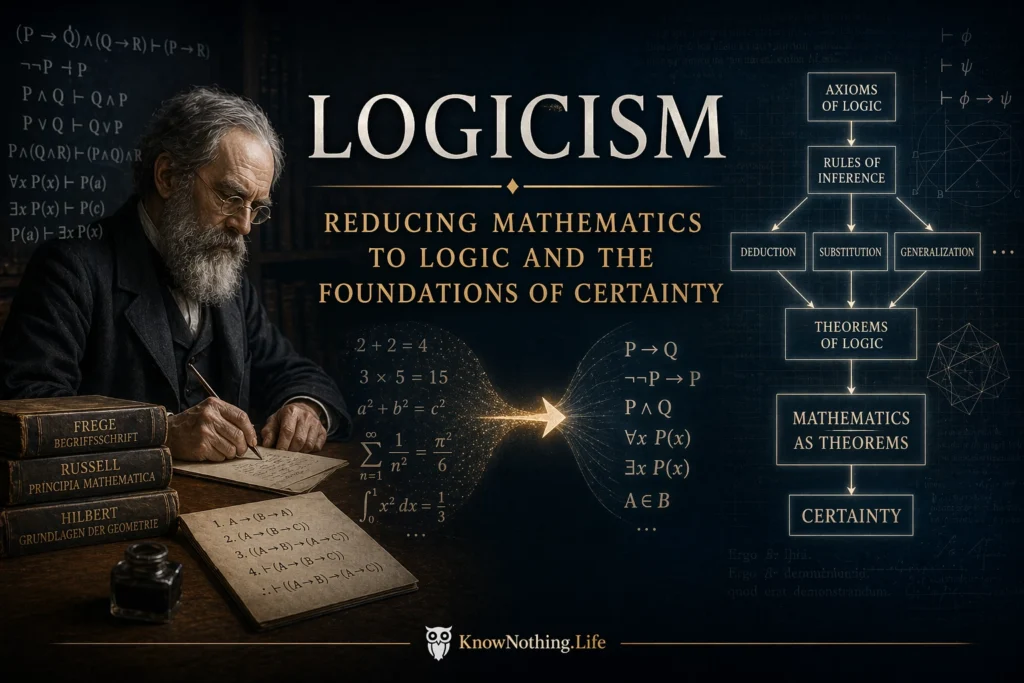
Logicism is one of the most ambitious and intellectually daring projects in the philosophy of mathematics. Its central claim is both simple and radical: all of mathematics can be reduced to logic. According to this view, mathematical truths are not independent or mysterious but are, at their core, logical truths. If successful, logicism would place mathematics on the firmest possible foundation, grounding it in the most basic principles of reasoning itself.
The appeal of logicism lies in its promise of certainty. Logic is often regarded as the most fundamental and indisputable form of knowledge. If mathematics can be derived from logic, then its truths inherit this certainty. Yet the project is not merely about securing foundations; it also aims to clarify the nature of mathematical objects, the meaning of mathematical statements, and the source of mathematical knowledge. By examining logicism, we gain insight into the deep connections between logic, language, and mathematical structure.
Historical Origins
The roots of logicism can be traced to the work of Gottlob Frege, who sought to demonstrate that arithmetic could be derived from purely logical principles. Frege’s project was grounded in his broader philosophical goal of explaining how language relates to meaning and reference. He argued that numbers are not physical objects but logical entities defined by their role in a system of concepts. For example, the number 2 is understood in terms of the concept of “two-ness,” which can be analyzed logically.
Frege’s work laid the foundation for later developments by Bertrand Russell and Alfred North Whitehead, who collaborated on the monumental work Principia Mathematica. Their goal was to formalize all of mathematics within a logical framework, deriving its theorems from a set of logical axioms. This effort represented the high point of the logicist program, demonstrating both its potential and its challenges. While they succeeded in deriving significant portions of mathematics, the complexity of their system revealed the difficulty of the task.
The Core Thesis of Logicism
At the heart of logicism is the claim that mathematical concepts can be defined in purely logical terms. Numbers, for instance, are not primitive entities but can be constructed from logical notions such as sets and relations. This approach seeks to eliminate the need for any specifically mathematical assumptions, showing that mathematics is, in essence, an extension of logic.
This thesis has profound implications for the nature of mathematical truth. If mathematics is reducible to logic, then its truths are analytic—true by virtue of their logical form rather than by reference to any external reality. This contrasts with views that treat mathematics as describing an abstract realm of objects or as a system of human-created symbols. Logicism thus offers a unifying perspective, suggesting that the certainty of mathematics derives from the structure of reasoning itself.
Definitions and the Construction of Numbers
A key component of logicism is the attempt to define numbers in logical terms. Frege’s approach involved defining numbers as classes of equivalent concepts. For example, the number 2 can be understood as the class of all pairs—sets containing exactly two elements. This definition captures the idea of “twoness” without appealing to any intuitive or empirical notion of number.
This method of definition allows numbers to be treated as logical objects, constructed from more fundamental elements. It also provides a framework for deriving arithmetic operations and relations from logical principles. By grounding numbers in logic, logicism aims to show that mathematical reasoning is not a separate domain but a continuation of logical reasoning. However, this approach depends on the coherence and consistency of the underlying logical system, which became a central issue in the development of the theory.
Russell’s Paradox and the Crisis of Foundations
The logicist project encountered a major obstacle with the discovery of Russell’s Paradox. This paradox arises when considering the set of all sets that do not contain themselves, leading to a contradiction. If such a set exists, it both must and must not contain itself, undermining the consistency of naive set theory.
The significance of this paradox cannot be overstated. It revealed that the logical foundations on which logicism depended were themselves unstable. In response, Russell developed the theory of types, a more restrictive framework designed to avoid such contradictions. While this solution allowed the logicist program to continue, it also introduced additional complexity, raising questions about whether the reduction of mathematics to logic was as straightforward as originally envisioned.
Principia Mathematica and Formalization
The publication of Principia Mathematica by Russell and Whitehead marked a milestone in the logicist project. This work attempted to derive all of mathematics from a set of logical axioms using a formal symbolic system. The rigor and precision of this approach demonstrated the power of formal methods, influencing the development of modern logic and computer science.
However, the sheer complexity of Principia Mathematica highlighted the challenges of logicism. Even basic mathematical truths required extensive derivations, suggesting that the reduction of mathematics to logic might be impractical. Moreover, the reliance on additional axioms and assumptions raised questions about whether the system was purely logical or whether it smuggled in mathematical content under the guise of logic.
Gödel and the Limits of Logicism
The work of Kurt Gödel dealt a significant blow to the logicist program. Gödel’s incompleteness theorems showed that any sufficiently powerful formal system cannot be both complete and consistent. This means that there will always be true mathematical statements that cannot be proven within the system.
For logicism, this result was devastating. If mathematics cannot be fully captured by a formal logical system, then the goal of reducing all mathematical truth to logic becomes unattainable. Gödel’s work revealed inherent limitations in formal approaches to mathematics, suggesting that mathematical truth extends beyond what can be derived from logical axioms alone. While some aspects of logicism remain influential, its original ambition was fundamentally challenged.
Logicism and the Nature of Mathematical Truth
Despite these challenges, logicism continues to offer valuable insights into the nature of mathematical truth. It emphasizes the role of logical structure in mathematical reasoning, highlighting the importance of rigor and formalization. Even if mathematics cannot be fully reduced to logic, the logicist perspective has shaped our understanding of how mathematical systems are constructed and justified.
Logicism also raises important questions about the relationship between language and reality. By treating mathematics as an extension of logic, it suggests that mathematical truths are grounded in the way we use symbols and rules. This view aligns with broader philosophical approaches that emphasize the role of language in shaping knowledge. At the same time, it leaves open the question of whether mathematical truths have an existence independent of our linguistic frameworks.
Contemporary Relevance
In contemporary philosophy, logicism is often seen as part of a broader landscape of foundational theories. While its original program has been modified and, in some respects, abandoned, its influence persists in areas such as formal logic, analytic philosophy, and theoretical computer science. The emphasis on formal systems and symbolic reasoning continues to shape modern approaches to mathematics and computation.
Moreover, logicism remains a reference point in debates about the nature of mathematics. It represents one extreme in the spectrum of views, contrasting with Platonism and constructivism. By exploring its successes and limitations, philosophers gain a clearer understanding of the possibilities and constraints of foundational theories. Logicism thus continues to play a vital role in the ongoing effort to understand mathematics at its deepest level.
Final Thoughts
Logicism stands as one of the most ambitious attempts to unify mathematics and logic. Its vision of mathematics as an extension of logical reasoning offers a powerful and elegant account of mathematical truth. Although its original goals were ultimately undermined by paradoxes and limitations, its influence on the development of modern logic and philosophy cannot be overstated.
What logicism reveals is not only the potential for reducing complex systems to simpler foundations but also the limits of such reduction. Mathematics, it turns out, is both more and less than logic: more, because it encompasses truths that exceed formal derivation, and less, because it relies on logical structure for its coherence. In this tension lies the enduring significance of logicism, reminding us that the search for certainty is as much about recognizing limits as it is about achieving clarity.