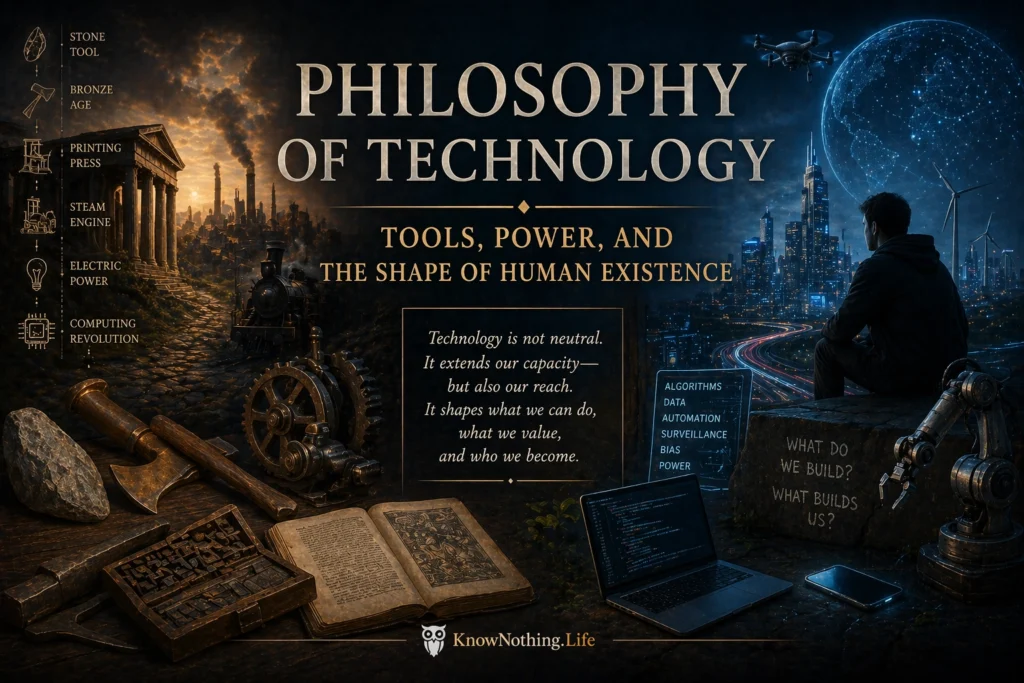
Technology is often understood as a collection of tools—devices designed to solve problems, increase efficiency, or extend human capabilities. Yet this view captures only the surface of a much deeper phenomenon. Technology is not merely something we use; it is something that shapes how we think, act, and understand the world. The philosophy of technology examines this deeper dimension, asking not just what technology does, but what it means for human life.
As technological systems become increasingly complex and pervasive, their influence extends far beyond practical utility. From artificial intelligence to digital communication, technology transforms social structures, alters perception, and redefines what it means to be human. The philosophy of technology explores these transformations, probing questions about agency, ethics, knowledge, and reality. It seeks to understand whether technology is a neutral instrument or a force that actively shapes the trajectory of human civilization.
What Is Technology?
At its most basic level, technology can be defined as the application of knowledge for practical purposes. This includes tools, machines, systems, and processes designed to achieve specific ends. However, this definition is only a starting point. Philosophers argue that technology is not simply a collection of artifacts but a mode of engagement with the world—a way of revealing, organizing, and transforming reality.
Some thinkers distinguish between technology as instrument and technology as system. As an instrument, technology is a means to an end, something humans control and deploy according to their intentions. As a system, however, technology becomes a network of interconnected processes that shape human behavior and limit choices. This distinction highlights a central tension in the philosophy of technology: whether humans remain in control of their creations or become increasingly shaped by them.
Technology and Human Agency
One of the most important questions in the philosophy of technology concerns human agency. Do we control technology, or does it control us? The intuitive answer is that technology is a tool we use, but this perspective may underestimate its influence. Technologies often create new possibilities while simultaneously constraining others, subtly guiding human behavior in ways that are not always apparent.
For example, communication technologies do more than transmit information; they shape how we interact, think, and even perceive time. Social media platforms, for instance, encourage certain forms of expression while discouraging others, influencing social norms and personal identity. In this sense, technology is not neutral but actively participates in the construction of human experience. The challenge is to recognize these influences without falling into technological determinism—the idea that technology alone dictates the course of history.
Heidegger and the Essence of Technology
A pivotal figure in the philosophy of technology is Martin Heidegger, who offered a profound and unconventional analysis of its nature. Heidegger argued that the essence of technology is not found in its devices but in a way of revealing the world. He introduced the concept of enframing (Gestell), which describes how modern technology orders and structures reality as a resource to be exploited.
According to Heidegger, technology encourages us to see the world not as something to be experienced or understood, but as something to be used. Nature becomes a “standing reserve,” valued primarily for its utility. This perspective has far-reaching implications, shaping not only how we interact with the environment but also how we understand ourselves. Heidegger’s analysis challenges the assumption that technology is merely a tool, suggesting instead that it transforms our relationship with being itself.
Technology and Knowledge
Technology is deeply intertwined with knowledge. It both arises from and contributes to our understanding of the world. Scientific discoveries often lead to new technologies, which in turn enable further discoveries. This reciprocal relationship highlights the role of technology as a mediator between humans and reality.
However, the knowledge produced through technology is not neutral. The tools we use influence what we can observe, measure, and understand. For example, digital technologies allow us to process vast amounts of data, but they also encourage a focus on quantifiable information, potentially overlooking qualitative aspects of experience. This raises questions about the limits of technologically mediated knowledge and the ways in which our tools shape our perception of truth.
Ethics and Responsibility
The rapid advancement of technology brings with it significant ethical challenges. Questions about privacy, surveillance, environmental impact, and artificial intelligence are central to contemporary debates. The philosophy of technology seeks to address these issues by examining the values embedded in technological systems and the responsibilities of those who create and use them.
One key concern is the distribution of power. Technologies can concentrate power in the hands of a few, creating inequalities and limiting access to resources. At the same time, they can empower individuals and communities, enabling new forms of participation and expression. Ethical reflection must therefore consider not only the consequences of technology but also the structures of power it creates and sustains.
Technology and the Self
Technology does not only shape society; it also transforms the individual. From wearable devices to virtual environments, technology increasingly mediates our experience of the body and the self. It extends our capabilities, allowing us to see farther, communicate faster, and process information more efficiently. Yet these extensions also raise questions about identity and authenticity.
As technology becomes more integrated into daily life, the boundary between human and machine becomes less clear. This is particularly evident in discussions of artificial intelligence and human enhancement. Are we still the same beings when our cognitive processes are augmented by machines? The philosophy of technology explores these questions, examining how technological integration reshapes our understanding of what it means to be human.
Critiques of Technological Progress
The idea of technological progress is often taken for granted, associated with improvement, efficiency, and advancement. However, philosophers have questioned whether progress in technology necessarily leads to progress in human well-being. While technology can solve problems, it can also create new ones, sometimes on a larger scale.
Critics argue that an uncritical embrace of technology can lead to unintended consequences, such as environmental degradation, social fragmentation, and loss of meaning. These concerns highlight the need for a more reflective approach to technological development—one that considers not only what can be done but what should be done. The philosophy of technology encourages this reflection, urging us to evaluate the broader impact of our innovations.
Technology in the Modern World
In the contemporary world, technology is more pervasive than ever. Digital networks connect billions of people, artificial intelligence systems perform complex tasks, and biotechnology reshapes the boundaries of life itself. These developments have transformed nearly every aspect of human existence, from work and communication to culture and identity.
At the same time, they have introduced new challenges. Issues such as data privacy, algorithmic bias, and the ethical use of AI require careful consideration. The philosophy of technology provides a framework for addressing these challenges, emphasizing the need for critical thinking and ethical responsibility. It reminds us that technology is not an autonomous force but a human creation, shaped by choices and values.
Final Thoughts
The philosophy of technology reveals that technology is far more than a collection of tools. It is a powerful force that shapes how we understand the world and ourselves. By examining its nature, influence, and implications, we gain a deeper appreciation of its role in human life.
Ultimately, the question is not whether technology is good or bad, but how it is integrated into our lives. The challenge is to harness its potential while remaining aware of its limitations and consequences. In doing so, we can ensure that technology serves not only our needs but also our values, contributing to a future that is both innovative and humane.