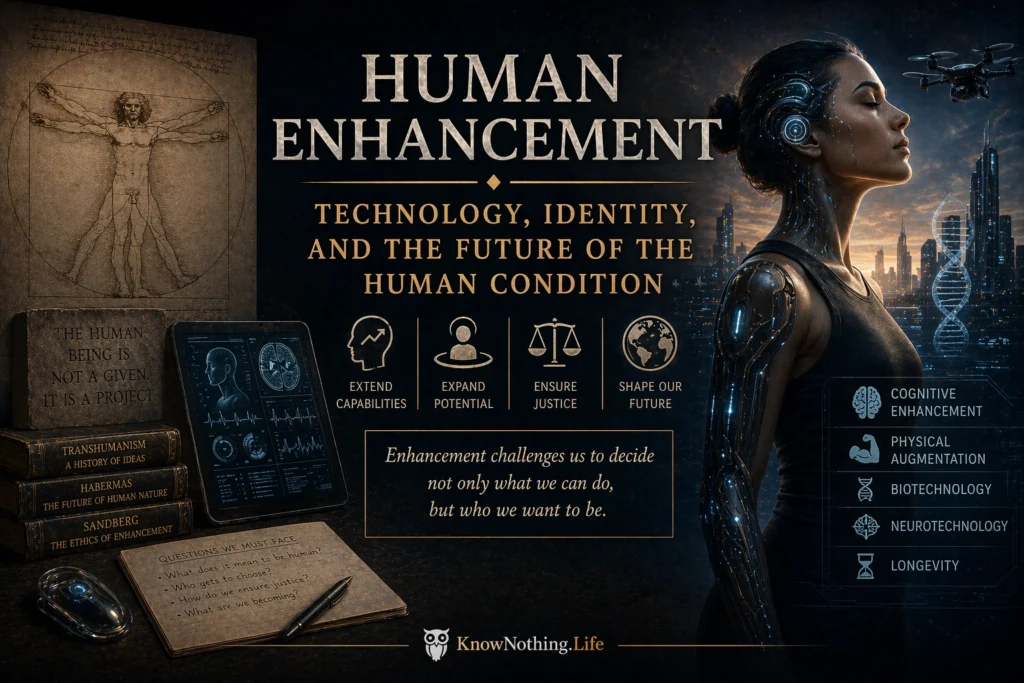
Human enhancement refers to the use of science and technology to improve human capabilities beyond what is typically considered natural or normal. While medicine has long sought to treat illness and restore health, enhancement goes a step further, aiming not merely to heal but to improve. From cognitive enhancers and genetic engineering to brain–computer interfaces and prosthetic augmentation, the possibilities of enhancing human beings are expanding rapidly. These developments raise profound philosophical and ethical questions about what it means to be human.
The central tension in the debate over human enhancement lies between aspiration and caution. On one hand, enhancement promises to reduce suffering, extend lifespan, and unlock new forms of human potential. On the other, it challenges deeply held assumptions about identity, equality, and the limits of human nature. The philosophy of human enhancement examines these tensions, asking whether improvement is always desirable, who gets to decide what counts as “better,” and how far we should go in reshaping ourselves.
What Is Human Enhancement?
Human enhancement encompasses a wide range of interventions aimed at improving physical, cognitive, or emotional capacities. These include biomedical technologies such as gene editing, pharmaceuticals designed to boost memory or focus, and mechanical devices that augment strength or mobility. Unlike traditional medical treatments, which aim to restore normal functioning, enhancements often seek to surpass it.
The distinction between therapy and enhancement is not always clear. For example, a drug that restores memory in patients with cognitive impairment might also be used to enhance memory in healthy individuals. This overlap complicates ethical evaluation, as it blurs the line between necessity and choice. Understanding human enhancement therefore requires not only technical knowledge but also philosophical reflection on what constitutes health, normality, and improvement.
The Promise of Enhancement
Proponents of human enhancement emphasize its potential to improve quality of life. Advances in biotechnology could eliminate genetic diseases, extend lifespan, and enhance physical and cognitive abilities. These possibilities are often associated with the broader movement of transhumanism, which envisions a future in which humans transcend biological limitations through technology.
Enhancement also has the potential to address global challenges. For example, cognitive enhancements could improve problem-solving and innovation, while physical enhancements might increase resilience in extreme environments. From this perspective, human enhancement is not merely a personal choice but a collective opportunity to advance human flourishing. However, realizing these benefits requires careful consideration of the risks and ethical implications involved.
Identity and the Self
One of the most profound questions raised by human enhancement concerns personal identity. If we significantly alter our cognitive or physical capacities, do we remain the same individuals? Enhancements that affect memory, personality, or perception have the potential to reshape the very traits that define who we are.
This raises concerns about authenticity. Some critics argue that enhancement may lead to a loss of genuine achievement or selfhood, as abilities are increasingly shaped by external interventions rather than personal effort. Others counter that human identity has always been shaped by tools, culture, and technology, and that enhancement is simply a continuation of this process. The challenge is to determine whether there are limits beyond which enhancement undermines the coherence or integrity of the self.
Equality and Access
Human enhancement also raises significant issues of justice and equality. If enhancements are expensive or limited in availability, they may exacerbate existing social inequalities. Those with access to enhancement technologies could gain advantages in education, employment, and social status, creating a divide between the enhanced and the unenhanced.
This possibility has led to concerns about a “biological elite,” a group of individuals whose enhanced abilities set them apart from the rest of society. Addressing these concerns requires consideration of how enhancement technologies are distributed and regulated. Ensuring equitable access is a complex challenge, particularly in a global context where resources and opportunities vary widely. The ethics of enhancement must therefore grapple with questions of fairness and social justice.
The Limits of Human Nature
A central theme in the debate over human enhancement is the concept of human nature. Some argue that there are essential features of humanity that should not be altered, and that enhancement risks eroding these qualities. This perspective often emphasizes the value of limitations, suggesting that struggle, vulnerability, and finitude are integral to the human experience.
Others reject the idea of a fixed human nature, viewing it as dynamic and open to transformation. From this perspective, enhancement is a natural extension of human creativity and adaptability. Humans have always used technology to extend their capabilities, from tools and language to modern medicine. The question is not whether we should change ourselves, but how we should guide that change in a way that aligns with our values.
Enhancement and Ethics
The ethical evaluation of human enhancement involves multiple considerations, including autonomy, beneficence, and risk. Individuals may have the right to choose enhancements for themselves, but these choices can have broader social consequences. For example, widespread use of cognitive enhancers could create pressure for others to adopt them, effectively reducing the freedom to remain unenhanced.
Risk is another critical factor. Many enhancement technologies are still experimental, with uncertain long-term effects. Genetic modifications, in particular, raise concerns about unintended consequences that could be passed on to future generations. Ethical decision-making must therefore balance the potential benefits of enhancement with the need for caution and responsibility.
Human Enhancement and Technology
The development of enhancement technologies is closely tied to broader trends in science and engineering. Advances in artificial intelligence, biotechnology, and nanotechnology are expanding the possibilities for modifying human capabilities. Brain–computer interfaces, for example, have the potential to merge human cognition with digital systems, creating new forms of interaction and intelligence.
These developments blur the boundary between human and machine, raising questions about what it means to be human in a technologically integrated world. As enhancement technologies become more sophisticated, they challenge traditional distinctions between natural and artificial, organic and mechanical. The philosophy of human enhancement must therefore engage with the evolving relationship between humans and technology.
Cultural and Social Perspectives
Attitudes toward human enhancement vary across cultures and societies. Some view it as an exciting opportunity for progress, while others see it as a threat to moral and social values. Religious perspectives, for example, may emphasize the sanctity of the human body and the limits of human intervention, while secular perspectives may focus on autonomy and innovation.
These differences highlight the importance of cultural context in shaping ethical judgments. What is considered acceptable or desirable in one society may be viewed differently in another. The global nature of technological development makes it essential to engage in cross-cultural dialogue, ensuring that diverse perspectives are considered in shaping the future of human enhancement.
The Future of Humanity
The possibilities of human enhancement raise questions about the long-term future of humanity. If enhancement technologies continue to advance, they may lead to the emergence of new forms of human existence. This could include extended lifespans, enhanced cognitive abilities, and even the integration of biological and artificial systems.
Such changes have the potential to redefine fundamental aspects of human life, including work, relationships, and meaning. They also raise the possibility of divergence, where different groups pursue different forms of enhancement, leading to a plurality of human experiences. The future of humanity may not be a single path but a range of possibilities shaped by technological innovation and ethical choice.
Final Thoughts
Human enhancement represents both an opportunity and a challenge. It offers the potential to improve human life in unprecedented ways, but it also raises complex ethical and philosophical questions. At its core, the debate is not just about technology but about values—what we consider important, what we are willing to change, and what we seek to preserve.
As we move forward, it is essential to approach human enhancement with both imagination and responsibility. By carefully considering its implications, we can strive to harness its benefits while addressing its risks. In doing so, we engage in a deeper reflection on what it means to be human and what kind of future we wish to create.