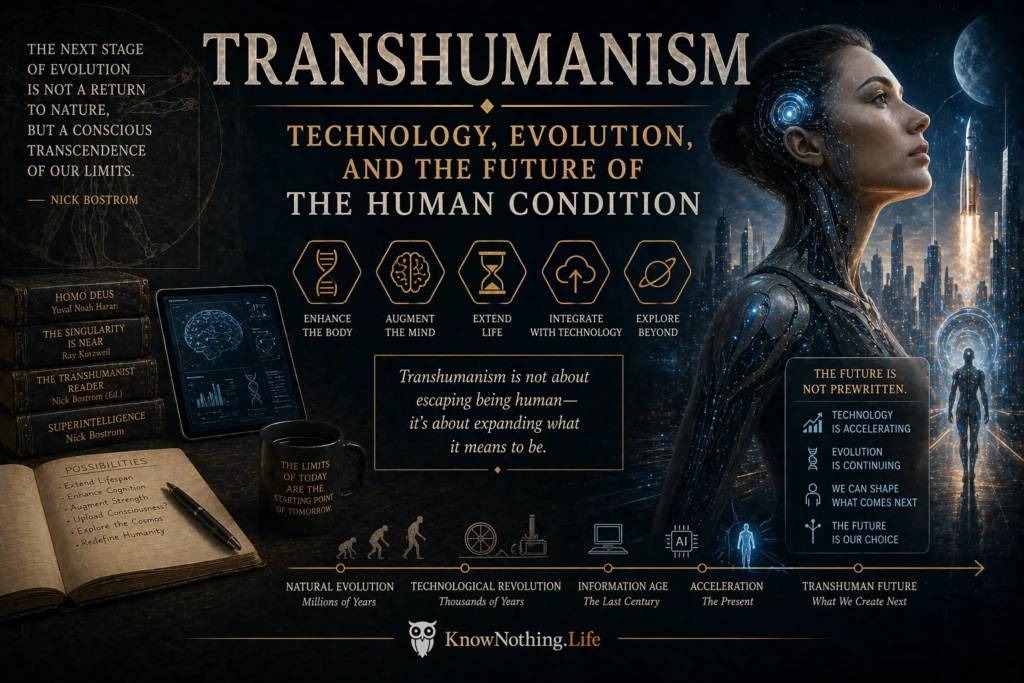
Transhumanism is a philosophical and cultural movement that advocates the use of advanced technology to enhance human capabilities, overcome biological limitations, and ultimately transform the human condition. At its core lies the belief that humanity is not a finished product of evolution, but an ongoing project—one that can be consciously shaped through science, engineering, and innovation. From extending lifespan to augmenting intelligence, transhumanism envisions a future in which humans transcend the constraints of biology and move toward new forms of existence.
The idea has gained increasing prominence in the twenty-first century as developments in biotechnology, artificial intelligence, and neuroscience have begun to make once-speculative possibilities more tangible. What was once confined to science fiction is now the subject of serious academic, ethical, and technological inquiry. Transhumanism occupies a unique space between philosophy and futurism, combining speculative vision with practical ambition.
Yet the movement also raises profound questions about identity, ethics, and the nature of humanity itself. If humans can radically alter their bodies and minds, what does it mean to be human? Where is the line between therapy and enhancement, and who gets to decide? These questions place transhumanism at the center of contemporary debates about technology’s role in shaping the future.
Historical and Philosophical Foundations
Although transhumanism is often associated with modern technology, its intellectual roots stretch back centuries. Enlightenment thinkers emphasized progress, reason, and the potential for human improvement, laying the groundwork for later ideas about enhancing human capabilities. Philosophers such as Friedrich Nietzsche explored the concept of the “Übermensch,” a figure who transcends conventional human limitations and values, suggesting that humanity is something to be overcome rather than preserved in its current form.
In the twentieth century, these ideas were further developed in the context of scientific and technological advancement. The term “transhumanism” itself was popularized by Julian Huxley, who envisioned a future in which humanity consciously directs its own evolution. Later thinkers, including Nick Bostrom, expanded on these ideas, articulating a more systematic framework for understanding the ethical and practical implications of human enhancement.
Transhumanism also draws from fields such as cybernetics, systems theory, and evolutionary biology. It reflects a shift from viewing evolution as a natural, undirected process to seeing it as something that can be guided and accelerated through technological intervention. This perspective redefines humanity not as a static category, but as a dynamic stage in an ongoing evolutionary trajectory.
Core Principles of Transhumanism
At the heart of transhumanism is the commitment to enhancing human capacities. This includes improving physical health, extending lifespan, increasing cognitive abilities, and expanding sensory experiences. Technologies such as genetic engineering, neural implants, and advanced prosthetics are seen as tools for achieving these goals. The ultimate aim is not merely to improve quality of life, but to fundamentally expand the range of what humans can experience and achieve.
Another central principle is the rejection of biological determinism. Transhumanists argue that many aspects of the human condition—aging, disease, cognitive limitations—are not immutable facts, but challenges to be addressed through innovation. This perspective reframes traditional boundaries between natural and artificial, suggesting that technological augmentation is a continuation of humanity’s long history of tool use and self-modification.
Transhumanism also emphasizes individual choice and autonomy. Advocates argue that people should have the freedom to decide how they wish to enhance their bodies and minds, provided that such choices do not harm others. This libertarian dimension underscores the movement’s focus on personal empowerment, while also raising questions about inequality and access to enhancement technologies.
Technologies Driving Transhumanism
The vision of transhumanism is closely tied to rapid advancements in science and technology. Biotechnology plays a central role, with developments in gene editing—such as CRISPR—offering the potential to eliminate genetic diseases and enhance desirable traits. These technologies challenge traditional notions of medicine, blurring the line between healing and enhancement.
Artificial intelligence is another key driver. AI systems not only augment human decision-making but also raise the possibility of merging human cognition with machine intelligence. Brain-computer interfaces, for example, aim to create direct communication pathways between the brain and external devices, potentially enabling new forms of interaction and thought. Such innovations suggest a future in which the boundaries between human and machine become increasingly fluid.
Nanotechnology and robotics further expand the scope of transhumanist ambitions. From microscopic devices that repair cells to advanced prosthetics that outperform natural limbs, these technologies redefine what the human body can be. Together, they form a technological ecosystem that supports the transhumanist goal of transcending biological limitations.
Ethical and Philosophical Challenges
Despite its promise, transhumanism raises significant ethical concerns. One of the most pressing issues is inequality. Access to enhancement technologies may be limited by economic or social factors, potentially creating a divide between those who can afford to enhance themselves and those who cannot. This could lead to new forms of stratification, where enhanced individuals hold significant advantages over others.
Another challenge concerns identity and authenticity. If a person’s abilities are significantly augmented by technology, to what extent are those abilities truly their own? Critics argue that excessive reliance on enhancement could undermine the value of human effort and achievement. Others question whether radical modifications might erode the sense of self, leading to a loss of continuity in personal identity.
There are also concerns about unintended consequences. Technological interventions in complex systems like the human body and brain carry risks that may not be fully understood. Ethical debates surrounding genetic modification, for example, highlight the potential for unforeseen effects that could impact future generations. These challenges underscore the need for careful consideration and responsible governance of emerging technologies.
Transhumanism and the Concept of Posthumanism
Transhumanism often intersects with the idea of posthumanism, which explores what lies beyond the human as we currently understand it. While transhumanism focuses on enhancing and extending human capabilities, posthumanism examines the broader implications of moving beyond traditional human boundaries. It raises questions about the nature of consciousness, embodiment, and the relationship between humans and other forms of intelligence.
In this context, the “posthuman” represents a potential future state in which beings possess abilities far beyond those of current humans. These might include vastly superior intelligence, extended lifespans, or entirely new modes of existence. Some transhumanists view this as the ultimate goal, while others see it as one possible outcome among many.
The concept of posthumanism also challenges anthropocentric assumptions, encouraging a rethinking of humanity’s place in the broader ecosystem of life and technology. It suggests that the future may not be defined solely by human perspectives, but by a diverse array of intelligent systems and forms of existence.
Transhumanism in Contemporary Society
Today, transhumanist ideas are increasingly influencing public discourse and technological development. Companies and research institutions are investing heavily in areas such as longevity research, AI, and neural interfaces. These efforts reflect a growing recognition that enhancing human capabilities is not just a theoretical possibility, but a practical objective.
Cultural representations of transhumanism, from literature to film, have also played a significant role in shaping public perception. These narratives often explore both the potential benefits and the risks of human enhancement, providing a space for society to grapple with complex ethical questions. They highlight the tension between aspiration and caution that defines much of the transhumanist debate.
At the same time, policy discussions are beginning to address the implications of these technologies. Governments and organizations are considering how to regulate emerging fields, balancing innovation with ethical responsibility. This ongoing dialogue illustrates the dynamic interplay between technological possibility and societal values.
Conclusion
Transhumanism represents one of the most ambitious and controversial visions of the future. By advocating the use of technology to transcend biological limitations, it challenges deeply held assumptions about what it means to be human. Its emphasis on enhancement, autonomy, and progress reflects a broader cultural shift toward viewing humanity as a project that can be actively shaped.
Yet the movement’s bold aspirations are matched by equally significant challenges. Ethical concerns, questions of identity, and the risk of inequality all complicate the pursuit of transhumanist goals. These issues highlight the need for thoughtful engagement with the technologies that promise to redefine human existence.
Ultimately, transhumanism invites a fundamental reconsideration of humanity’s place in the world. It asks not only what we are, but what we might become—and whether we are prepared to embrace the responsibilities that come with that transformation.