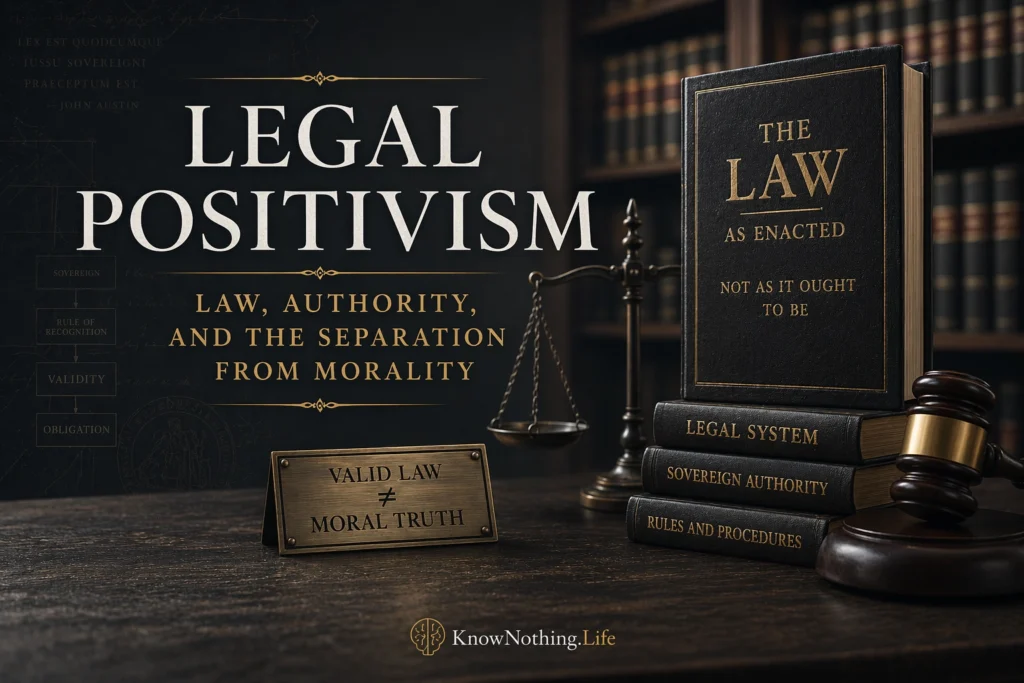
Legal positivism is one of the most influential and debated theories in the philosophy of law, grounded in the claim that the validity of law depends on social facts rather than moral values. At its core lies a deceptively simple idea: law is what is enacted, recognized, and enforced by legitimate authority, not what is morally right or just. This perspective challenges the intuition that unjust laws are somehow not “real” laws, insisting instead that legality and morality are conceptually distinct.
From its early formulation by John Austin to its refinement by H. L. A. Hart, legal positivism has evolved into a sophisticated framework for understanding how legal systems function. It does not deny the importance of morality but seeks to clarify the difference between describing what the law is and evaluating what it ought to be. By drawing this distinction, legal positivism provides a powerful analytical tool for examining legal systems across cultures and historical periods.
The Core Principles of Legal Positivism
At the heart of legal positivism lies the “separability thesis,” the claim that law and morality are not inherently connected. According to this view, a rule can be legally valid even if it is morally unjust. This does not mean that morality is irrelevant to law, but rather that the existence of a law is one thing, and its moral value is another. This distinction allows for a clearer understanding of how legal systems operate, especially in cases where laws conflict with ethical principles.
Another key principle is the idea that law is grounded in social facts—specifically, the practices and institutions that create, interpret, and enforce rules. For positivists, what makes something a law is not its content but its source. A law is valid if it has been created according to the recognized procedures of a legal system, whether through legislation, judicial decisions, or other accepted mechanisms.
This focus on social facts distinguishes legal positivism from theories that appeal to higher moral or natural standards. By emphasizing observable practices and institutional structures, positivism aims to provide an objective account of law that can be applied across different societies, regardless of their moral beliefs or cultural values.
John Austin and the Command Theory of Law
One of the earliest systematic versions of legal positivism was developed by John Austin, who defined law as a command issued by a sovereign and backed by the threat of sanctions. According to Austin, laws are rules that people are obligated to follow because they are enforced by a political authority with the power to punish noncompliance.
Austin’s command theory emphasized the hierarchical structure of legal systems, with the sovereign at the top. The sovereign is defined as a person or body that is habitually obeyed by the majority and does not habitually obey anyone else. This framework provided a clear and straightforward account of legal authority, focusing on power and obedience as the foundation of law.
However, Austin’s theory faced significant criticisms. It struggled to account for laws that do not fit the command model, such as those that grant powers rather than impose obligations. It also had difficulty explaining the continuity of legal systems over time, particularly when sovereign authority changes. Despite these limitations, Austin’s work laid the groundwork for later developments in legal positivism.
H. L. A. Hart and the Modern Turn
Legal positivism underwent a major transformation with the work of H. L. A. Hart, who offered a more nuanced and flexible account of law. Rejecting the simplicity of Austin’s command theory, Hart introduced the idea that legal systems are composed of both primary and secondary rules. Primary rules govern behavior by imposing duties, while secondary rules provide the framework for creating, modifying, and interpreting those primary rules.
One of Hart’s most important contributions is the concept of the “rule of recognition,” a foundational rule that determines which norms count as law within a given legal system. This rule is not written in a statute but exists as a shared practice among officials, guiding their recognition of valid laws. The rule of recognition explains how legal systems maintain coherence and authority without relying on a single sovereign figure.
Hart also emphasized the internal perspective of law, highlighting how individuals within a legal system view rules as standards that ought to be followed, not merely as threats backed by force. This insight allowed him to address some of the shortcomings of earlier positivist theories, presenting law as a complex social institution grounded in both practice and normative understanding.
Law, Morality, and the Separability Thesis
The separability of law and morality remains one of the most controversial aspects of legal positivism. Critics argue that this distinction undermines the moral authority of law, potentially legitimizing unjust or oppressive systems. If a law can be valid regardless of its moral content, what prevents legal systems from enforcing deeply unethical rules?
Positivists respond by clarifying that their theory is descriptive, not prescriptive. They do not claim that unjust laws should be obeyed, only that such laws can exist as part of a legal system. By separating law from morality, positivism allows for a more precise critique of unjust laws, identifying them as legally valid but morally wrong. This distinction can be crucial in contexts where moral resistance is necessary, such as in cases of civil disobedience.
The debate over the separability thesis has led to further refinements within legal positivism. Some theorists, known as “inclusive” or “soft” positivists, argue that moral criteria can be incorporated into a legal system’s rule of recognition. Others, known as “exclusive” or “hard” positivists, maintain a stricter separation. These internal debates demonstrate the ongoing evolution of positivist thought.
Legal Positivism and Legal Interpretation
Legal positivism has important implications for how laws are interpreted and applied. If law is grounded in social facts and institutional practices, then interpretation must focus on identifying the sources of law rather than appealing to external moral principles. This approach often aligns with textualism or formalism, which emphasize the importance of legal texts and established rules.
However, positivism does not necessarily dictate a single method of interpretation. Even within a positivist framework, judges may need to exercise discretion when laws are unclear or incomplete. This raises questions about the role of moral reasoning in judicial decision-making, particularly in hard cases where legal rules do not provide clear answers.
Philosophers such as Joseph Raz have explored these issues, emphasizing the authority of law as a system that provides reasons for action. Raz’s work highlights the tension between the need for clear, authoritative rules and the reality of interpretive judgment. Legal positivism, in this context, offers a framework for understanding how law guides behavior while leaving room for complexity and debate.
Criticisms and Challenges
Despite its influence, legal positivism has faced persistent criticism from a variety of perspectives. One major challenge comes from natural law theorists, who argue that law cannot be fully understood without reference to moral principles. For them, the idea that unjust laws are still valid laws is both philosophically and ethically problematic.
Another line of criticism focuses on the role of interpretation and judicial discretion. Critics such as Ronald Dworkin argue that law is not merely a system of rules but also includes moral principles that guide decision-making. Dworkin contends that judges do not simply apply existing laws but interpret them in light of broader values, challenging the positivist emphasis on social facts.
There are also practical concerns about the application of legal positivism in complex, modern societies. As legal systems become more intricate and interconnected, the boundaries between law and morality may become increasingly difficult to maintain. These challenges have prompted ongoing debates about the scope and limits of positivist theory.
Legal Positivism in Contemporary Context
In the modern world, legal positivism continues to play a central role in legal theory and practice. Its emphasis on clarity, structure, and institutional authority makes it particularly useful for analyzing complex legal systems and ensuring consistency in legal interpretation.
At the same time, contemporary legal issues—such as human rights, international law, and technological regulation—raise questions that push beyond traditional positivist frameworks. The global nature of many legal challenges requires coordination across different legal systems, each with its own rules and practices. Positivism provides tools for understanding these systems, but it must also adapt to new realities.
Despite these challenges, legal positivism remains a vital part of the philosophical landscape. Its insistence on distinguishing between what the law is and what it ought to be continues to shape debates about justice, authority, and the role of law in society.
Final Thoughts
Legal positivism offers a powerful and enduring framework for understanding the nature of law. By grounding legal validity in social facts and institutional practices, it provides a clear and objective account of how legal systems function. Its emphasis on the separation of law and morality allows for rigorous analysis and critical evaluation, even in the face of injustice.
At the same time, the theory’s limitations and challenges ensure that it remains a subject of ongoing debate. Questions about morality, interpretation, and authority continue to test the boundaries of positivist thought, inviting new perspectives and refinements.
In the end, legal positivism does not claim to provide all the answers but offers a disciplined way of asking the right questions. It invites us to examine the structures that govern our lives with clarity and precision, while leaving open the deeper moral inquiries that define the pursuit of justice.