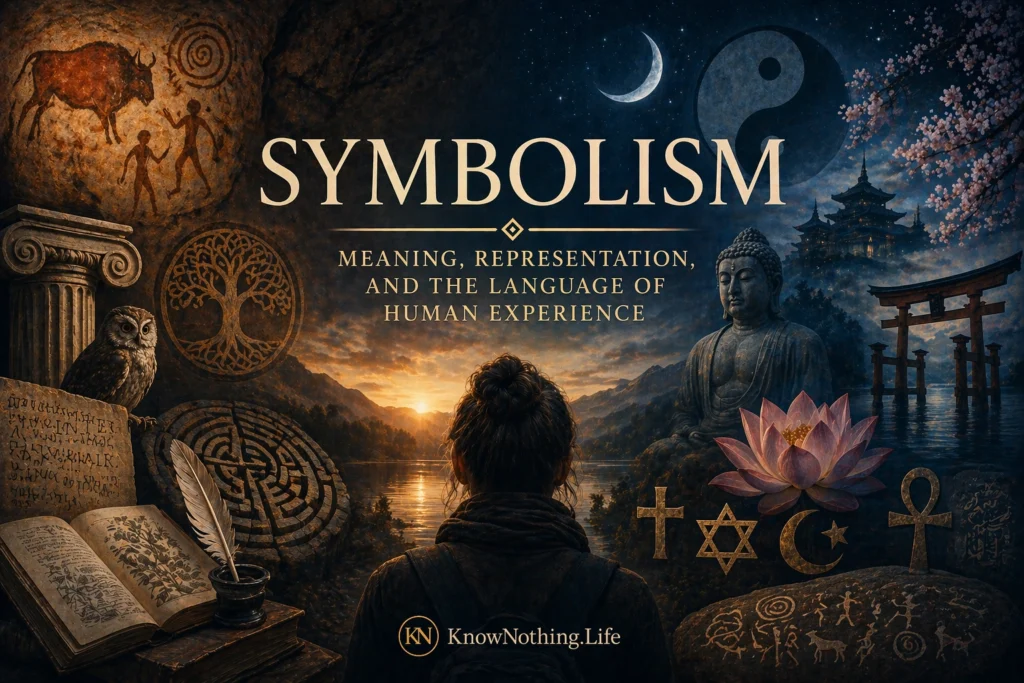
Symbolism is one of the most fundamental features of human thought and communication. It allows individuals to represent ideas, emotions, and realities through signs, images, and language that stand for something beyond themselves. From words and gestures to art and rituals, symbols shape how people understand the world and express their inner lives. Without symbolism, complex communication, culture, and abstract thinking would be impossible.
Philosophically, symbolism raises deep questions about meaning and representation. How do symbols come to signify what they do? Is meaning inherent in symbols, or is it constructed through social agreement? These questions connect symbolism to broader inquiries in philosophy of language, epistemology, and metaphysics. By examining symbolism, philosophers seek to understand how humans bridge the gap between the visible and the invisible, the concrete and the abstract.
Historical Foundations of Symbolic Thought
The philosophical study of symbolism can be traced to early reflections on language and representation. In ancient Greece, Plato explored the relationship between words and the realities they describe, questioning whether names are naturally connected to their objects or assigned by convention. This inquiry laid the groundwork for later debates about the nature of symbolic meaning.
Aristotle further developed these ideas by analyzing language as a system of signs that represent mental states and external objects. For Aristotle, symbols function as intermediaries between thought and reality, enabling communication and understanding. This perspective highlights the role of symbolism in linking subjective experience with shared meaning.
In the modern period, philosophers such as Ferdinand de Saussure introduced the concept of the sign as composed of a “signifier” (the form of the symbol) and a “signified” (the concept it represents). This structural approach emphasized that meaning arises from relationships within a system, rather than from inherent connections between symbols and their referents. These developments shaped contemporary theories of symbolism and semiotics.
The Nature of Symbols
Symbols are entities that stand for or represent something beyond themselves. Unlike simple signs, which may have direct or causal connections to what they indicate, symbols involve a level of abstraction and interpretation. For example, a word represents an object not through resemblance but through a shared understanding within a linguistic community.
Philosophically, symbols can be understood as mediators between thought and reality. They allow individuals to grasp and communicate concepts that may not be directly observable, such as emotions, values, or abstract ideas. This mediating function makes symbolism central to human cognition, enabling the development of language, art, and culture.
The arbitrariness of many symbols raises important questions about meaning. If symbols do not inherently resemble what they represent, how do they acquire significance? The answer lies in social conventions and shared practices, which establish and sustain symbolic systems. This perspective underscores the collective nature of meaning, highlighting the role of community in shaping symbolic understanding.
Language as a Symbolic System
Language is the most complex and pervasive system of symbols in human life. It allows individuals to communicate thoughts, describe experiences, and construct narratives about the world. Words, as symbols, do not simply label objects but organize and interpret reality, shaping how individuals perceive and understand their environment.
Philosophers such as Ludwig Wittgenstein emphasized that the meaning of language depends on its use within specific contexts. According to Wittgenstein, words gain significance through their role in “language games,” which are embedded in forms of life. This view highlights the dynamic and context-dependent nature of symbolic meaning.
Language also enables abstraction, allowing individuals to think beyond immediate experience. Through symbolic representation, humans can discuss concepts such as justice, beauty, and truth, which have no direct physical form. This capacity for abstraction is a defining feature of human cognition, illustrating the power of symbolic systems.
Symbolism in Art and Culture
Symbolism plays a central role in art and culture, where it is used to convey meaning in ways that go beyond literal representation. Artistic symbols can evoke emotions, suggest ideas, and create layers of interpretation, engaging audiences in a process of reflection and understanding.
In literature, symbols often carry multiple meanings, allowing texts to be interpreted in different ways. A single image or motif can represent a range of concepts, depending on context and perspective. This richness of meaning reflects the complexity of symbolic expression, which cannot be reduced to simple definitions.
Cultural symbols, such as rituals, traditions, and icons, also shape collective identity. They provide shared reference points that unify communities and convey values across generations. By participating in symbolic practices, individuals connect with broader cultural narratives, reinforcing a sense of belonging and continuity.
Symbolism and Thought
Symbolism is not only a tool for communication but also a foundation of thought itself. Cognitive processes often rely on symbolic representation, allowing individuals to manipulate ideas and solve problems. This perspective suggests that thinking is, in many ways, a symbolic activity, involving the use of mental representations.
Philosophers and cognitive scientists have explored how symbols function in the mind. Some theories propose that thought involves internal symbolic structures, analogous to language, while others emphasize more dynamic and embodied processes. Despite these differences, there is broad agreement that symbolism plays a crucial role in enabling complex cognition.
The relationship between symbolism and thought also raises questions about the limits of understanding. If thought depends on symbolic systems, then the scope of human cognition may be shaped by the symbols available. This idea highlights the importance of developing and expanding symbolic frameworks, as they influence how individuals conceptualize and engage with the world.
Symbolism, Power, and Ideology
Symbols are not neutral; they can be used to shape perception and reinforce power structures. Political symbols, for example, can evoke loyalty, identity, and authority, influencing how individuals respond to institutions and leaders. Similarly, cultural symbols can perpetuate stereotypes or challenge dominant narratives.
Philosophers such as Roland Barthes analyzed how symbols function within systems of ideology. Barthes argued that everyday objects and images can carry ideological meanings, shaping how reality is understood. This perspective reveals the subtle ways in which symbolism influences thought and behavior.
The study of symbolism in relation to power highlights the importance of critical analysis. By examining how symbols are used and interpreted, individuals can uncover underlying assumptions and challenge dominant frameworks. This process is essential for fostering awareness and promoting more equitable forms of representation.
Symbolism in Contemporary Context
In the modern world, symbolism continues to evolve, particularly in the context of digital media and global communication. Images, icons, and memes circulate rapidly, creating new forms of symbolic expression. These developments expand the possibilities of communication while also introducing challenges related to interpretation and meaning.
Digital platforms enable the creation and dissemination of symbols on an unprecedented scale, allowing individuals to participate in shaping cultural narratives. At the same time, the speed and volume of information can lead to ambiguity and misunderstanding, as symbols are interpreted differently across contexts.
Philosophical inquiry into contemporary symbolism focuses on these dynamics, exploring how new technologies influence the creation and interpretation of meaning. By analyzing these changes, philosophers seek to understand how symbolic systems adapt to evolving conditions and what implications this has for communication and culture.
Conclusion
Symbolism is a fundamental aspect of human life, shaping how individuals think, communicate, and understand the world. It provides the means by which abstract ideas are expressed and shared, linking personal experience with collective meaning. Through language, art, and culture, symbols create a rich and dynamic landscape of interpretation.
Philosophical analysis reveals that symbolism is not merely a tool but a central feature of human cognition and social interaction. It highlights the interplay between individual thought and collective practice, showing how meaning is constructed and sustained within communities. At the same time, it underscores the importance of critical engagement, as symbols can both illuminate and obscure reality.
Ultimately, symbolism offers insight into the nature of human experience. It reveals the ways in which individuals navigate the complexities of meaning, bridging the gap between the tangible and the intangible. By examining symbolism, philosophy deepens our understanding of how humans create and inhabit worlds of significance.