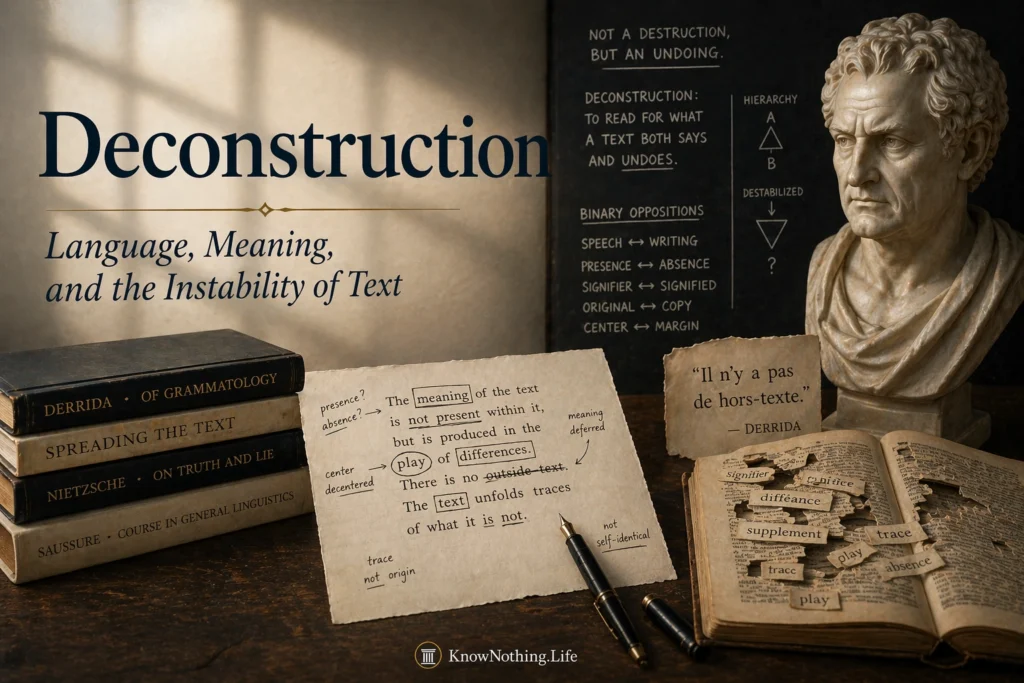
Deconstruction is one of the most influential and controversial methods in contemporary philosophy and literary theory. Emerging in the late 20th century, it challenges traditional assumptions about meaning, language, and interpretation. Rather than seeking stable truths or fixed interpretations, deconstruction examines how meaning is constructed, revealing internal tensions and contradictions within texts and ideas. It does not aim to destroy meaning but to show how meaning is never fully settled or complete.
At its core, deconstruction is a critical practice that questions the structures through which knowledge is organized. It invites readers to look beyond surface meanings and to explore the underlying assumptions that shape interpretation. By focusing on what is excluded, marginalized, or taken for granted, deconstruction exposes the complexity and ambiguity inherent in language. This approach has had a profound impact across disciplines, influencing philosophy, literature, cultural studies, and beyond.
Origins and Intellectual Context
Deconstruction is most closely associated with the work of Jacques Derrida, who developed the method as part of a broader critique of Western philosophical traditions. Derrida challenged the idea that language can provide direct access to truth, arguing instead that meaning is always mediated by systems of difference and interpretation. His work builds on earlier thinkers, including structuralists, while simultaneously questioning their assumptions.
The intellectual context of deconstruction includes a broader movement away from foundationalism—the belief that knowledge rests on stable, self-evident principles. Instead, deconstruction emphasizes the contingent and constructed nature of meaning. It reflects a shift toward examining the limits of language and the ways in which meaning is shaped by context, history, and power. This perspective marks a departure from traditional approaches that sought certainty and clarity in philosophical inquiry.
Language and Difference
A central concept in deconstruction is the idea that meaning arises through difference rather than through direct reference. Words do not have fixed meanings on their own; instead, they acquire meaning in relation to other words within a system. This relational nature of language means that meaning is always shifting, as it depends on context and interpretation.
Derrida introduced the concept of “différance” to capture this dynamic, emphasizing both difference and deferral. Meaning is not only defined by what it is not but is also deferred, never fully present in any single expression. This challenges the traditional view that language can provide clear and stable representations of reality. Instead, deconstruction reveals that language is inherently unstable, with meanings that are constantly evolving and open to reinterpretation.
Binary Oppositions
Deconstruction often focuses on binary oppositions—pairs of concepts that structure thought, such as presence/absence, speech/writing, or reason/emotion. These oppositions are typically hierarchical, with one term privileged over the other. For example, traditional philosophy often privileges speech over writing, associating speech with immediacy and authenticity.
Deconstruction examines how these hierarchies are constructed and how they can be destabilized. By showing that each term depends on the other for its meaning, it undermines the assumption of clear distinctions and fixed hierarchies. This process reveals that what appears stable and self-evident is often supported by hidden assumptions and exclusions. In this way, deconstruction challenges the foundations of conceptual frameworks that shape understanding.
Textual Analysis
Deconstruction is frequently applied through close reading of texts, analyzing how language operates within them. This involves identifying ambiguities, contradictions, and tensions that disrupt straightforward interpretations. Rather than seeking a single, definitive meaning, deconstructive analysis explores the multiple meanings that a text can generate.
This approach highlights the idea that texts are not self-contained entities with fixed meanings but are open to interpretation. The meaning of a text is shaped by its context, the reader’s perspective, and the interplay of language within it. Deconstruction thus transforms the act of reading into a dynamic process, where interpretation is continually evolving and never fully resolved.
Deconstruction and Philosophy
In philosophy, deconstruction challenges traditional assumptions about truth, knowledge, and meaning. It questions the idea that philosophical concepts can be defined with absolute precision, showing instead that they are often shaped by linguistic and conceptual structures that contain inherent ambiguities.
Derrida’s work engages with a wide range of philosophical traditions, from ancient to modern, revealing how their arguments rely on distinctions that are not as stable as they appear. By exposing these tensions, deconstruction does not simply reject philosophical ideas but invites a more critical and reflective engagement with them. It encourages philosophers to examine the limits of their own methods and assumptions.
Critiques and Misunderstandings
Deconstruction has often been misunderstood as a form of relativism or nihilism, suggesting that meaning is entirely arbitrary or that truth does not exist. However, this interpretation oversimplifies its aims. Deconstruction does not deny the existence of meaning but questions the idea that meaning can be fixed or fully determined.
Critics have also argued that deconstruction can lead to excessive skepticism, undermining the possibility of meaningful interpretation. Others contend that its emphasis on language overlooks material and social realities. These critiques highlight the challenges of applying deconstruction, as well as the need to balance its insights with other approaches. Despite these debates, deconstruction remains a powerful tool for examining the complexity of language and meaning.
Deconstruction and Power
Deconstruction is not only concerned with language but also with power. The structures that shape meaning often reflect broader social and political dynamics, influencing how knowledge is produced and understood. By analyzing these structures, deconstruction can reveal how certain perspectives are privileged while others are marginalized.
This aspect of deconstruction has made it influential in fields such as cultural studies and critical theory, where it is used to examine issues of identity, representation, and authority. By uncovering the assumptions embedded in language and discourse, deconstruction provides a means of challenging dominant narratives and opening space for alternative viewpoints.
The Limits of Meaning
One of the key insights of deconstruction is that meaning is never complete. Every attempt to define or fix meaning encounters limits, as language itself is inherently open-ended. This does not mean that interpretation is arbitrary but that it is always provisional, subject to revision and reinterpretation.
This perspective encourages humility in the pursuit of knowledge, recognizing that understanding is always partial and evolving. It also highlights the creative potential of interpretation, as new meanings can emerge through engagement with texts and ideas. Deconstruction thus reframes the search for meaning as an ongoing process rather than a final destination.
Conclusion
Deconstruction is a complex and influential approach that challenges traditional views of language, meaning, and interpretation. By examining the structures that shape understanding, it reveals the instability and openness of meaning, encouraging a more critical and reflective engagement with texts and ideas.
Rather than offering definitive answers, deconstruction invites ongoing inquiry, emphasizing the importance of questioning assumptions and exploring multiple perspectives. In doing so, it reshapes the way we think about language and knowledge, highlighting both the limitations and the possibilities inherent in interpretation.