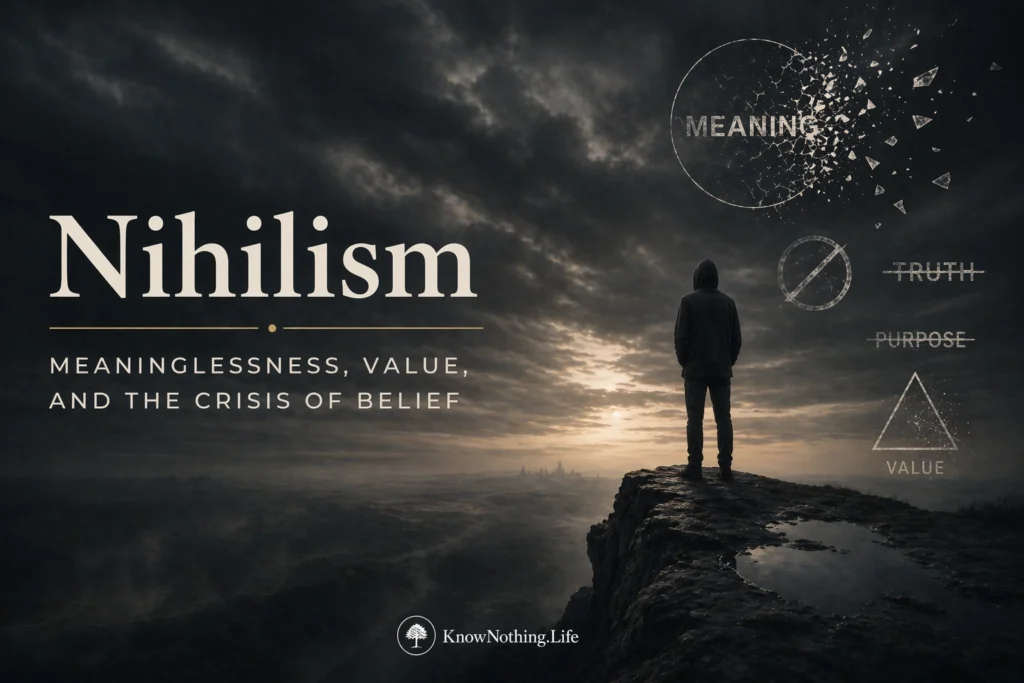
Nihilism is one of the most provocative and often misunderstood positions in philosophy. At its core, it is the view that life lacks inherent meaning, objective value, or ultimate purpose. Rather than offering a single unified doctrine, nihilism encompasses a range of perspectives that challenge deeply held assumptions about truth, morality, and existence. It forces a confrontation with the possibility that the structures we rely on to make sense of the world may not rest on any firm foundation.
The term is frequently associated with Friedrich Nietzsche, who did not simply endorse nihilism but diagnosed it as a defining condition of modernity. Nietzsche argued that traditional sources of meaning—particularly religion and metaphysics—had lost their authority, leaving individuals to face a void where certainty once existed. This shift created both a crisis and an opportunity, raising questions about how humanity might respond to the absence of objective values.
The Nature and Types of Nihilism
Nihilism is not a monolithic idea but includes several distinct forms, each addressing different aspects of human experience. Existential nihilism asserts that life has no inherent meaning or purpose, challenging the assumption that existence is guided by any overarching goal. Moral nihilism denies the existence of objective moral truths, suggesting that concepts such as right and wrong are not grounded in any universal standard. Epistemological nihilism questions the possibility of knowledge, casting doubt on the reliability of truth claims.
These variations share a common thread: the rejection of foundational certainties. Where traditional philosophies often seek stable grounds for meaning or knowledge, nihilism exposes the fragility of these foundations. It does not necessarily claim that nothing exists, but rather that the meanings and values attributed to existence may lack objective justification.
Understanding these distinctions is crucial for appreciating the scope of nihilism. It is not simply a denial of everything but a critical examination of the assumptions that underlie belief systems. By challenging these assumptions, nihilism invites a deeper inquiry into the nature of meaning and value.
Nietzsche and the Death of God
Friedrich Nietzsche’s declaration that “God is dead” is one of the most famous expressions of nihilism. This statement does not refer to a literal event but to the decline of religious belief as a central source of meaning and moral authority in modern society. With the loss of this foundation, individuals are left without a clear framework for understanding their place in the world.
Nietzsche viewed this development as both inevitable and transformative. The collapse of traditional values creates a vacuum, leading to what he described as nihilism—the recognition that previously accepted truths no longer hold. This can result in disorientation, despair, and a sense of purposelessness, as individuals struggle to find new sources of meaning.
However, Nietzsche did not see nihilism as an endpoint. Instead, he regarded it as a transitional phase, a necessary step toward the creation of new values. By confronting the absence of objective meaning, individuals are challenged to become creators of value, shaping their own lives and perspectives. This response transforms nihilism from a purely negative condition into a catalyst for innovation and self-determination.
Nihilism and the Loss of Meaning
The central concern of nihilism is the loss of meaning, a condition that can have profound psychological and philosophical implications. When individuals come to believe that life lacks inherent purpose, they may experience a sense of emptiness or alienation. This loss of meaning can affect not only personal identity but also social relationships and cultural structures.
Philosophers have explored how meaning is constructed and what happens when its foundations are undermined. Without shared narratives or guiding principles, individuals may struggle to orient themselves, leading to uncertainty and fragmentation. This condition is often associated with modernity, where traditional sources of meaning have been challenged by scientific, cultural, and social changes.
At the same time, the absence of predetermined meaning can be seen as an opportunity. It allows individuals to question inherited assumptions and to explore alternative ways of understanding existence. While this process can be unsettling, it also opens the possibility for new forms of meaning that are more flexible and responsive to individual experience.
Moral Nihilism and Ethics
Moral nihilism presents a particularly challenging aspect of the broader nihilist framework. By denying the existence of objective moral truths, it raises questions about how ethical judgments can be justified. If there is no universal standard of right and wrong, what grounds moral decision-making?
Critics of moral nihilism argue that it undermines the possibility of ethical behavior, leading to relativism or even moral indifference. Without objective values, it may seem difficult to justify actions or to hold individuals accountable. This concern highlights the importance of moral frameworks in maintaining social cohesion and guiding behavior.
However, proponents of nihilist perspectives suggest that morality can still function as a human construct, shaped by cultural, social, and individual factors. While these constructs may lack objective grounding, they can still provide practical guidance and meaning. This view emphasizes the role of human agency in creating and sustaining ethical systems, even in the absence of universal truths.
Nihilism and Existentialism
Nihilism is often linked to existentialism, as both address the absence of inherent meaning and the need for individuals to confront this reality. However, the two philosophies differ in their responses. While nihilism emphasizes the lack of meaning, existentialism focuses on the possibility of creating meaning through choice and action.
Philosophers such as Jean-Paul Sartre argued that individuals must take responsibility for defining their own lives, transforming the absence of meaning into a source of freedom. This perspective acknowledges the insights of nihilism while offering a more constructive response.
The relationship between nihilism and existentialism highlights the diversity of philosophical approaches to the problem of meaning. While nihilism exposes the limitations of traditional frameworks, existentialism seeks to move beyond them, emphasizing creativity and engagement. Together, they provide a comprehensive exploration of the challenges and possibilities of human existence.
Cultural and Historical Context
Nihilism is often associated with periods of cultural and intellectual upheaval, where established beliefs and institutions are called into question. In the 19th and 20th centuries, rapid social change, scientific advancement, and the decline of religious authority contributed to the emergence of nihilist thought.
Literature and art have played a significant role in expressing and exploring nihilist themes. Writers and artists have depicted the sense of disillusionment and fragmentation that accompanies the loss of meaning, offering insights into the emotional and cultural dimensions of nihilism. These expressions reflect the broader impact of nihilist ideas on human experience.
Understanding the historical context of nihilism helps to clarify its significance. It is not merely a theoretical position but a response to real changes in how individuals understand themselves and their world. This connection between philosophy and context underscores the relevance of nihilism as a lens for interpreting modern life.
Responses to Nihilism
Philosophers have proposed various responses to the challenges posed by nihilism, ranging from rejection to transformation. Some seek to restore traditional sources of meaning, arguing that the loss of belief is not inevitable and that established frameworks can still provide guidance.
Others, following Friedrich Nietzsche, advocate for the creation of new values. This approach emphasizes the role of individuals as active participants in shaping meaning, rather than passive recipients of inherited beliefs. By embracing creativity and self-determination, individuals can respond to nihilism in a constructive way.
There are also perspectives that accept the absence of objective meaning while focusing on practical and experiential aspects of life. These approaches suggest that meaning can arise from relationships, activities, and personal commitments, even if it lacks ultimate justification. This pragmatic response highlights the adaptability of human beings in the face of uncertainty.
Nihilism in Contemporary Thought
In contemporary philosophy and culture, nihilism continues to be a topic of debate and reflection. The challenges it raises about meaning, value, and truth remain relevant in a world characterized by diversity and rapid change. Advances in science and technology, along with shifting cultural norms, have further complicated traditional understandings of existence.
Nihilism also intersects with discussions in psychology, where issues of meaning and purpose are linked to well-being and mental health. The recognition of meaninglessness can lead to existential anxiety, but it can also prompt individuals to seek new forms of engagement and fulfillment.
In this context, nihilism serves as both a critique and a catalyst. By questioning established assumptions, it encourages ongoing reflection and exploration. Its relevance lies not only in its conclusions but in the questions it raises, which continue to shape philosophical and cultural discourse.
Final Thoughts
Nihilism presents a challenging yet compelling perspective on human existence, confronting the possibility that life lacks inherent meaning, value, or purpose. By exposing the fragility of traditional beliefs, it forces a reevaluation of the foundations on which individuals and societies are built.
While often associated with despair or negativity, nihilism also opens the door to new possibilities. It invites individuals to question assumptions, explore alternative perspectives, and engage with life in a more reflective and intentional way. In this sense, it is not merely a doctrine of negation but a starting point for deeper inquiry.
Ultimately, nihilism is less about providing answers than about confronting questions. It challenges us to consider what remains when familiar certainties are stripped away, and how we might respond to that condition. Whether through rejection, transformation, or acceptance, the engagement with nihilism reveals the resilience and creativity of the human spirit in the face of uncertainty.