Classical conditioning is a fundamental learning process through which organisms come to associate previously unrelated stimuli, allowing one stimulus to predict the occurrence of another. First systematically studied by Ivan Pavlov, classical conditioning revealed that learning does not always require conscious effort or direct reinforcement. Instead, it can emerge automatically through repeated pairings of stimuli, shaping behavior in subtle but powerful ways. This process underlies a wide range of responses, from basic physiological reactions to complex emotional patterns.
At its core, classical conditioning reflects the brain’s capacity to detect regularities in the environment. When one event consistently precedes another, the organism learns to anticipate what will happen next. This anticipation allows for adaptive behavior, preparing the organism to respond to important stimuli. While originally studied in controlled laboratory settings, classical conditioning has since been recognized as a pervasive mechanism that influences everyday experiences, including preferences, fears, and habits.
Historical Foundations and Pavlov’s Experiments
The origins of classical conditioning lie in Pavlov’s investigations into the physiology of digestion. While studying salivation in dogs, Pavlov observed that the animals began to salivate not only in response to food but also in response to stimuli associated with feeding, such as the presence of a lab assistant. This observation led him to explore how associations between stimuli could produce learned responses.
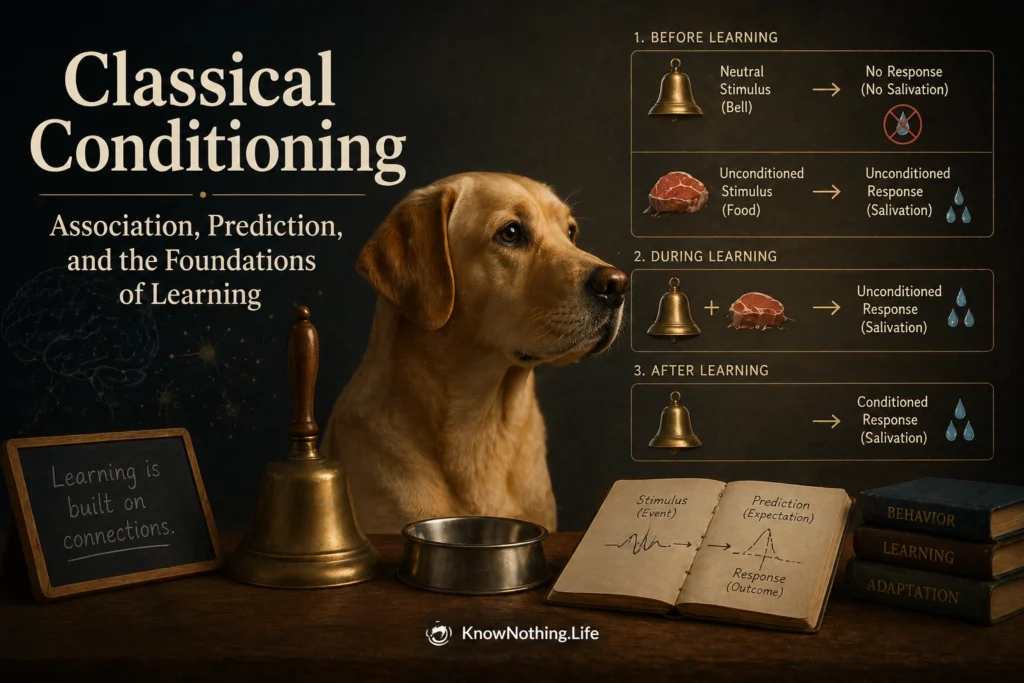
In his experiments, Pavlov introduced a neutral stimulus, such as a bell, and paired it repeatedly with the presentation of food, which naturally elicited salivation. Over time, the neutral stimulus alone came to trigger salivation, demonstrating that the association between the two stimuli had been learned. Pavlov identified key components of this process, including the unconditioned stimulus (food), the unconditioned response (salivation), the conditioned stimulus (bell), and the conditioned response (salivation to the bell).
These experiments provided a systematic framework for studying associative learning, highlighting the conditions under which associations are formed. Pavlov’s work demonstrated that learning could occur without direct reinforcement of behavior, challenging existing theories and laying the foundation for behaviorist approaches to psychology. His findings continue to influence contemporary research, illustrating the enduring significance of classical conditioning.
Basic Principles of Classical Conditioning
Classical conditioning is governed by several key principles that determine how associations are formed and maintained. One of the most important is acquisition, the phase during which the association between the conditioned stimulus and the unconditioned stimulus is established. Repeated pairings strengthen this association, increasing the likelihood that the conditioned response will occur.
Another critical principle is extinction, which occurs when the conditioned stimulus is presented repeatedly without the unconditioned stimulus. Over time, the conditioned response diminishes and may eventually disappear. However, extinction does not erase the original learning; instead, it reflects the formation of a new association. This is evidenced by spontaneous recovery, where the conditioned response reappears after a period of rest.
Generalization and discrimination further illustrate the flexibility of classical conditioning. Generalization occurs when stimuli similar to the conditioned stimulus elicit the conditioned response, while discrimination involves learning to distinguish between similar stimuli based on their associations. These processes allow organisms to adapt their responses to a range of environmental cues, enhancing the utility of learned associations.
Timing, Contiguity, and Contingency
The effectiveness of classical conditioning depends on the temporal relationship between stimuli. Contiguity refers to the closeness in time between the conditioned and unconditioned stimuli, with shorter intervals generally leading to stronger associations. However, timing alone is not sufficient; the conditioned stimulus must also reliably predict the unconditioned stimulus.
This predictive relationship is captured by the concept of contingency, which emphasizes the importance of the conditioned stimulus as a signal for the unconditioned stimulus. When the conditioned stimulus consistently precedes the unconditioned stimulus, learning is more likely to occur. If the relationship is inconsistent or unpredictable, the association may not form as strongly.
Research has shown that forward conditioning, where the conditioned stimulus precedes the unconditioned stimulus, is particularly effective. In contrast, backward conditioning, where the unconditioned stimulus comes first, is generally less successful. These findings highlight the importance of temporal structure in learning, demonstrating that classical conditioning is not merely about pairing stimuli but about establishing meaningful predictive relationships.
Biological Preparedness and Constraints
While classical conditioning is a general learning mechanism, it is not equally effective for all types of associations. The concept of biological preparedness suggests that organisms are predisposed to form certain associations more readily than others, based on evolutionary history. For example, humans and animals are more likely to develop conditioned fears of stimuli that have historically posed threats, such as snakes or heights.
This phenomenon reflects the adaptive nature of learning, where certain associations are more relevant for survival. Preparedness allows organisms to learn important relationships quickly, even with minimal exposure. At the same time, it imposes constraints on learning, making some associations difficult or impossible to acquire.
The study of preparedness highlights the interaction between biology and learning, demonstrating that conditioning is influenced by both environmental and genetic factors. It challenges the notion that all associations are equally learnable, emphasizing the role of evolutionary pressures in shaping cognitive processes.
Emotional Conditioning and Everyday Behavior
Classical conditioning plays a significant role in shaping emotional responses and everyday behavior. Many preferences and aversions are formed through associative learning, often without conscious awareness. For example, a person may develop a liking for a particular brand after repeated exposure to positive imagery, or a fear of a situation following a negative experience.
Emotional conditioning is particularly evident in the development of phobias, where a neutral stimulus becomes associated with a fearful experience. Once established, these associations can be difficult to extinguish, as the conditioned response may persist even in the absence of the original threat. Understanding this process has important implications for therapy, where techniques such as exposure therapy are used to reduce conditioned fear responses.
In addition to fear and preference, classical conditioning influences a wide range of behaviors, including habits and physiological responses. It demonstrates how the environment shapes behavior through subtle and often unconscious processes, highlighting the pervasive impact of associative learning in everyday life.
Neural Mechanisms of Classical Conditioning
The neural basis of classical conditioning involves the interaction of multiple brain systems that support learning and memory. The amygdala plays a central role in emotional conditioning, particularly in the formation of fear responses. It processes the emotional significance of stimuli and facilitates the association between conditioned and unconditioned stimuli.
Other brain regions, such as the cerebellum, are involved in conditioning of motor responses, while the hippocampus contributes to the contextual aspects of learning. These regions work together to encode and store associations, allowing for the retrieval of conditioned responses when the relevant stimuli are encountered.
Neuroscientific research has also identified changes at the level of neural connections, such as synaptic strengthening, that underlie learning. These changes reflect the brain’s capacity for plasticity, enabling the formation and modification of associations. By linking behavioral processes to neural mechanisms, research on classical conditioning provides a comprehensive understanding of how learning occurs.
Applications and Practical Implications
The principles of classical conditioning have been applied across a wide range of fields, from psychology and education to marketing and healthcare. In therapeutic settings, conditioning techniques are used to treat conditions such as phobias and anxiety disorders. Systematic desensitization and exposure therapy, for example, rely on the principles of extinction and counterconditioning to reduce fear responses.
In marketing, classical conditioning is used to influence consumer behavior by associating products with positive stimuli, such as attractive imagery or pleasant music. This approach leverages the automatic nature of associative learning, shaping preferences without requiring conscious deliberation. Similarly, in education, understanding conditioning can inform strategies for creating positive learning environments and reinforcing desired behaviors.
The broad applicability of classical conditioning underscores its significance as a fundamental learning mechanism. By understanding how associations are formed and modified, individuals and organizations can design interventions that influence behavior in predictable ways.
Contemporary Perspectives and Future Directions
While classical conditioning remains a cornerstone of learning theory, contemporary research has expanded and refined its principles. Advances in cognitive psychology and neuroscience have introduced more complex models that incorporate factors such as attention, expectation, and prediction error. These models suggest that learning involves not only the formation of associations but also the updating of predictions based on new information.
The integration of classical conditioning with computational approaches, such as reinforcement learning models, has provided new insights into how organisms adapt to their environments. These approaches emphasize the role of prediction and feedback in learning, aligning classical conditioning with broader theories of cognition.
As research continues to evolve, classical conditioning remains a vital area of study, offering insights into the mechanisms of learning and behavior. Its principles continue to inform both theoretical understanding and practical applications, demonstrating the enduring relevance of Pavlov’s discoveries. By examining how associations are formed and maintained, cognitive psychology continues to deepen our understanding of one of the most fundamental processes of human experience.