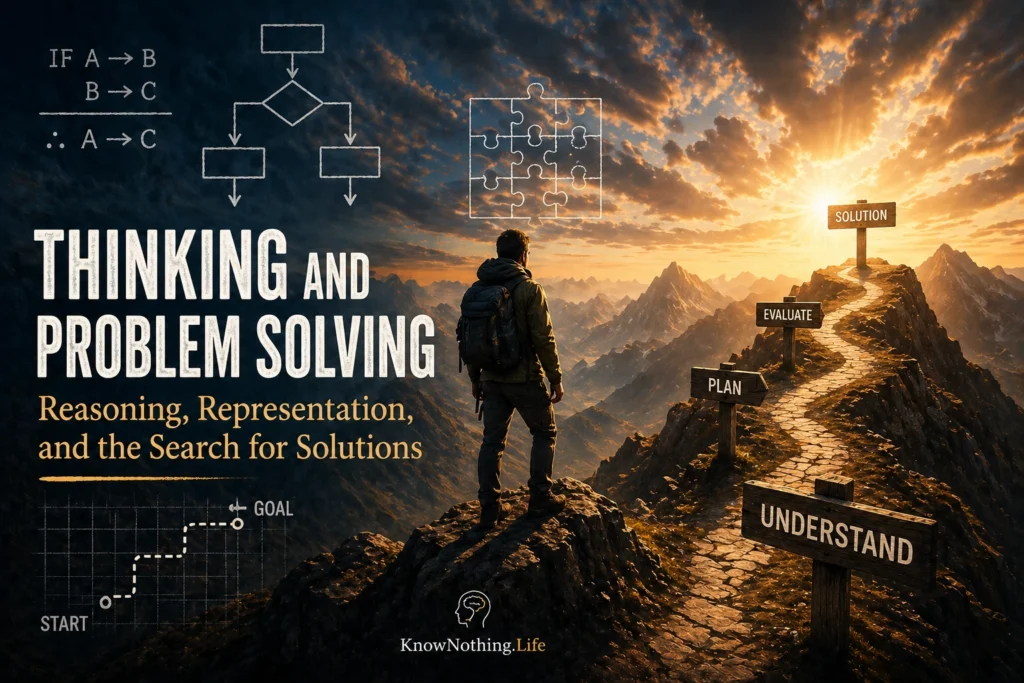
Thinking and problem solving are central processes of human cognition, enabling individuals to interpret information, generate ideas, and navigate challenges. Thinking encompasses a wide range of mental activities, including reasoning, decision-making, and conceptualization, while problem solving refers specifically to the process of identifying, analyzing, and resolving obstacles. Together, these processes allow individuals to move beyond immediate perception, using internal representations to plan, predict, and adapt.
At a fundamental level, thinking involves the manipulation of mental representations—symbols, images, and concepts that stand in for real-world objects and events. These representations allow individuals to simulate possibilities, evaluate alternatives, and construct solutions without direct physical interaction. Problem solving builds on this capacity, requiring the integration of knowledge, strategies, and cognitive control to achieve a desired outcome. The study of thinking and problem solving therefore provides insight into how the mind transforms information into purposeful action.
Historical Foundations and Theoretical Perspectives
The scientific study of thinking and problem solving has evolved through multiple theoretical traditions, each offering distinct insights into how cognitive processes operate. Early behaviorist approaches focused on observable behavior, often neglecting internal mental processes. However, researchers soon recognized that problem solving could not be fully explained without considering the role of cognition.
One influential perspective emerged from Gestalt psychology, associated with figures such as Wolfgang Köhler, who emphasized the role of insight in problem solving. Köhler’s studies with primates demonstrated that solutions could arise suddenly, through a reorganization of the problem rather than gradual trial-and-error. This concept of insight challenged purely associative models and highlighted the importance of perception and structure in thinking.
Later developments in cognitive psychology introduced information-processing models, which conceptualize thinking as a sequence of operations performed on mental representations. These models emphasize the role of memory, attention, and strategy in problem solving. Contemporary approaches integrate these perspectives, recognizing that thinking involves both structured processes and flexible, creative insights.
Mental Representation and Problem Framing
Effective problem solving begins with how a problem is represented. Mental representation refers to the way information about a problem is structured in the mind, including the identification of goals, constraints, and possible actions. The way a problem is framed can significantly influence the strategies used and the likelihood of finding a solution.
Problems can be represented in various forms, such as visual images, verbal descriptions, or abstract symbols. For example, a mathematical problem may be represented as an equation, while a spatial problem may involve mental imagery. The choice of representation can either facilitate or hinder problem solving, depending on how well it captures the essential features of the problem.
Reframing a problem can lead to new insights and solutions. When individuals change their perspective or reinterpret the elements of a problem, they may discover alternative approaches that were previously overlooked. This flexibility highlights the importance of representation in thinking, demonstrating that problem solving is not only about applying strategies but also about understanding the problem itself.
Strategies for Problem Solving
Problem solving involves a variety of strategies that guide the search for solutions. One common approach is the use of algorithms, which are systematic procedures that guarantee a correct solution if followed correctly. Algorithms are effective for well-defined problems, such as mathematical calculations, but they can be time-consuming and impractical for complex or ambiguous tasks.
Heuristics, in contrast, are mental shortcuts that simplify problem solving by reducing the number of possible solutions. While heuristics are efficient and often effective, they do not guarantee accuracy and can lead to errors. Common heuristics include working backward from the goal, breaking a problem into smaller parts, and using analogies to apply known solutions to new situations.
The choice of strategy depends on factors such as the nature of the problem, available knowledge, and cognitive resources. Skilled problem solvers are often able to select and adapt strategies based on the demands of the task. This adaptability reflects the dynamic nature of thinking, where multiple approaches are integrated to achieve a solution.
Insight and Creative Problem Solving
Insight is a form of problem solving characterized by a sudden realization or “aha” moment, where the solution becomes clear after a period of impasse. Unlike analytical approaches, which involve step-by-step reasoning, insight often emerges from a restructuring of the problem. This process may involve breaking away from initial assumptions or recognizing hidden relationships between elements.
Creative problem solving extends beyond insight, involving the generation of novel and useful solutions. Creativity requires the ability to think divergently, exploring multiple possibilities, as well as convergently, selecting the most effective solution. This balance between exploration and evaluation is central to innovation in fields ranging from science to art.
Factors such as prior knowledge, cognitive flexibility, and environmental context influence the likelihood of insight and creativity. Encouraging diverse perspectives and allowing time for incubation can enhance creative problem solving. These processes highlight the importance of both structure and spontaneity in thinking, demonstrating that effective problem solving often involves a combination of analytical and intuitive approaches.
Barriers to Effective Problem Solving
Despite the capacity for flexible thinking, individuals often encounter barriers that hinder problem solving. One common obstacle is functional fixedness, the tendency to view objects or concepts only in their typical roles. This limitation can prevent individuals from considering alternative uses or solutions, restricting creativity and innovation.
Mental set, another barrier, refers to the tendency to approach problems using familiar strategies, even when they are not effective. While prior experience can facilitate problem solving, it can also lead to rigidity, making it difficult to adapt to new situations. Overcoming mental set often requires a willingness to abandon established approaches and explore new possibilities.
Cognitive biases also influence problem solving, leading to systematic errors in judgment and reasoning. For example, confirmation bias can cause individuals to focus on information that supports their existing beliefs while ignoring contradictory evidence. Recognizing and addressing these biases is essential for improving problem-solving performance and achieving more accurate outcomes.
Decision-Making and Reasoning
Thinking and problem solving are closely linked to decision-making and reasoning, processes that involve evaluating options and drawing conclusions. Decision-making requires selecting among alternatives based on criteria such as probability, value, and risk. Reasoning involves the use of logic to derive conclusions from premises, encompassing both deductive and inductive processes.
Research has shown that decision-making is often influenced by heuristics and biases, leading to deviations from rational models. For example, individuals may rely on the availability heuristic, judging the likelihood of events based on how easily examples come to mind. These shortcuts can be useful but may also result in errors, particularly in complex or uncertain situations.
Understanding the interplay between reasoning and decision-making provides insight into how individuals navigate uncertainty and make choices. It highlights the balance between efficiency and accuracy in cognitive processes, illustrating the challenges of making informed decisions in a complex world.
Neural Basis of Thinking and Problem Solving
The neural mechanisms underlying thinking and problem solving involve a network of brain regions that support cognitive control, memory, and integration. The prefrontal cortex plays a central role, enabling planning, decision-making, and the regulation of behavior. This region is associated with executive functions, which coordinate the various components of thinking.
Other areas, such as the parietal cortex and temporal lobes, contribute to specific aspects of problem solving, including spatial processing and the retrieval of knowledge. These regions interact within a distributed network, allowing for the integration of information across domains. This coordination is essential for complex tasks that require multiple cognitive processes.
Neuroscientific research has also explored the role of neural dynamics in insight and creativity, identifying patterns of brain activity associated with sudden problem resolution. These findings provide a biological basis for cognitive processes, linking mental activity to underlying neural mechanisms and enhancing our understanding of how thinking occurs.
Applications and Future Directions
The study of thinking and problem solving has wide-ranging applications across education, business, and technology. In educational settings, teaching strategies that promote critical thinking and problem-solving skills are essential for preparing individuals to cope with complex challenges. Techniques such as collaborative learning, inquiry-based instruction, and metacognitive training can enhance these abilities.
In professional contexts, effective problem solving is critical for innovation and decision-making. Organizations often seek to foster environments that encourage creativity and adaptability, recognizing the value of diverse perspectives and flexible thinking. Understanding cognitive processes can inform the design of systems and tools that support these goals.
Future research in thinking and problem solving is likely to focus on integrating cognitive, neural, and computational approaches. Advances in artificial intelligence are providing new models for understanding human cognition, while interdisciplinary research is exploring the interaction between thinking and other processes such as emotion and social context. As the field continues to evolve, it will deepen our understanding of how the mind navigates complexity and generates solutions.
Conclusion: The Architecture of Thought and Action
Thinking and problem solving are central to human cognition, enabling individuals to interpret information, generate ideas, and overcome challenges. Through the manipulation of mental representations, the application of strategies, and the integration of knowledge, the mind transforms information into purposeful action. These processes reflect both the strengths and limitations of cognition, balancing efficiency with accuracy and structure with flexibility.
By studying thinking and problem solving, cognitive psychology provides valuable insights into how individuals navigate the complexities of the world. These insights have practical implications for education, decision-making, and innovation, offering tools for enhancing cognitive performance. As research continues to advance, understanding the mechanisms of thought will remain essential for unlocking human potential.