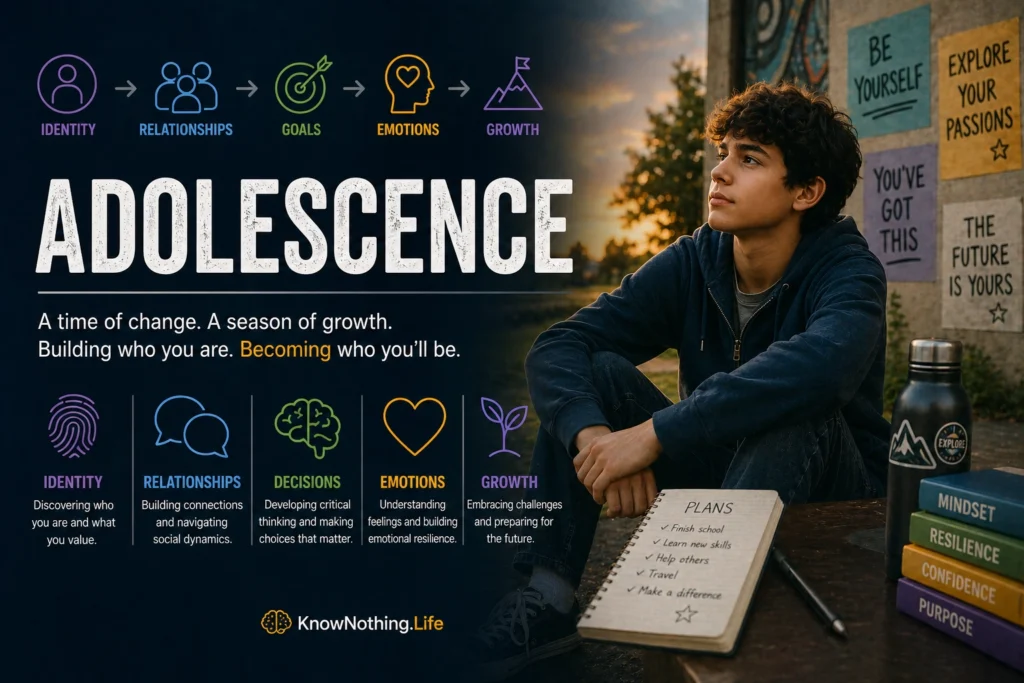
Adolescence is a transitional stage of development that bridges childhood and adulthood, typically spanning the teenage years into the early twenties. It is a period marked by rapid physical growth, expanding cognitive capacity, and profound social and emotional change. During this time, individuals begin to form a more defined sense of identity, navigate increasingly complex relationships, and develop the skills necessary for independent life. While often associated with instability or conflict, adolescence is better understood as a period of exploration, adaptation, and transformation.
What makes adolescence especially significant is its role in shaping long-term trajectories. The decisions, experiences, and relationships formed during this stage can influence future education, career paths, mental health, and social functioning. At the same time, adolescence is characterized by heightened plasticity, meaning that individuals are particularly responsive to both positive and negative influences. This combination of vulnerability and opportunity makes it a critical period for development.
Biological Changes and Puberty
One of the most visible aspects of adolescence is the onset of puberty, a series of biological changes that lead to physical maturation and reproductive capability. These changes are driven by hormonal activity, particularly the release of sex hormones such as estrogen and testosterone. Puberty involves growth spurts, changes in body composition, and the development of secondary sexual characteristics, all of which contribute to the transformation from child to adult.
The timing of puberty can vary significantly among individuals, influenced by genetic, nutritional, and environmental factors. Early or late maturation can have important psychological and social implications, affecting self-esteem, peer relationships, and behavior. Adolescents who mature earlier or later than their peers may experience challenges in adjusting to these differences, highlighting the interaction between biological development and social context.
Beyond physical changes, puberty also influences brain development. Hormonal shifts interact with neural processes, contributing to changes in mood, motivation, and behavior. These biological transformations are not isolated; they interact with cognitive and social changes, shaping the overall experience of adolescence.
Brain Development and Risk-Taking
Adolescent brain development is characterized by significant changes in structure and function, particularly in areas related to decision-making, emotion regulation, and reward processing. The prefrontal cortex, responsible for planning, impulse control, and reasoning, continues to develop well into early adulthood. In contrast, the limbic system, which is associated with emotion and reward, becomes highly active during adolescence.
This imbalance between cognitive control and emotional reactivity helps explain why adolescents may engage in risk-taking behaviors. The heightened sensitivity to rewards and social stimuli can lead to increased exploration and experimentation. While this can result in risky behaviors, it also plays an important role in learning and adaptation, allowing adolescents to gain experience and develop independence.
Research by Laurence Steinberg has highlighted the role of social context in adolescent decision-making. His work suggests that peer presence can amplify risk-taking tendencies, as adolescents are particularly sensitive to social evaluation. Understanding these dynamics provides insight into the complex interplay between brain development, behavior, and environment during this stage.
Cognitive Development and Abstract Thinking
Cognitive development during adolescence involves the transition to more advanced forms of reasoning. Building on earlier stages of development, adolescents begin to engage in abstract thinking, allowing them to consider hypothetical situations, analyze complex problems, and reflect on their own thought processes. This capacity for metacognition—thinking about thinking—enables greater self-awareness and critical reflection.
The emergence of abstract reasoning is often associated with the formal operational stage described by Jean Piaget. During this stage, individuals can think systematically, consider multiple perspectives, and engage in scientific reasoning. These abilities support academic learning and problem-solving, as well as the development of personal beliefs and values.
However, cognitive development in adolescence is not uniform. While many individuals demonstrate advanced reasoning in certain contexts, they may still rely on more concrete thinking in others. This variability reflects the ongoing nature of development and the influence of experience, education, and social context. Cognitive growth during adolescence is therefore both a continuation of earlier development and a foundation for adult thinking.
Identity Formation
One of the central tasks of adolescence is the development of identity—the sense of who one is and how one fits into the world. This process involves exploring different roles, values, and beliefs, as individuals seek to establish a coherent and stable sense of self. Identity formation is influenced by personal experiences, social relationships, and cultural context, making it a complex and dynamic process.
The work of Erik Erikson provides a framework for understanding this process. Erikson described adolescence as a stage of “identity versus role confusion,” in which individuals must integrate different aspects of themselves into a unified identity. Successful resolution of this stage leads to a strong sense of self, while difficulties can result in uncertainty and confusion.
Identity formation is not limited to personal characteristics; it also involves social and cultural dimensions. Adolescents may explore aspects of identity related to gender, ethnicity, religion, and career aspirations. This exploration is often accompanied by experimentation and change, reflecting the search for meaning and belonging. The development of identity during adolescence has lasting implications for future relationships, goals, and well-being.
Social Relationships and Peer Influence
Social relationships undergo significant transformation during adolescence. While family remains important, peers become increasingly influential, providing opportunities for social interaction, support, and identity exploration. Friendships during this stage tend to become more intimate and complex, involving shared experiences, emotional connection, and mutual understanding.
Peer influence can have both positive and negative effects. On one hand, supportive peer relationships can enhance self-esteem, encourage prosocial behavior, and provide a sense of belonging. On the other hand, peer pressure can lead to risky behaviors, particularly in contexts where conformity is valued. Adolescents’ sensitivity to social evaluation makes them particularly responsive to peer dynamics, shaping their behavior and decision-making.
Family relationships also evolve during adolescence, often involving a shift toward greater autonomy. While conflicts may arise as adolescents seek independence, supportive family environments remain crucial for healthy development. Open communication, guidance, and emotional support help adolescents navigate the challenges of this stage, balancing independence with connection.
Emotional Development and Mental Health
Adolescence is a period of heightened emotional intensity, as individuals experience a wide range of feelings and develop the capacity to understand and regulate them. Emotional development involves learning to identify, express, and manage emotions, as well as to empathize with others. These skills are essential for building relationships and coping with challenges.
The interplay between biological changes, cognitive development, and social context can contribute to emotional variability during adolescence. Hormonal fluctuations, evolving self-concept, and social pressures can all influence mood and behavior. While these changes are a normal part of development, they can also increase vulnerability to mental health challenges such as anxiety and depression.
Supporting emotional development during adolescence involves providing stable environments, encouraging open communication, and promoting coping strategies. Schools, families, and communities play important roles in fostering resilience and well-being. By addressing emotional needs and providing appropriate support, it is possible to help adolescents navigate this stage successfully.
Cultural and Environmental Influences
Adolescence does not occur in a vacuum; it is shaped by cultural, social, and environmental factors that influence development. Cultural norms and expectations define the roles and responsibilities associated with adolescence, affecting how individuals experience this stage. In some cultures, adolescence is marked by formal rites of passage, while in others it is a more gradual transition.
Socioeconomic conditions also play a significant role, influencing access to education, healthcare, and opportunities for growth. Adolescents in different environments may face varying challenges and resources, shaping their developmental trajectories. For example, access to supportive educational systems can enhance cognitive and social development, while adverse conditions may create barriers to growth.
The influence of media and technology has become increasingly significant in modern adolescence. Digital environments provide new opportunities for communication and learning, but they also introduce challenges related to social comparison, privacy, and mental health. Understanding these influences is essential for addressing the complexities of adolescence in contemporary society.
Conclusion
Adolescence is a complex and transformative stage of development, characterized by significant changes in physical, cognitive, emotional, and social domains. It represents a period of both challenge and opportunity, as individuals navigate the transition from childhood to adulthood and begin to establish their identities and independence. The interplay of biological processes, cognitive growth, and social influences shapes the experience of adolescence, creating diverse pathways of development.
By studying adolescence, developmental psychology provides valuable insights into the processes that shape human behavior and well-being. Understanding this stage allows for the development of strategies to support healthy growth, address challenges, and foster resilience. Ultimately, adolescence is not merely a transitional phase but a critical period that lays the foundation for adult life, highlighting the importance of guidance, support, and opportunity during these formative years.