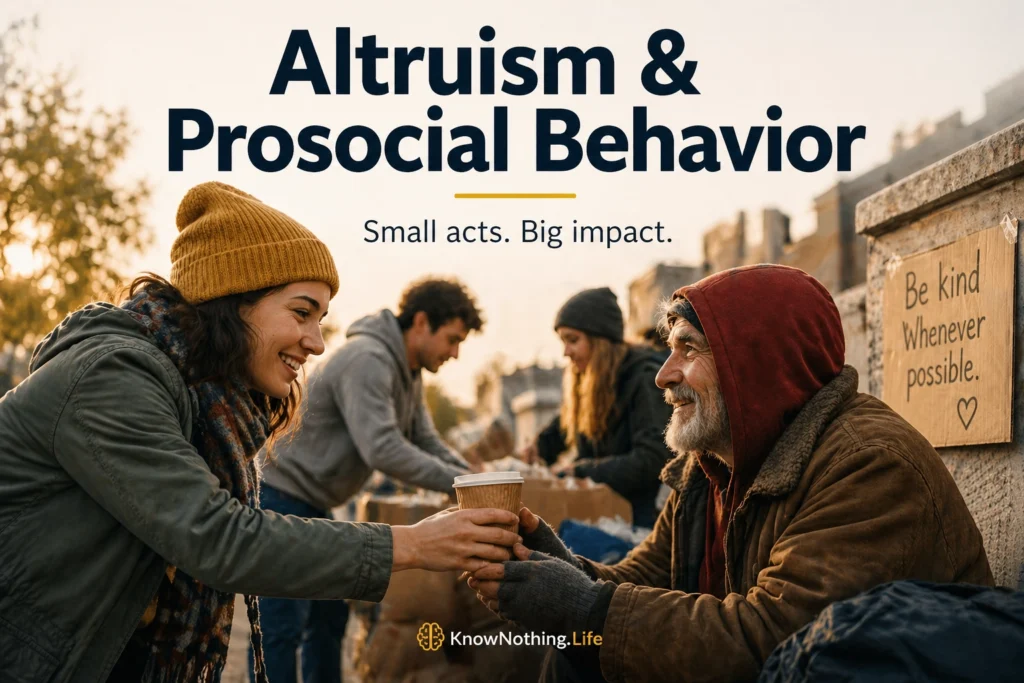
Altruism and prosocial behavior occupy a central place in the study of human nature, raising enduring questions about whether people are fundamentally self-interested or capable of genuine concern for others. Altruism is typically defined as behavior intended to benefit another individual, even at a cost to oneself, while prosocial behavior encompasses a broader range of actions that promote the welfare of others, including cooperation, sharing, and helping. These behaviors are visible across cultures and contexts—from small acts of kindness to large-scale humanitarian efforts—suggesting that the impulse to assist others is deeply embedded in human life.
Philosophers and psychologists alike have grappled with the motivations behind such behavior. Auguste Comte, who coined the term “altruism,” framed it as a moral obligation to live for others rather than oneself. In contrast, later thinkers questioned whether true selflessness is possible. The tension between egoism and altruism continues to define the field, with empirical research seeking to determine whether helping behavior is driven by empathy, social norms, evolutionary pressures, or hidden self-interest. Understanding altruism is not merely an academic exercise; it offers insight into cooperation, morality, and the foundations of social life.
Theoretical Foundations of Altruism
One of the most influential psychological explanations of altruism is the empathy-altruism hypothesis proposed by C. Daniel Batson. In his work The Altruism Question: Toward a Social-Psychological Answer, Batson argued that empathic concern for another person can produce genuinely selfless motivation to help. According to this view, when individuals feel compassion or sympathy, they are motivated to improve the other person’s well-being, even if no external rewards are present. Batson’s experiments demonstrated that participants often chose to help others even when escape from the situation was easy, suggesting that empathy can override self-interest.
In contrast, social exchange theory offers a more skeptical perspective. Drawing on the work of George Homans, this approach suggests that helping behavior is guided by a cost-benefit analysis, where individuals seek to maximize rewards such as social approval, reduced guilt, or reciprocal assistance. From this standpoint, even seemingly selfless acts may be motivated by anticipated psychological or social gains. The idea that “we help because it feels good” challenges the notion of pure altruism while still acknowledging the importance of prosocial actions.
A third perspective comes from evolutionary psychology, particularly the concept of kin selection introduced by William D. Hamilton. Hamilton’s theory posits that individuals are more likely to help relatives because doing so increases the survival of shared genes. This idea is captured in the notion of “inclusive fitness,” which extends the concept of survival beyond the individual to include genetic relatives. While this explanation accounts for many forms of altruism in both humans and animals, it does not fully explain why individuals sometimes help strangers, prompting further exploration into additional mechanisms.
Prosocial Behavior and Social Norms
Prosocial behavior is strongly shaped by social norms that define expectations for helping others. One such norm is the reciprocity norm, which suggests that individuals should return favors and kindnesses received from others. This principle fosters cooperation and mutual support, creating a stable social environment in which individuals can rely on one another. The norm of social responsibility, on the other hand, emphasizes an obligation to help those who are dependent or in need, regardless of potential personal gain.
The influence of norms is evident in everyday behavior, as people often feel compelled to assist others even when it is inconvenient. Robert Cialdini, in his work Influence: The Psychology of Persuasion, highlighted how social expectations and perceived obligations shape decision-making. Cialdini noted that individuals are particularly sensitive to cues about what others consider appropriate behavior, leading them to conform to prosocial norms even in ambiguous situations.
Cultural differences further complicate the picture, as norms vary across societies. In collectivist cultures, prosocial behavior is often directed toward in-group members and emphasizes harmony and interdependence. In individualistic cultures, helping behavior may be more selective and influenced by personal choice. Despite these variations, the presence of prosocial norms across cultures suggests that helping behavior is a fundamental aspect of human social organization.
The Bystander Effect and Situational Influences
While individuals are often willing to help others, situational factors can significantly influence whether prosocial behavior occurs. One of the most well-documented phenomena in this area is the bystander effect, first studied by John Darley and Bibb Latané. In their classic experiments, Darley and Latané found that individuals were less likely to help a person in distress when other people were present. This counterintuitive finding challenged the assumption that more witnesses would increase the likelihood of assistance.
The bystander effect is often explained through processes such as diffusion of responsibility, where individuals assume that someone else will intervene, and pluralistic ignorance, where people look to others for cues about how to respond. If no one else appears concerned, individuals may interpret the situation as non-emergency, even when help is needed. These mechanisms highlight the importance of context in shaping behavior, demonstrating that prosocial tendencies can be suppressed under certain conditions.
Subsequent research has explored ways to overcome the bystander effect, emphasizing the role of awareness and individual responsibility. When individuals are directly addressed or feel personally accountable, they are more likely to act. This insight has practical implications for emergency response, public safety campaigns, and efforts to encourage civic engagement.
Empathy, Emotion, and Moral Development
Empathy plays a central role in motivating prosocial behavior, serving as a bridge between emotional experience and action. The ability to understand and share the feelings of others allows individuals to recognize suffering and respond with care. Martin Hoffman, in Empathy and Moral Development, argued that empathy is a foundational component of moral reasoning, guiding individuals toward actions that alleviate distress.
Emotional processes such as guilt and compassion also contribute to helping behavior. Guilt, for example, can motivate individuals to repair harm or assist others as a way of restoring moral balance. Compassion, on the other hand, reflects a genuine concern for others’ well-being and often leads to sustained prosocial engagement. These emotions interact with cognitive processes, shaping how individuals interpret situations and decide whether to help.
Moral development further influences prosocial behavior, as individuals acquire values and principles that guide their actions. Lawrence Kohlberg proposed a stage-based theory in which moral reasoning evolves from self-interest to adherence to social norms and, ultimately, to abstract principles of justice. While Kohlberg’s model has been subject to critique, it underscores the idea that prosocial behavior is not only emotional but also deeply tied to cognitive and moral frameworks.
Altruism in Everyday Life and Society
Altruism and prosocial behavior manifest in countless ways in everyday life, from helping a stranger carry groceries to volunteering in community organizations. These actions contribute to social cohesion, fostering trust and cooperation among individuals. At a societal level, prosocial behavior underpins institutions such as charity, healthcare, and education, reflecting a collective commitment to the well-being of others.
Large-scale acts of altruism, such as disaster relief and humanitarian aid, highlight the capacity for individuals and groups to respond to suffering beyond their immediate circles. Peter Singer, in The Life You Can Save, argued that individuals in affluent societies have a moral obligation to assist those in extreme poverty. Singer’s perspective challenges traditional boundaries of moral responsibility, extending the scope of altruism to a global scale.
At the same time, everyday prosocial behavior often goes unnoticed, embedded in routine interactions and social expectations. Small acts of kindness, though seemingly insignificant, accumulate to create environments of support and cooperation. As Adam Smith observed in The Theory of Moral Sentiments, human beings possess an innate capacity for sympathy, allowing them to “enter into” the experiences of others. This capacity forms the basis of moral life and social harmony.
Conclusion
Altruism and prosocial behavior reveal the complex interplay between emotion, cognition, social norms, and evolutionary forces in shaping human action. While debates about the purity of altruistic motives continue, the evidence suggests that individuals are capable of genuine concern for others, driven by empathy, moral values, and social expectations. Theories from Batson, Hamilton, and Cialdini provide valuable frameworks for understanding these behaviors, while research on situational influences highlights the conditions under which helping is more or less likely to occur.
Ultimately, the study of altruism challenges simplistic views of human nature, demonstrating that self-interest and concern for others are not mutually exclusive but often intertwined. Prosocial behavior, whether motivated by empathy, obligation, or shared identity, plays a vital role in sustaining social life. In a world marked by both conflict and cooperation, the capacity for altruism remains one of the most powerful forces shaping human relationships and collective well-being.