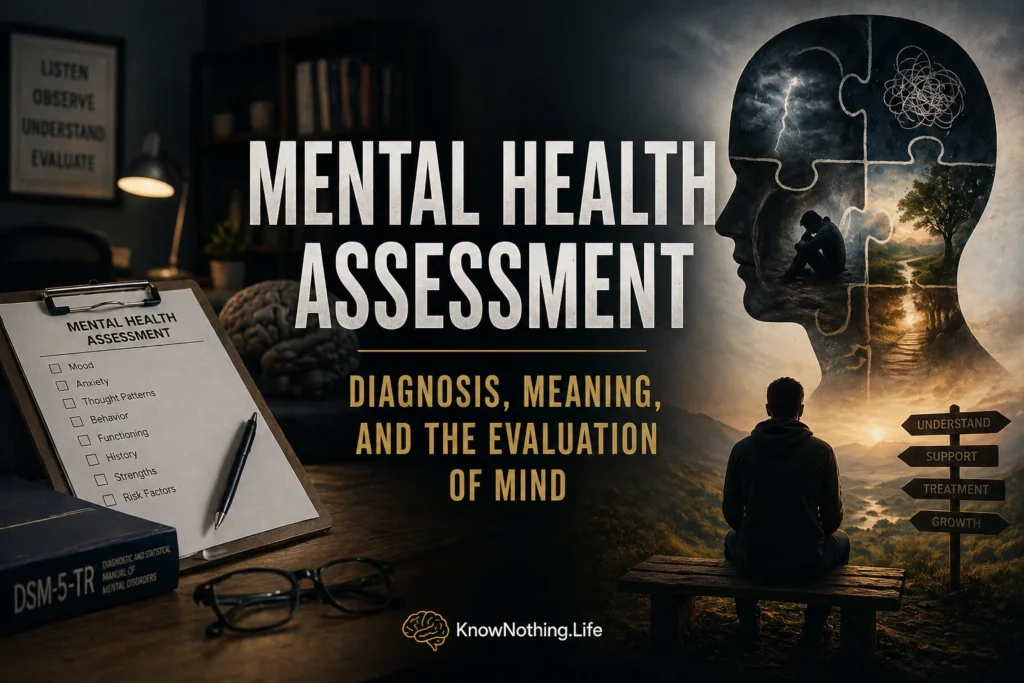
Mental health assessment is the foundation of psychological and psychiatric practice. It is the process through which clinicians gather, interpret, and organize information about an individual’s thoughts, emotions, behaviors, and functioning in order to understand their condition and guide treatment. Far from being a purely technical exercise, assessment involves judgment, interpretation, and the integration of multiple perspectives, making it both a scientific and deeply human endeavor.
The importance of careful assessment has been emphasized throughout the history of psychiatry. Emil Kraepelin, one of the pioneers of modern diagnostic classification, sought to bring order to the study of mental disorders by identifying patterns of symptoms and course over time. His work laid the groundwork for contemporary diagnostic systems, but it also highlighted a central challenge: mental health cannot be measured as directly as physical health, requiring interpretation of subjective experience. As clinician and scholar Nancy McWilliams later noted in Psychoanalytic Diagnosis, “Diagnosis is not simply about labeling; it is about understanding the person.”
Historical Development of Assessment
The evolution of mental health assessment reflects broader changes in how the mind has been understood. Early approaches were often descriptive and observational, relying on clinical judgment without standardized criteria. In the late 19th and early 20th centuries, figures like Kraepelin began to systematize diagnosis, emphasizing patterns of symptoms and longitudinal course as a way of distinguishing disorders.
The development of standardized diagnostic manuals marked a significant shift toward greater consistency. The Diagnostic and Statistical Manual of Mental Disorders (DSM), first published by the American Psychiatric Association, provided a structured framework for classification, allowing clinicians to communicate more reliably about diagnoses. Similarly, the International Classification of Diseases (ICD), developed by the World Health Organization, offered a global standard for mental and physical health conditions.
Despite these advances, debates about the nature of diagnosis have persisted. Critics argue that categorical systems may oversimplify the complexity of mental health, reducing dynamic and individualized experiences to fixed labels. Philosopher and psychiatrist Karl Jaspers, in General Psychopathology, warned that classification must not replace understanding, emphasizing that the clinician’s task is to grasp the meaning of symptoms within the context of the individual’s life.
Core Components of Assessment
A comprehensive mental health assessment typically includes several key components, each contributing to a holistic understanding of the individual. The clinical interview is central, providing an opportunity to gather detailed information about the person’s history, current symptoms, and subjective experience. This process often involves exploring mood, thought patterns, behavior, relationships, and functioning across different areas of life.
Observation is another critical element. Clinicians attend not only to what is said but how it is expressed—tone of voice, body language, and emotional responsiveness. These observations can reveal discrepancies between reported experience and outward presentation, offering additional insight into the individual’s condition. Mental status examination (MSE), a structured method of observing cognitive and emotional functioning, is often used to assess aspects such as orientation, memory, attention, and thought processes.
Standardized assessments and psychological tests may also be employed to provide objective data. These can include personality inventories, cognitive assessments, and symptom checklists. While such tools enhance reliability, they must be interpreted within the broader clinical context. As Paul Meehl argued in his work on clinical versus statistical prediction, structured methods can improve accuracy, but they cannot replace the nuanced understanding that emerges from clinical experience.
Diagnostic Frameworks and Classification
Diagnosis is a central outcome of mental health assessment, serving as a guide for treatment and communication. The DSM and ICD systems classify disorders based on clusters of symptoms, duration, and functional impairment. These frameworks aim to provide clear criteria, reducing variability in diagnosis across clinicians and settings.
However, diagnosis is not without controversy. Some critics argue that categorical systems impose artificial boundaries on conditions that exist along a continuum. For example, anxiety and depression often overlap, challenging the notion of discrete disorders. Dimensional approaches, which assess symptoms along a spectrum, have been proposed as alternatives that may better capture the complexity of mental health.
Thomas Szasz famously critiqued the concept of mental illness itself in The Myth of Mental Illness, arguing that psychiatric diagnoses can function as social labels rather than medical conditions. While his views are widely debated, they highlight the ethical and conceptual challenges involved in diagnosis. Assessment must therefore balance the need for classification with sensitivity to individual experience and context.
Cultural and Contextual Considerations
Mental health assessment is deeply influenced by cultural and social factors. Symptoms may be expressed differently across cultures, and what is considered pathological in one context may be normative in another. For example, experiences that might be labeled as hallucinations in one culture could be interpreted as spiritual or religious phenomena in another.
Culturally competent assessment requires awareness of these differences and an ability to adapt methods accordingly. Clinicians must consider language, beliefs, and social norms when interpreting symptoms, avoiding assumptions based on their own cultural framework. The DSM itself has incorporated cultural formulation guidelines to address these issues, emphasizing the importance of context in understanding mental health.
Anthropologist Arthur Kleinman has been a leading voice in this area, arguing that “illness is what the patient feels when he goes to the doctor, disease is what he has on the way home.” This distinction underscores the gap between clinical categories and lived experience, highlighting the need for assessment to bridge both perspectives.
Ethical Dimensions of Assessment
Mental health assessment carries significant ethical responsibilities. Diagnoses can influence treatment decisions, access to services, and even legal outcomes, making accuracy and fairness essential. Issues of confidentiality, informed consent, and respect for autonomy are central to ethical practice.
One ethical challenge involves the potential for bias. Clinicians must be aware of how their own assumptions and expectations may influence their interpretations. Research has shown that factors such as race, gender, and socioeconomic status can affect diagnostic outcomes, raising concerns about equity and justice in mental health care.
Another issue is the potential impact of labeling. While diagnosis can provide clarity and access to treatment, it can also lead to stigma and self-identification with illness. As Erving Goffman argued in Stigma: Notes on the Management of Spoiled Identity, labels can shape how individuals are perceived and how they perceive themselves. Ethical assessment therefore requires careful consideration of both the benefits and consequences of diagnosis.
Contemporary Developments
Advances in technology and research are reshaping mental health assessment. Digital tools, including mobile applications and wearable devices, allow for real-time monitoring of mood, behavior, and physiological states. These innovations provide new sources of data, offering a more dynamic and continuous view of mental health.
Neuroscience has also contributed to the development of biomarkers and imaging techniques that may eventually complement traditional assessment methods. While these approaches hold promise, they are not yet sufficient to replace clinical evaluation, as mental health remains deeply tied to subjective experience and context.
There is also growing interest in transdiagnostic approaches, which focus on underlying processes—such as emotion regulation or cognitive biases—rather than specific diagnostic categories. This shift reflects a broader trend toward integration, recognizing that many mental health conditions share common mechanisms.
Conclusion
Mental health assessment is a complex and evolving practice that lies at the heart of psychological care. It involves not only the identification of symptoms but the interpretation of meaning, context, and experience. By integrating clinical observation, standardized tools, and theoretical frameworks, assessment seeks to provide a comprehensive understanding of the individual.
At its best, mental health assessment goes beyond diagnosis to capture the richness of human experience, guiding treatment while respecting individuality. As the field continues to evolve, balancing scientific rigor with empathy and cultural awareness will remain essential. In doing so, assessment becomes not merely a tool for classification, but a pathway to understanding and care.