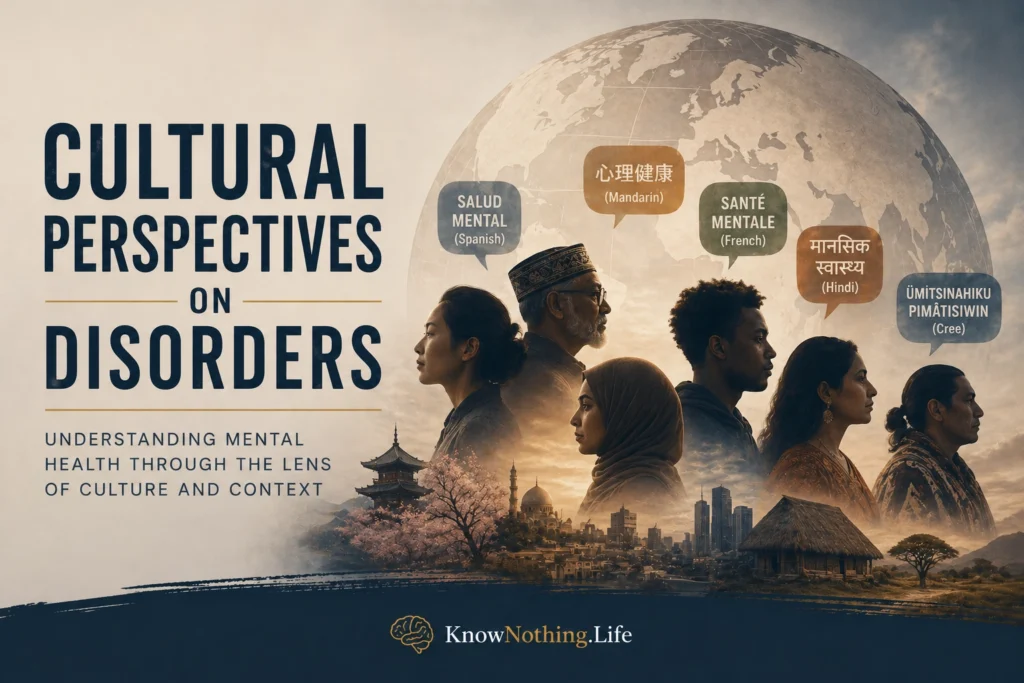
Cultural perspectives on psychological disorders challenge the assumption that mental illness can be fully understood through universal, context-free categories. While biological and psychological processes are essential, they are always interpreted through cultural frameworks that shape how distress is experienced, expressed, and treated. What counts as “normal” or “abnormal” behavior is not fixed but negotiated within systems of meaning, values, and social expectations. As a result, disorders cannot be understood solely as internal dysfunctions; they are also cultural phenomena that reflect the norms and structures of the societies in which they appear.
This shift in perspective gained prominence through the work of scholars such as Arthur Kleinman, who argued in Rethinking Psychiatry that mental illness must be understood within “local moral worlds.” Kleinman emphasized that symptoms are not merely biological signals but culturally mediated expressions of suffering. Similarly, Clifford Geertz described culture as “webs of significance” through which individuals interpret their experiences. Together, these thinkers highlight a central insight: psychological disorders are not just conditions to be diagnosed but meanings to be interpreted within cultural contexts.
Culture and the Definition of Disorder
One of the most fundamental ways culture shapes mental health is through defining what counts as a disorder. Diagnostic systems such as the DSM attempt to establish standardized criteria, but these criteria are influenced by cultural assumptions about behavior, emotion, and functioning. Behaviors considered pathological in one culture may be acceptable or even valued in another. For example, intense spiritual experiences, visions, or trance states may be interpreted as symptoms of psychosis in some contexts, while in others they are recognized as signs of religious or spiritual significance.
The relativity of disorder raises important questions about the universality of psychiatric categories. Thomas Szasz famously argued in The Myth of Mental Illness that many diagnoses reflect social judgments rather than objective medical conditions. While his position is controversial, it underscores the role of cultural norms in shaping what is labeled as abnormal. Even within contemporary psychiatry, there is growing recognition that diagnostic categories must be applied with cultural sensitivity to avoid misinterpretation and overpathologizing.
At the same time, cross-cultural research suggests that some patterns of disorder appear consistently across societies, such as major depression or schizophrenia. However, even these conditions manifest differently depending on cultural context. The challenge, therefore, is not to choose between universalism and relativism but to understand how universal vulnerabilities are expressed through culturally specific forms. This balanced perspective allows for both scientific rigor and cultural awareness in the study of mental health.
Cultural Expression of Symptoms
Culture not only defines disorders but also shapes how symptoms are experienced and communicated. Emotional distress is often expressed in culturally patterned ways, influencing whether individuals report psychological, physical, or behavioral symptoms. In many non-Western cultures, for example, psychological distress is more likely to be expressed through somatic complaints such as headaches, fatigue, or gastrointestinal problems. This phenomenon reflects cultural norms about the acceptability of emotional expression and the language available to describe inner experiences.
The concept of “idioms of distress,” developed by Mark Nichter, captures this idea. Idioms of distress are culturally specific ways of expressing and interpreting suffering. They provide a framework through which individuals communicate their experiences to others, often in ways that are socially recognizable and meaningful. For instance, conditions such as “ataque de nervios” in Latin American cultures or “kufungisisa” (“thinking too much”) in parts of Africa illustrate how distress can be embedded in cultural narratives that differ from Western diagnostic categories.
These variations have important implications for diagnosis and treatment. Clinicians who are unfamiliar with cultural expressions of distress may misinterpret symptoms or overlook underlying issues. This highlights the importance of cultural competence in mental health care. As Kleinman noted, “Patients and healers operate with different explanatory models,” and effective treatment requires bridging these perspectives. Understanding how culture shapes symptom expression allows for more accurate assessment and more responsive care.
Culture-Bound Syndromes
One of the most striking examples of cultural influence on mental health is the existence of culture-bound syndromes—patterns of symptoms that are specific to particular cultural contexts. These syndromes illustrate how cultural beliefs and practices can shape not only the expression of distress but also its form and meaning. Examples include “amok” in Southeast Asia, characterized by sudden outbursts of aggression, and “hikikomori” in Japan, involving extreme social withdrawal.
Culture-bound syndromes challenge the universality of Western diagnostic frameworks by demonstrating that not all forms of distress fit neatly into existing categories. They also highlight the role of cultural narratives in shaping behavior. For instance, “koro,” a syndrome involving the fear that one’s genitals are retracting into the body, reflects cultural beliefs about sexuality and bodily integrity. These conditions are not simply individual pathologies but are embedded in shared systems of meaning.
The recognition of culture-bound syndromes has led to greater inclusion of cultural context in diagnostic manuals. The DSM-5, for example, includes a section on “cultural concepts of distress,” acknowledging that mental health cannot be fully understood without considering cultural variation. This shift represents a move toward a more inclusive and globally relevant understanding of psychological disorders.
Cultural Influences on Treatment
Culture plays a critical role not only in the experience of disorder but also in approaches to treatment. Different cultures have distinct beliefs about the causes of mental illness and the appropriate methods of healing. In some societies, mental health issues are understood in spiritual or supernatural terms, leading individuals to seek help from religious leaders, shamans, or traditional healers. In others, biomedical approaches dominate, emphasizing medication and psychotherapy.
These differences are not merely theoretical; they shape real-world treatment choices and outcomes. Jerome Frank, in Persuasion and Healing, argued that all forms of therapy share common elements, including the provision of meaning, hope, and a supportive relationship. This suggests that effective treatment depends not only on specific techniques but also on their cultural resonance. A therapy that aligns with a patient’s beliefs is more likely to be accepted and effective.
Cultural competence in mental health care involves recognizing and respecting these differences. It requires clinicians to adapt their approaches to fit the cultural context of their patients, rather than imposing a one-size-fits-all model. This may involve integrating traditional practices with modern therapies or collaborating with community leaders to provide culturally appropriate care. Such approaches not only improve outcomes but also promote trust and engagement in treatment.
Globalization and Changing Perspectives
In an increasingly interconnected world, cultural perspectives on disorders are evolving. Globalization has facilitated the spread of Western psychiatric models, leading to greater standardization in diagnosis and treatment. At the same time, it has raised concerns about the potential loss of cultural diversity in understanding mental health. Critics argue that the global dominance of Western frameworks may overshadow local knowledge and practices, leading to a form of “cultural homogenization.”
Scholars such as Allan Young have examined how global mental health initiatives can both help and hinder cultural understanding. While these initiatives aim to expand access to care, they may also impose categories that do not fully capture local experiences. This tension highlights the need for a more pluralistic approach that respects cultural diversity while addressing universal aspects of mental health.
At the same time, globalization has created new forms of stress and identity challenges, contributing to emerging patterns of disorder. Rapid social change, migration, and technological shifts can disrupt traditional support systems and create new sources of anxiety and uncertainty. Understanding these dynamics requires a cultural perspective that is both locally grounded and globally informed.
Conclusion
Cultural perspectives on disorders reveal that mental health is not merely a biological or psychological phenomenon but a deeply contextual one. Culture shapes how disorders are defined, experienced, expressed, and treated, influencing every stage of the mental health process. By examining these influences, psychology moves beyond narrow models to embrace a more holistic understanding of human behavior.
The integration of cultural perspectives does not undermine the scientific study of mental health; rather, it enriches it by acknowledging the diversity of human experience. As the field continues to evolve, the challenge will be to balance universal knowledge with cultural specificity, ensuring that mental health care is both effective and respectful of the contexts in which it is delivered. In this sense, cultural perspectives are not peripheral but central to understanding disorders, offering insights that are essential for both theory and practice.