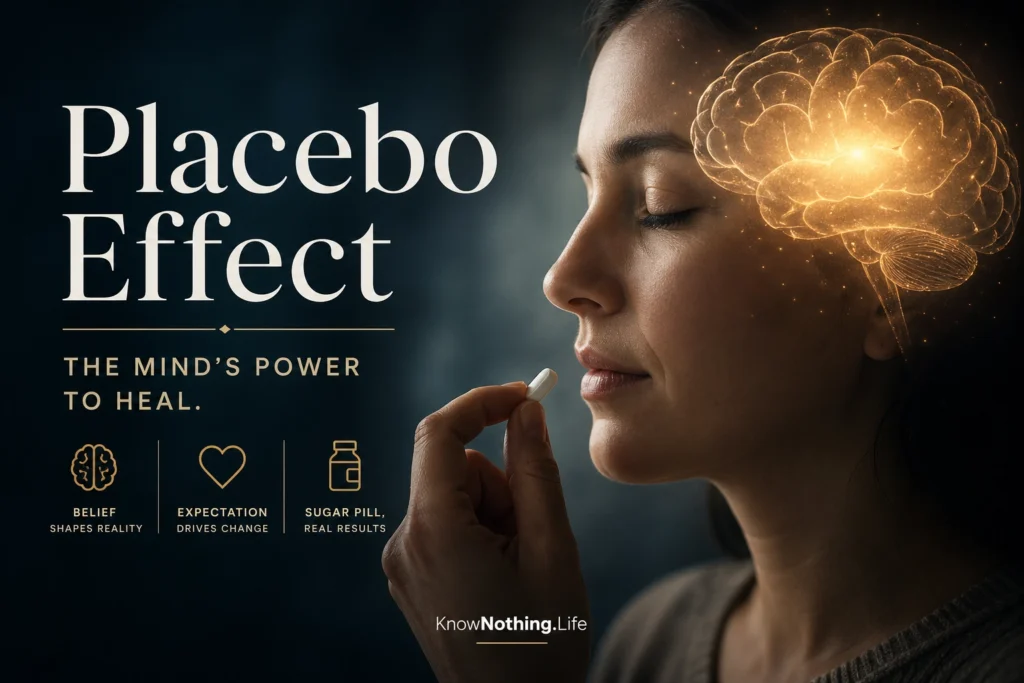
The placebo effect is one of the most intriguing and revealing phenomena in medicine and psychology, demonstrating that belief, expectation, and context can produce measurable physiological changes. Traditionally defined as a beneficial response to an inert treatment, the placebo effect challenges the assumption that healing must always come from active pharmacological or surgical interventions. Instead, it reveals that the mind plays a powerful role in shaping bodily outcomes, influencing pain perception, immune function, and even neurological activity.
Historically, placebos were often dismissed as nuisances in clinical trials—effects to be controlled for rather than understood. However, research over the past several decades has transformed this perspective, showing that placebo responses are not merely “all in the mind” but are rooted in identifiable biological processes. As physician and researcher Ted Kaptchuk has argued, “Placebo effects are genuine psychobiological events,” emphasizing that they arise from the brain’s capacity to translate expectation into physiological change. This shift has elevated the placebo effect from a methodological concern to a central topic in the study of mind-body interaction.
Historical Foundations and Conceptual Evolution
The use of placebos dates back centuries, long before modern scientific frameworks were established. In early medical practice, treatments often relied on ritual, symbolism, and patient belief, all of which could produce therapeutic effects independent of the treatment’s active ingredients. The term “placebo,” derived from the Latin meaning “I shall please,” initially referred to treatments given more to satisfy patients than to cure them. Over time, as medicine became more evidence-based, the placebo effect was reframed as a confounding factor in clinical research.
The modern scientific study of the placebo effect began in earnest with the work of Henry K. Beecher, whose 1955 paper “The Powerful Placebo” argued that a significant portion of therapeutic outcomes could be attributed to placebo responses. Beecher’s work highlighted the need for controlled trials to distinguish between true treatment effects and those arising from expectation. However, subsequent research has shown that placebo effects are not uniform or purely psychological; they vary depending on context, condition, and individual differences. This evolving understanding has led to a more nuanced view of the placebo effect as a complex interaction between mind, brain, and body.
Neurobiological Mechanisms
One of the most significant developments in placebo research has been the identification of its underlying neurobiological mechanisms. Studies using brain imaging and pharmacological techniques have demonstrated that placebo responses involve specific neural pathways and chemical processes. For example, placebo-induced pain relief has been linked to the activation of endogenous opioid systems, which reduce pain through the release of natural analgesics in the brain.
Neuroscientist Fabrizio Benedetti has been a leading figure in uncovering these mechanisms. His research has shown that expectations of relief can trigger the same brain regions activated by actual analgesic drugs. In some cases, blocking opioid receptors can eliminate the placebo effect, providing direct evidence that it operates through physiological pathways. Benedetti has stated, “The placebo effect is not a single phenomenon but a collection of different mechanisms,” highlighting its complexity and variability. These findings demonstrate that belief and expectation can produce real, measurable changes in the brain and body.
Expectation, Conditioning, and Learning
Expectation is widely regarded as the central driver of the placebo effect. When individuals anticipate a positive outcome, their brains can initiate processes that align with that expectation, effectively preparing the body for improvement. This anticipation is influenced by factors such as prior experience, cultural beliefs, and the context of treatment. For instance, a patient who has previously benefited from a medication may experience a stronger placebo response when given a similar-looking pill.
Conditioning also plays a crucial role in placebo responses. Drawing on principles of classical conditioning first demonstrated by Ivan Pavlov, researchers have shown that repeated associations between a treatment and a physiological response can lead to conditioned placebo effects. For example, if a patient consistently experiences pain relief after taking a medication, their body may begin to produce a similar response when given an inert substitute. This learning process illustrates how the brain can internalize patterns of response and reproduce them in the absence of active treatment.
The Role of Context and Meaning
The effectiveness of a placebo is heavily influenced by the context in which it is administered. Factors such as the appearance of the treatment, the behavior of the healthcare provider, and the environment of care all contribute to the patient’s expectations and experience. A treatment that appears more “medical” or is delivered with greater confidence is more likely to produce a strong placebo response. This phenomenon underscores the importance of meaning and symbolism in the healing process.
Anthropologist Daniel Moerman has referred to the placebo effect as the “meaning response,” emphasizing that it arises from the significance patients attach to treatments and interactions. According to Moerman, “It is not the inert substance that produces the effect, but the meaning imbued in it by the patient.” This perspective shifts the focus from the substance itself to the broader context of care, suggesting that healing is influenced as much by perception and interpretation as by physical intervention.
Placebo and Clinical Practice
The implications of the placebo effect for clinical practice are profound, raising questions about how treatments are delivered and how patient expectations are managed. While the use of deceptive placebos raises ethical concerns, research has shown that even open-label placebos—where patients are informed that they are receiving a placebo—can produce beneficial effects. This suggests that transparency and trust do not necessarily undermine the placebo response.
Clinicians can harness aspects of the placebo effect by fostering positive expectations, building strong therapeutic relationships, and creating supportive environments. As Jerome Groopman noted in How Doctors Think, “The manner in which a diagnosis is conveyed and treatment is offered can significantly influence outcomes.” This insight highlights that communication and empathy are not merely adjuncts to treatment but integral components of effective care. By understanding the mechanisms of the placebo effect, healthcare providers can enhance the efficacy of both active and supportive interventions.
The Nocebo Effect
Closely related to the placebo effect is the nocebo effect, in which negative expectations lead to adverse outcomes. Patients who anticipate side effects or believe that a treatment will be ineffective may experience worsening symptoms, even when receiving an inert substance. This phenomenon illustrates the power of belief not only to heal but also to harm.
Research on the nocebo effect has shown that it involves many of the same neural pathways as the placebo effect, but in the opposite direction. Negative expectations can increase anxiety, activate stress responses, and amplify pain perception. Benedetti has observed that “expectation can modulate physiological systems in both positive and negative ways,” underscoring the dual nature of cognitive influence. Understanding the nocebo effect is essential for minimizing harm and optimizing patient outcomes, particularly in contexts where side effects are a concern.
Ethical Considerations
The placebo effect raises important ethical questions about the use of deception in medicine. Historically, placebos were often administered without patient knowledge, raising concerns about autonomy and informed consent. Modern ethical standards emphasize transparency, making the use of deceptive placebos problematic in most clinical contexts.
However, the recognition that placebo effects can occur without deception has opened new possibilities for ethical application. Open-label placebo studies suggest that patients can benefit from placebo treatments even when they are aware of their nature, provided that the rationale is clearly explained. This approach aligns with ethical principles while still leveraging the mind’s capacity to influence health. As Kaptchuk has argued, “Harnessing the placebo effect does not require trickery, but understanding,” pointing toward a future in which these effects are integrated into care in a transparent and respectful manner.
Future Directions in Placebo Research
The study of the placebo effect continues to evolve, with new research exploring its role in a wide range of conditions, from chronic pain and depression to immune disorders and neurological diseases. Advances in neuroscience, genetics, and personalized medicine are providing deeper insights into why some individuals are more responsive to placebo treatments than others.
Emerging technologies, such as brain imaging and digital health tools, are enabling more precise measurement of placebo responses and their underlying mechanisms. Researchers are also investigating how placebo effects can be intentionally integrated into treatment protocols to enhance outcomes. As the field progresses, the placebo effect is likely to play an increasingly important role in shaping a more holistic and patient-centered approach to healthcare.
Conclusion
The placebo effect reveals a fundamental truth about human health: the mind is not separate from the body, but deeply intertwined with it. Through mechanisms involving expectation, conditioning, and meaning, the brain can influence physiological processes in ways that were once thought impossible. Far from being a mere curiosity, the placebo effect is a powerful demonstration of the mind-body connection and its implications for healing.
By understanding and ethically harnessing the placebo effect, researchers and clinicians can develop more effective and compassionate approaches to treatment. It challenges conventional assumptions about medicine, reminding us that healing is not solely a matter of chemistry or biology, but also of belief, context, and human connection.