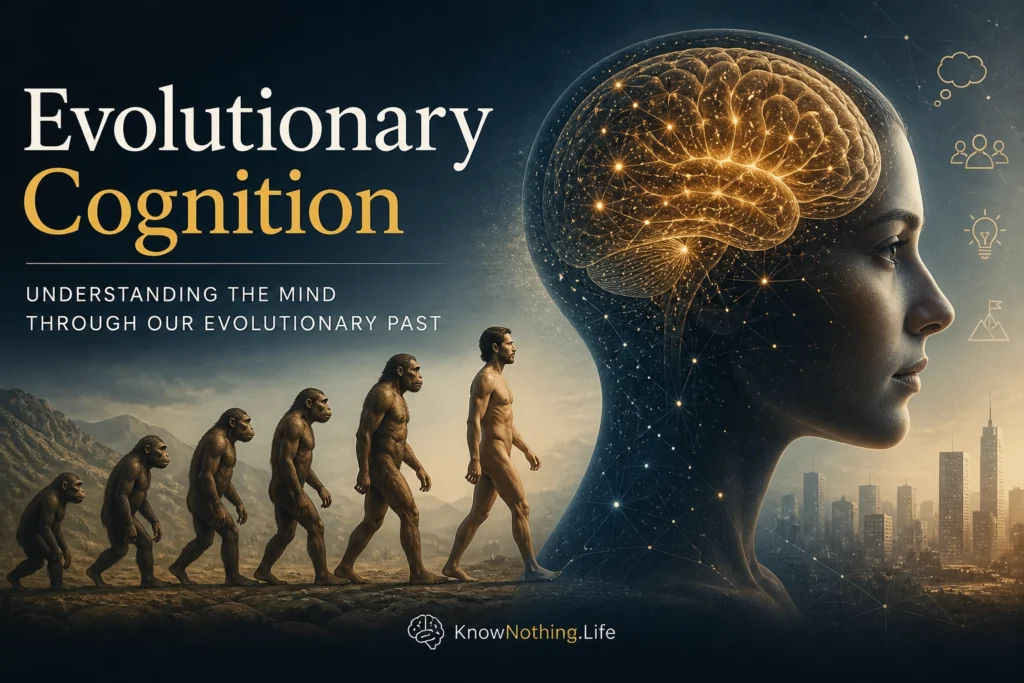
Evolutionary cognition is the study of how human thinking, perception, and reasoning have been shaped by the forces of natural selection. It seeks to explain the structure of the human mind not as a general-purpose processor, but as a collection of specialized systems that evolved to solve recurring problems faced by our ancestors. These problems included finding food, avoiding predators, navigating social relationships, and making decisions under uncertainty. By examining cognition through an evolutionary lens, researchers aim to understand why we think the way we do, not just how.
The intellectual roots of this perspective lie in the work of Charles Darwin, whose theory of natural selection provided a framework for explaining biological adaptation. Darwin suggested that mental faculties, like physical traits, could evolve through selection pressures. In The Descent of Man, he argued that “the difference in mind between man and the higher animals… is one of degree and not of kind,” implying continuity between human cognition and that of other species. This insight laid the groundwork for modern evolutionary approaches to the mind.
The Modular Mind Hypothesis
A central concept in evolutionary cognition is the idea that the mind is composed of specialized modules, each designed to perform specific functions. This perspective contrasts with earlier views that treated the mind as a general-purpose reasoning system. Instead, evolutionary psychologists argue that cognitive processes are domain-specific, reflecting adaptations to particular environmental challenges.
The modularity hypothesis was advanced by Leda Cosmides and John Tooby, who proposed that “the human brain is a computational system composed of many specialized mechanisms.” These mechanisms include systems for language, face recognition, threat detection, and social reasoning. Each module is thought to have evolved to solve a distinct problem, making cognition efficient and context-sensitive. While the extent of modularity remains debated, the concept has been influential in shaping research on cognitive architecture.
Adaptive Problems and Cognitive Solutions
Evolutionary cognition emphasizes the relationship between adaptive problems and the cognitive solutions that evolved to address them. For example, early humans needed to identify safe foods, detect predators, and navigate complex social environments. These challenges required rapid and accurate decision-making, leading to the development of specialized cognitive strategies.
One well-known example is the “cheater detection” module proposed by Leda Cosmides, which suggests that humans are particularly adept at identifying violations of social contracts. This ability would have been advantageous in cooperative societies, where detecting free riders was essential for maintaining group cohesion. Similarly, spatial reasoning abilities may have evolved to support navigation and resource location. These examples illustrate how cognitive processes can be understood as solutions to recurring evolutionary challenges.
Heuristics and Biases
Human cognition is often characterized by the use of heuristics—mental shortcuts that simplify decision-making. While these shortcuts can be efficient, they can also lead to systematic biases. Evolutionary cognition interprets heuristics not as flaws, but as adaptations that were effective in ancestral environments.
Research by Daniel Kahneman and Amos Tversky has documented a range of cognitive biases, such as availability and representativeness. Kahneman argued that “people rely on a limited number of heuristic principles which reduce the complex tasks of assessing probabilities,” highlighting the efficiency of these processes. From an evolutionary perspective, heuristics may have provided quick and generally reliable solutions in environments where time and information were limited. However, in modern contexts, these same shortcuts can lead to errors, illustrating a mismatch between evolved cognition and contemporary environments.
Language and Symbolic Thought
Language is one of the most distinctive features of human cognition, enabling complex communication, abstract reasoning, and cultural transmission. The evolution of language has been a major focus of research, with debates about whether it emerged as a specialized adaptation or as a byproduct of other cognitive capacities.
Linguist Noam Chomsky proposed that humans possess an innate “language acquisition device,” suggesting that language is a biological endowment. Chomsky argued that “language is a mirror of mind,” reflecting underlying cognitive structures. Evolutionary perspectives on language often emphasize its role in social coordination and information sharing, which would have been critical for survival. The development of symbolic thought, closely linked to language, allowed humans to represent and manipulate abstract concepts, greatly expanding cognitive capabilities.
Social Cognition and Theory of Mind
Social cognition is a key aspect of evolutionary cognition, as humans are highly social beings whose survival depends on cooperation and interaction. Theory of mind—the ability to attribute mental states to others—is a central component of social cognition, enabling individuals to predict and interpret behavior.
Research by Simon Baron-Cohen has explored the development of theory of mind, suggesting that it is a specialized cognitive system. Baron-Cohen argued that “understanding minds is a crucial survival skill,” as it allows individuals to navigate social relationships effectively. This ability supports behaviors such as empathy, deception, and collaboration, all of which have evolutionary significance. Social cognition thus reflects the importance of interpersonal interaction in shaping human thought.
Emotion and Cognition Integration
Evolutionary cognition emphasizes the integration of emotion and cognition, viewing them as complementary systems rather than opposing forces. Emotions provide rapid assessments of situations, guiding attention and action, while cognitive processes allow for more deliberate analysis and planning.
Psychologist Antonio Damasio has argued that “emotion is an integral component of the machinery of reason,” challenging the traditional separation of emotion and cognition. From an evolutionary perspective, emotions enhance decision-making by prioritizing certain outcomes and motivating behavior. For example, fear can prompt immediate action in response to danger, while positive emotions reinforce beneficial behaviors. This integration highlights the adaptive nature of both emotional and cognitive processes.
Cultural Evolution and Cognitive Development
While evolutionary cognition focuses on biological adaptation, it also recognizes the role of cultural evolution in shaping human thought. Culture provides a framework for learning, transmitting knowledge, and developing new cognitive skills. Through cultural practices, individuals can acquire behaviors that extend beyond their biological predispositions.
Anthropologist Joseph Henrich has emphasized the importance of cultural evolution, arguing that “our species is unique in the extent to which we rely on socially transmitted information.” Cultural learning allows humans to adapt to diverse environments, creating a feedback loop between biology and culture. This perspective highlights that cognition is not only shaped by genetic evolution but also by the accumulation of cultural knowledge over generations.
Critiques and Alternative Perspectives
Evolutionary cognition has been subject to criticism, particularly regarding its assumptions about ancestral environments and the difficulty of testing certain hypotheses. Critics argue that some explanations may rely on speculative narratives rather than empirical evidence. Additionally, there is concern that the emphasis on adaptation may overlook the role of general cognitive processes.
Scholars such as Stephen Jay Gould have cautioned against “just-so stories,” where behaviors are explained through evolutionary narratives without sufficient evidence. Gould argued that not all traits are adaptive, and some may be byproducts of other processes. These critiques highlight the need for rigorous methods and interdisciplinary approaches in studying cognition.
Future Directions in Evolutionary Cognition
The future of evolutionary cognition lies in integrating insights from neuroscience, genetics, and artificial intelligence. Advances in brain imaging are providing new understanding of the neural basis of cognitive processes, while computational models are offering tools for simulating evolutionary scenarios.
There is also growing interest in how modern environments influence cognition, particularly in areas such as technology and information processing. Understanding how evolved cognitive systems interact with contemporary conditions can provide insights into challenges such as decision-making, learning, and mental health. As research progresses, evolutionary cognition will continue to evolve, incorporating new perspectives and methodologies.
Conclusion
Evolutionary cognition provides a powerful framework for understanding the structure and function of the human mind. By examining cognition as a product of natural selection, it offers insights into why we think and behave in certain ways. From modular systems to social cognition, the field highlights the adaptive nature of mental processes.
At the same time, evolutionary cognition recognizes the complexity of human thought, shaped by both biological and cultural factors. By integrating multiple perspectives, researchers can develop a more comprehensive understanding of cognition, bridging the gap between evolutionary history and modern experience.