The insanity defense represents one of the most complex and controversial intersections between psychology and law. At its core, it raises a fundamental question: to what extent should individuals be held legally responsible for actions committed while suffering from severe mental illness? Legal systems are built on the assumption that individuals possess the capacity to understand their actions and choose between right and wrong. When this capacity is compromised, the very foundation of criminal responsibility becomes uncertain.
The modern formulation of the insanity defense reflects centuries of evolving thought about human agency, morality, and mental illness. Early legal systems often treated mental incapacity inconsistently, but over time, courts began to formalize standards for determining when a defendant should not be held criminally responsible. The work of scholars such as Henry Maudsley helped bridge the gap between medical understanding and legal doctrine, emphasizing that mental disorders could profoundly impair judgment and behavior. As Maudsley argued, “Insanity is not a mere exaggeration of natural traits, but a disease of the brain.”
Today, the insanity defense remains a focal point of debate among psychologists, legal professionals, and the public. High-profile cases often spark controversy, with critics arguing that the defense allows dangerous individuals to escape punishment, while proponents maintain that it is a necessary safeguard for justice. Understanding the insanity defense requires examining its legal standards, psychological foundations, and broader implications for responsibility and fairness.
Historical Development of the Insanity Defense
The roots of the insanity defense can be traced to early English common law, where courts recognized that individuals who lacked reason should not be punished in the same way as those who acted with intent. One of the earliest formulations was the “wild beast test,” which held that a defendant could be excused if they lacked understanding comparable to that of an animal. While rudimentary, this standard reflected an emerging awareness that mental incapacity could affect culpability.
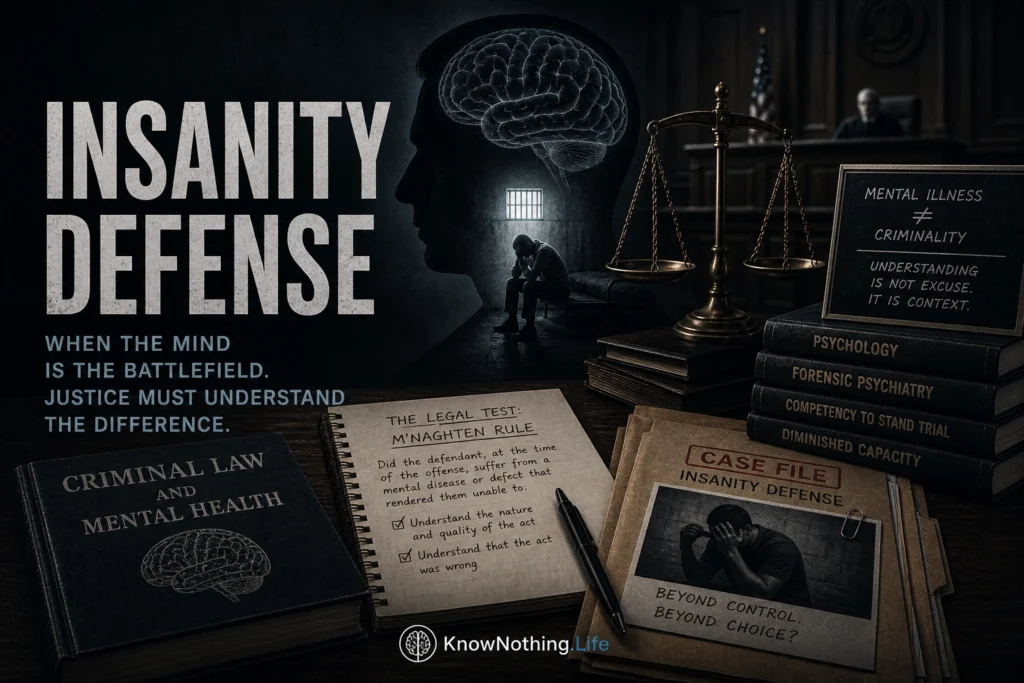
A more influential milestone came with the 1843 M’Naghten’s Case, which established what became known as the M’Naghten Rule. This standard focused on whether the defendant, due to a “defect of reason” caused by mental illness, either did not understand the nature of their act or did not know that it was wrong. The M’Naghten Rule remains one of the most widely used tests for insanity, emphasizing cognitive awareness as the key criterion.
Over time, criticisms of the M’Naghten standard led to the development of alternative tests that incorporated broader psychological insights. The “irresistible impulse” test, for example, considered whether a defendant was unable to control their actions, even if they understood them. Later, the Model Penal Code introduced by the American Law Institute proposed a more flexible standard, stating that a defendant is not responsible if they lack substantial capacity either to appreciate the criminality of their conduct or to conform their behavior to the law. These evolving standards reflect an ongoing effort to align legal definitions with scientific understanding of mental illness.
Psychological Foundations of Criminal Responsibility
The insanity defense is grounded in psychological theories about cognition, volition, and moral awareness. To hold someone criminally responsible, the legal system assumes that the individual had both the capacity to understand their actions and the ability to control them. Severe mental disorders can disrupt these capacities in profound ways, affecting perception, reasoning, and impulse control.
Psychiatric research has identified conditions such as schizophrenia, bipolar disorder with psychotic features, and severe major depression as potentially impairing reality testing. Individuals experiencing delusions or hallucinations may genuinely believe they are acting in self-defense or fulfilling a moral duty, even when their actions are objectively criminal. As Emil Kraepelin observed in his foundational work on mental disorders, disturbances in thought and perception can fundamentally alter a person’s grasp of reality.
The role of volition—one’s ability to control behavior—is equally important. Some psychological models emphasize that even when individuals understand their actions, they may be unable to resist them due to overwhelming impulses or emotional disturbances. This perspective aligns with the irresistible impulse test and highlights the importance of considering both cognitive and emotional dimensions of mental illness. The interplay between understanding and control remains central to debates about the insanity defense.
Assessment and Expert Testimony
Determining whether a defendant meets the criteria for insanity requires careful psychological evaluation. Forensic psychologists and psychiatrists play a critical role in this process, conducting assessments that examine the individual’s mental state at the time of the offense. These evaluations often include clinical interviews, psychological testing, and reviews of medical and legal records.
One of the challenges in assessing insanity is the retrospective nature of the inquiry. Experts must reconstruct the defendant’s mental state at the time of the crime, often relying on limited or indirect evidence. This process is inherently complex and subject to interpretation, leading to disagreements among experts. As Thomas Szasz controversially argued, “Mental illness is a metaphor,” raising questions about the objectivity of psychiatric diagnoses in legal contexts.
Expert testimony is presented in court to help judges and juries understand the psychological factors relevant to the case. However, the effectiveness of such testimony depends on how it is communicated and interpreted. Jurors may struggle to evaluate conflicting expert opinions or may be influenced by their own beliefs about mental illness. This underscores the importance of clear, evidence-based explanations and standardized assessment procedures.
Controversies and Public Perception
The insanity defense has long been a subject of public skepticism and misunderstanding. Many people believe it is used frequently and easily, allowing defendants to avoid punishment. In reality, the defense is relatively rare and successful in only a small percentage of cases. Research has shown that defendants who plead insanity often spend as much or more time in secure psychiatric facilities as they would have in prison.
High-profile cases have significantly shaped public perception. For example, the acquittal of John Hinckley Jr. in 1982, after he was found not guilty by reason of insanity for the attempted assassination of Ronald Reagan, sparked widespread outrage and led to calls for reform. Critics argued that the defense was too lenient, while supporters maintained that the verdict reflected a proper application of legal principles.
These controversies often reflect broader societal attitudes toward mental illness. Stigma and misconceptions can influence how jurors and the public perceive defendants who raise the insanity defense. As a result, legal outcomes may be shaped not only by evidence but also by cultural beliefs about responsibility and mental health. Addressing these biases is essential for ensuring fair and impartial judgments.
Legal Reforms and Modern Applications
In response to public concern and evolving scientific knowledge, many jurisdictions have reformed their approach to the insanity defense. Some have narrowed the criteria for insanity, while others have introduced alternative verdicts such as “guilty but mentally ill.” This verdict allows for the acknowledgment of mental illness while still holding the defendant criminally responsible, often resulting in treatment within the prison system.
The federal system in the United States adopted stricter standards following the Hinckley case, requiring defendants to prove insanity by clear and convincing evidence. This shift reflects a broader trend toward limiting the use of the defense while maintaining its availability in extreme cases. The balance between protecting society and ensuring justice for individuals with mental illness remains a central challenge.
Modern applications of the insanity defense also incorporate advances in neuroscience and psychology. Brain imaging and other technologies have been used to provide evidence of structural or functional abnormalities, although their role in legal decisions is still debated. As scientific understanding continues to evolve, the legal system must grapple with how to integrate new forms of evidence while preserving fundamental principles of justice.
Conclusion
The insanity defense stands at the intersection of law, psychology, and morality, raising profound questions about human responsibility and the nature of justice. By recognizing that severe mental illness can impair understanding and control, the defense reflects a commitment to fairness and compassion within the legal system. At the same time, it presents significant challenges, from the difficulty of assessing mental states to the influence of public perception.
The work of thinkers such as Henry Maudsley and Emil Kraepelin has contributed to a deeper understanding of mental illness, informing the development of legal standards. Yet debates continue about how best to balance individual rights with societal protection. As legal systems evolve, the insanity defense remains a vital, if contentious, mechanism for addressing the complexities of human behavior.
Ultimately, the insanity defense challenges us to confront the limits of responsibility and the role of compassion in justice. By integrating psychological insights with legal principles, it offers a framework for navigating some of the most difficult questions in the pursuit of fairness and truth.