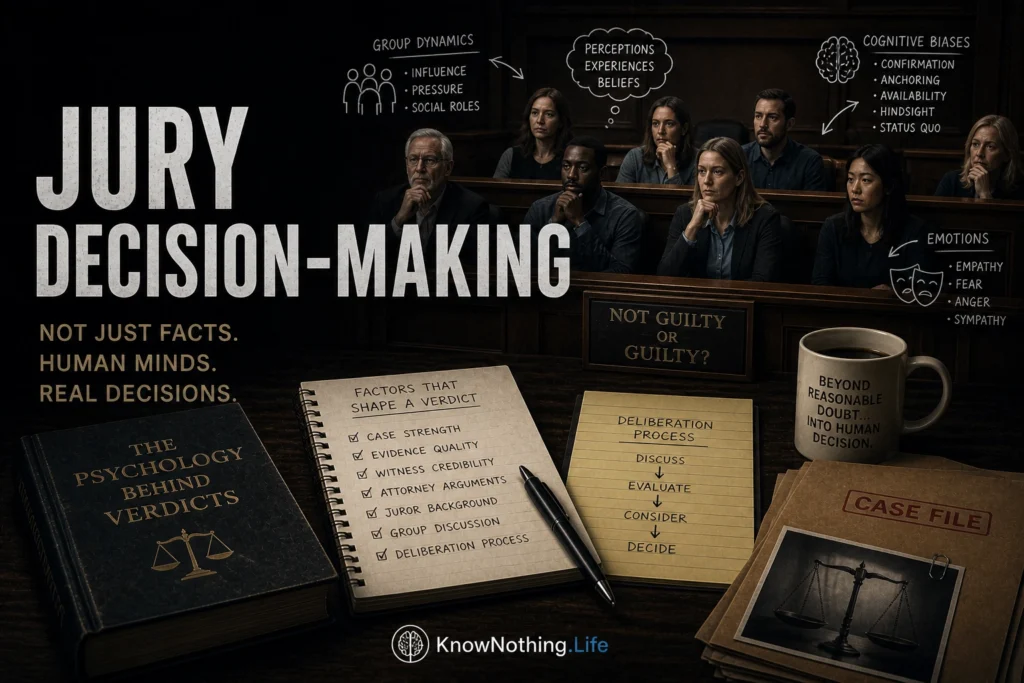
Jury decision-making stands at the heart of many modern legal systems, embodying the principle that ordinary citizens—not only legal experts—should participate in determining guilt, innocence, and liability. The jury is often idealized as a rational, impartial body that carefully weighs evidence and applies the law as instructed. Yet decades of psychological research suggest that jury decisions are shaped by far more than facts alone. Cognitive biases, group dynamics, emotional reactions, and persuasive narratives all play powerful roles in how verdicts are ultimately reached.
The scientific study of juries emerged alongside broader developments in social and cognitive psychology. Early legal scholars tended to assume that jurors acted as neutral fact-finders, but psychologists began to challenge this assumption by examining how real people process complex information. Researchers such as Kalven and Zeisel, in their influential work The American Jury (1966), provided one of the first systematic analyses of jury behavior, revealing that jurors often rely on intuitive judgments rather than purely legal reasoning. Their findings opened the door to a more nuanced understanding of how verdicts are formed.
Today, jury decision-making is recognized as a deeply human process, shaped by both individual cognition and collective interaction. Understanding this process is essential not only for evaluating the fairness of trials but also for improving legal procedures. This article explores the psychological mechanisms underlying jury decisions, from individual biases to group deliberation, and considers the implications for justice.
Cognitive Processes and Biases
At the individual level, jurors bring their own perceptions, experiences, and mental shortcuts into the courtroom. Cognitive psychology has shown that people rarely process information in a purely analytical way; instead, they rely on heuristics—mental shortcuts that simplify decision-making. The work of Daniel Kahneman and Amos Tversky demonstrated that these heuristics can lead to systematic biases, even in high-stakes contexts such as legal judgments.
One of the most influential biases in jury decision-making is confirmation bias, the tendency to interpret evidence in ways that support preexisting beliefs. Once jurors form an initial impression of a case—often early in the trial—they may selectively attend to information that reinforces that impression while discounting contradictory evidence. This can create a “coherence effect,” where the narrative that seems most consistent becomes increasingly persuasive, regardless of its objective accuracy. Kahneman later emphasized in Thinking, Fast and Slow (2011) that “confidence is a feeling, which reflects the coherence of the information and the cognitive ease of processing it.”
Another important bias is the anchoring effect, where initial information disproportionately influences subsequent judgments. For example, the first piece of evidence presented or the opening statements by attorneys can set a baseline that shapes how later information is interpreted. Jurors may also be influenced by the representativeness heuristic, judging a defendant’s guilt based on how closely they match stereotypes of criminal behavior. These cognitive tendencies highlight the challenge of ensuring that verdicts are based solely on evidence rather than on psychological shortcuts.
The Power of Narrative
Beyond individual biases, jurors are strongly influenced by the narratives constructed during a trial. Legal cases are not simply collections of facts; they are stories presented by opposing sides, each seeking to provide a coherent and compelling account of events. Research by Nancy Pennington and Reid Hastie introduced the “story model” of jury decision-making, which suggests that jurors actively construct narratives to make sense of evidence.
According to the story model, jurors evaluate evidence based on how well it fits into a plausible and internally consistent story. They are more likely to accept a narrative that aligns with their prior knowledge and expectations, even if the evidence is incomplete or ambiguous. This process allows jurors to organize complex information, but it also introduces the risk of bias, as narratives can be shaped by assumptions and stereotypes.
Attorneys play a critical role in shaping these narratives. Through opening statements, witness examinations, and closing arguments, they frame the case in ways designed to resonate with jurors’ intuitions. Emotional appeals, vivid imagery, and persuasive language can all enhance the impact of a narrative. As a result, the outcome of a trial may depend not only on the strength of the evidence but also on the effectiveness of storytelling. This underscores the importance of understanding how narrative influences decision-making in the courtroom.
Group Dynamics and Deliberation
Jury decision-making is not solely an individual process; it is also a collective one. After hearing the evidence, jurors engage in deliberation, where they discuss the case and attempt to reach a consensus. Social psychology has shown that group dynamics can significantly influence the outcome of these discussions. Research by Solomon Asch on conformity demonstrated that individuals often adjust their opinions to align with a majority, even when they privately disagree.
In the context of jury deliberation, conformity pressures can lead minority viewpoints to be suppressed. Jurors who initially hold dissenting opinions may change their votes to avoid conflict or to achieve unanimity more quickly. This can result in decisions that reflect group consensus rather than individual conviction. At the same time, the presence of diverse perspectives can improve decision quality by encouraging more thorough discussion and critical evaluation.
Group polarization is another important phenomenon. Studies have shown that group discussions can lead members to adopt more extreme positions than they initially held. A jury leaning slightly toward conviction may become more certain of guilt after deliberation, while a jury leaning toward acquittal may become more resolute in that direction. These dynamics highlight the complex interplay between individual judgment and social influence in jury decision-making.
Emotion and Moral Judgment
Although legal systems emphasize rationality, emotion plays a significant role in jury decisions. Jurors are often exposed to emotionally charged evidence, such as graphic descriptions of crimes or testimony from victims. These emotional responses can influence how evidence is interpreted and how moral judgments are formed. Research in moral psychology suggests that emotions such as anger, empathy, and disgust can shape perceptions of blame and punishment.
The work of Jonathan Haidt has been particularly influential in this area. In The Righteous Mind (2012), Haidt argued that moral judgments are often driven by intuitive emotional responses, with reasoning serving to justify those intuitions after the fact. This perspective challenges the idea that jurors carefully weigh evidence in a purely rational manner, suggesting instead that decisions may be guided by underlying moral intuitions.
Emotion can also interact with bias. For example, jurors may feel more empathy toward defendants who are perceived as similar to themselves, while reacting more negatively to those who are seen as different. These emotional dynamics can influence both verdicts and sentencing decisions, raising important questions about fairness and impartiality in the legal system.
The Role of Expert Testimony
Given the complexities of human cognition and behavior, expert testimony has become an increasingly important component of jury trials. Psychologists and other experts are often called upon to explain phenomena such as memory distortion, false confessions, and the effects of bias. Their role is to provide jurors with the tools needed to critically evaluate evidence and avoid common pitfalls.
However, the effectiveness of expert testimony depends on how it is presented and understood. Jurors may struggle to interpret technical information or may be influenced by the perceived credibility of the expert. Competing experts can further complicate matters, as jurors must decide which testimony to trust. As Saul Kassin has noted in his work on false confessions, educating jurors about psychological processes is essential but not always sufficient to prevent error.
The use of expert testimony reflects a broader effort to integrate scientific knowledge into legal decision-making. By providing insights into how memory, perception, and judgment operate, experts can help jurors make more informed decisions. Nevertheless, challenges remain in ensuring that this information is effectively communicated and appropriately applied.
Implications for Legal Reform
The study of jury decision-making has important implications for the design and reform of legal systems. Recognizing the influence of bias and group dynamics, some jurisdictions have implemented measures to improve jury performance. These include clearer jury instructions, opportunities for jurors to take notes, and the use of structured deliberation procedures that encourage equal participation.
Another area of reform involves the presentation of evidence. Efforts to reduce bias include limiting the use of prejudicial information, such as prior criminal history, and ensuring that lineups and identifications are conducted in ways that minimize suggestion. Additionally, educating jurors about common cognitive biases can help them approach evidence more critically, though the effectiveness of such interventions varies.
Ultimately, the goal of these reforms is not to eliminate human influence—an impossible task—but to create conditions that promote fairness and accuracy. By aligning legal procedures with psychological insights, it is possible to reduce the impact of bias and improve the quality of jury decisions. This ongoing process reflects the evolving relationship between law and psychology.
Conclusion
Jury decision-making is a complex and multifaceted process that reflects the interplay of cognition, emotion, and social interaction. While juries are designed to deliver impartial justice, psychological research reveals that their decisions are shaped by biases, narratives, and group dynamics. The work of scholars such as Daniel Kahneman, Nancy Pennington, and Solomon Asch has provided valuable insights into these processes, challenging traditional assumptions about rationality in the courtroom.
Understanding these influences is essential for improving the fairness and effectiveness of legal systems. By incorporating psychological knowledge into legal procedures, it is possible to mitigate the effects of bias and enhance the accuracy of verdicts. As the field continues to develop, the study of jury decision-making will remain central to the pursuit of justice, reminding us that the law is ultimately shaped by the human mind.