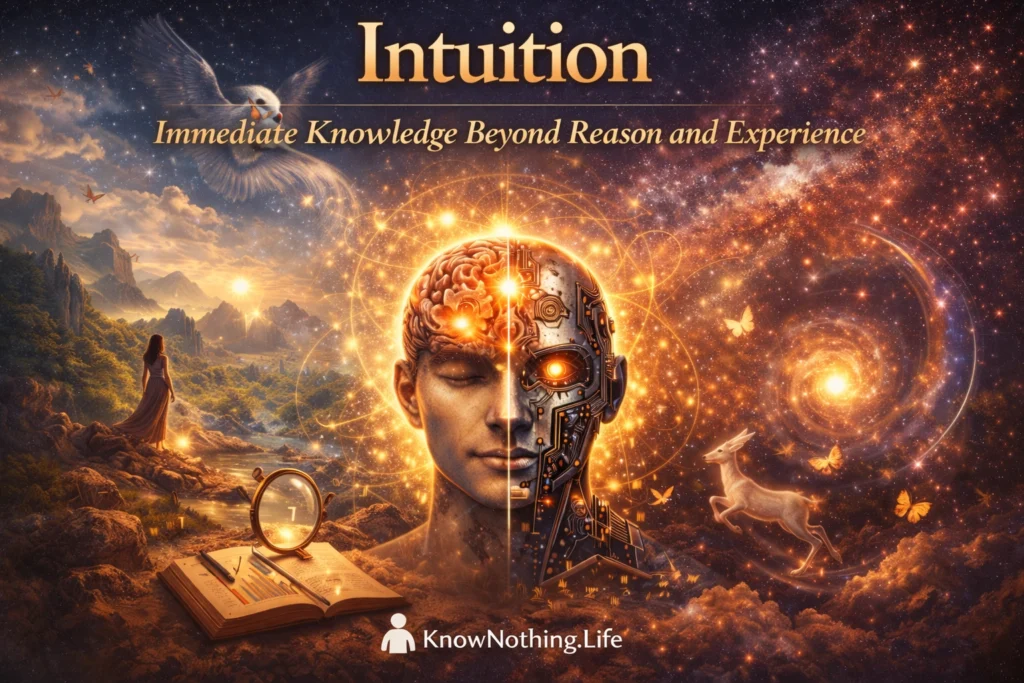
Intuition occupies a unique and often controversial place in epistemology. Unlike knowledge derived from reasoning or sensory experience, intuition is typically understood as a form of immediate awareness—a direct grasp of truth that does not depend on inference or observation. It is often described as a kind of intellectual “seeing,” where certain propositions appear self-evident or undeniable without the need for proof.
Philosophers have long debated whether intuition constitutes a genuine source of knowledge or merely a psychological feeling of certainty. While some regard intuition as essential for understanding fundamental truths in mathematics, logic, and ethics, others question its reliability and objectivity. This tension reflects a broader concern within epistemology: how to distinguish between knowledge that is justified and knowledge that merely seems obvious.
From ancient philosophy to contemporary analytic thought, intuition has played a central role in shaping philosophical arguments. Thinkers such as Plato, Immanuel Kant, G. E. Moore, and Edmund Husserl have all engaged with the concept, offering distinct interpretations of its nature and significance. By examining these perspectives, we can better understand the role intuition plays in human knowledge.
The Nature of Intuition
Intuition is often defined as a form of non-inferential knowledge—knowledge that arises without conscious reasoning or step-by-step justification. When we intuitively recognize that a statement such as “2 + 2 = 4” is true, we do not rely on empirical observation or complex argumentation. Instead, the truth appears immediately evident to the mind.
This immediacy distinguishes intuition from other sources of knowledge. While reasoning involves a chain of logical steps and perception depends on sensory input, intuition seems to operate independently of both. It provides a direct apprehension of truth, often described as self-evident. This has led many philosophers to regard intuition as foundational, serving as the starting point for further reasoning.
However, the nature of intuition remains difficult to pin down. Is it a cognitive faculty, a psychological state, or a form of perception? Different philosophical traditions offer different answers. Some treat intuition as a rational capacity, closely tied to logic and understanding, while others view it as a more holistic or experiential phenomenon. This ambiguity has contributed to ongoing debates about its epistemic status.
Intuition in Rationalist Philosophy
Within the rationalist tradition, intuition is often seen as a central source of knowledge. René Descartes, for example, regarded intuition as the foundation of certainty. In Meditations on First Philosophy, he distinguishes between intuition and deduction, describing intuition as the immediate grasp of simple truths.
For Descartes, intuition provides access to clear and distinct ideas—those that are so evident that they cannot be doubted. His famous statement, “Cogito, ergo sum” (“I think, therefore I am”), is not derived through reasoning but apprehended directly through intuition. This insight serves as the foundation upon which he builds his entire philosophical system.
Similarly, Baruch Spinoza elevates intuition to the highest form of knowledge in his work Ethics. Spinoza distinguishes between different kinds of knowledge, placing intuitive knowledge at the top because it involves a direct understanding of the essence of things. For rationalists, intuition is not merely a supplement to reason but an essential component of intellectual insight.
Kant and the Structure of Intuition
Immanuel Kant offers a distinct and highly influential account of intuition in Critique of Pure Reason. For Kant, intuition is not a mysterious faculty but a fundamental aspect of how we experience the world. He distinguishes between concepts, which are provided by the understanding, and intuitions, which are given through sensibility.
According to Kant, all knowledge begins with experience, but it does not arise solely from experience. Intuition provides the raw data of perception, structured by the forms of space and time. These forms are not derived from experience but are conditions that make experience possible. As Kant famously states, “Thoughts without content are empty, intuitions without concepts are blind.”
Kant’s account bridges the gap between rationalism and empiricism by showing how intuition and understanding work together. Intuition supplies the content of knowledge, while concepts organize that content into meaningful judgments. This synthesis highlights the complexity of intuition, positioning it as both a sensory and a structural component of cognition.
Intuition in Ethics and Common Sense Philosophy
Intuition has also played a significant role in moral philosophy, particularly in the work of G. E. Moore. In Principia Ethica, Moore argues that certain moral truths are known through intuition. He famously claims that the concept of “good” is indefinable and can only be recognized directly.
Moore’s ethical intuitionism suggests that moral knowledge does not depend on empirical evidence or logical deduction but on an immediate awareness of value. This view has been both influential and controversial, as it raises questions about the objectivity and universality of moral intuitions. If individuals have different intuitions, how can we determine which are correct?
In a broader sense, intuition is often associated with common sense—the basic beliefs that seem self-evident to most people. Philosophers in the Scottish common sense tradition, such as Thomas Reid, argued that certain principles are known intuitively and form the foundation of all knowledge. These include beliefs in the existence of the external world and the reliability of perception.
Phenomenology and Intuitive Experience
The phenomenological tradition, particularly in the work of Edmund Husserl, offers a different perspective on intuition. Husserl emphasizes the role of intuition in revealing the structures of consciousness. For him, intuition is not limited to abstract truths but includes the direct experience of phenomena.
In phenomenology, intuition involves a careful examination of how things appear to consciousness. By suspending assumptions about the external world, Husserl seeks to uncover the essential features of experience. This approach treats intuition as a method of inquiry rather than a source of unquestionable truths.
Husserl’s work highlights the richness of intuitive experience, showing that it encompasses not only intellectual insight but also perception, imagination, and emotion. This broader understanding of intuition expands its role in epistemology, connecting it to the lived experience of individuals.
Critiques and Limitations of Intuition
Despite its importance, intuition faces significant challenges as a source of knowledge. One major concern is its subjectivity. Unlike empirical evidence or logical proof, intuitive judgments can vary between individuals, raising questions about their reliability. What seems self-evident to one person may not appear so to another.
Another issue is the potential for cognitive bias. Psychological research has shown that intuitive judgments can be influenced by heuristics, emotions, and cultural factors. This suggests that intuition may not always provide a trustworthy guide to truth. Philosophers have therefore sought ways to distinguish between reliable and unreliable intuitions.
Some critics argue that intuition should not be regarded as a source of knowledge at all, but rather as a starting point for inquiry that must be tested through reasoning and evidence. This view reflects a more cautious approach, acknowledging the role of intuition while emphasizing the need for critical evaluation.
Contemporary Perspectives on Intuition
In contemporary philosophy, intuition continues to play a central role, particularly in analytic philosophy. Thought experiments, such as those used in discussions of knowledge and ethics, often rely on intuitive judgments to evaluate different scenarios. For example, Gettier cases depend on our intuitions about what counts as knowledge.
Philosophers have also begun to examine the nature of intuition itself, exploring whether it is a reliable guide to truth or merely a psychological phenomenon. Some argue that intuitions are shaped by underlying cognitive processes and can be studied empirically. Others maintain that intuition remains indispensable for philosophical reasoning.
The ongoing debate reflects the complexity of intuition as both a cognitive and epistemic phenomenon. While its status as a source of knowledge remains contested, its influence on philosophical thought is undeniable.
Conclusion
Intuition occupies a complex and multifaceted position within epistemology. It offers a form of immediate knowledge that appears to bypass both reasoning and experience, providing insight into fundamental truths. From René Descartes’ emphasis on clear and distinct ideas to Immanuel Kant’ analysis of intuition as a condition of experience, the concept has been interpreted in diverse and often conflicting ways.
While intuition provides a powerful tool for understanding certain kinds of knowledge, it also raises important questions about reliability and objectivity. Its subjective nature and susceptibility to bias challenge its status as a definitive source of truth. Yet its role in mathematics, ethics, and philosophical reasoning suggests that it cannot be easily dismissed.
As G. E. Moore observed, some truths seem to be known “directly and immediately.” Whether these insights constitute genuine knowledge or merely the appearance of it remains an open question. What is clear, however, is that intuition continues to play a vital role in the ongoing exploration of knowledge and understanding.