Sleep is a universal biological process, yet its internal structure is far from simple. Rather than a uniform state of rest, sleep unfolds in a sequence of distinct stages, each characterized by unique patterns of brain activity, physiology, and subjective experience. These stages—ranging from light sleep to deep restorative phases and vivid dreaming—form a repeating cycle that plays a crucial role in physical health, cognitive function, and emotional regulation. Understanding sleep stages is therefore essential not only for neuroscience but for grasping how the mind and body maintain equilibrium.
Scientific interest in sleep stages accelerated in the 20th century with the development of electroencephalography (EEG), which allowed researchers to observe brain activity during sleep. Pioneering work by Eugene Aserinsky and Nathaniel Kleitman led to the discovery of rapid eye movement (REM) sleep in 1953, revealing that the sleeping brain is often highly active. This finding overturned earlier assumptions that sleep was a passive state, instead demonstrating that it involves dynamic and complex processes.
Today, sleep is understood as a cyclical progression through multiple stages, broadly divided into non-REM (NREM) and REM sleep. Each stage contributes differently to restoration, memory consolidation, and neural maintenance. As Allan Hobson observed in his research on dreaming, “Sleep is not the absence of wakefulness but a state with its own patterns of activity.” This insight captures the essence of sleep stages as active, organized states rather than mere inactivity.
The Architecture of Sleep
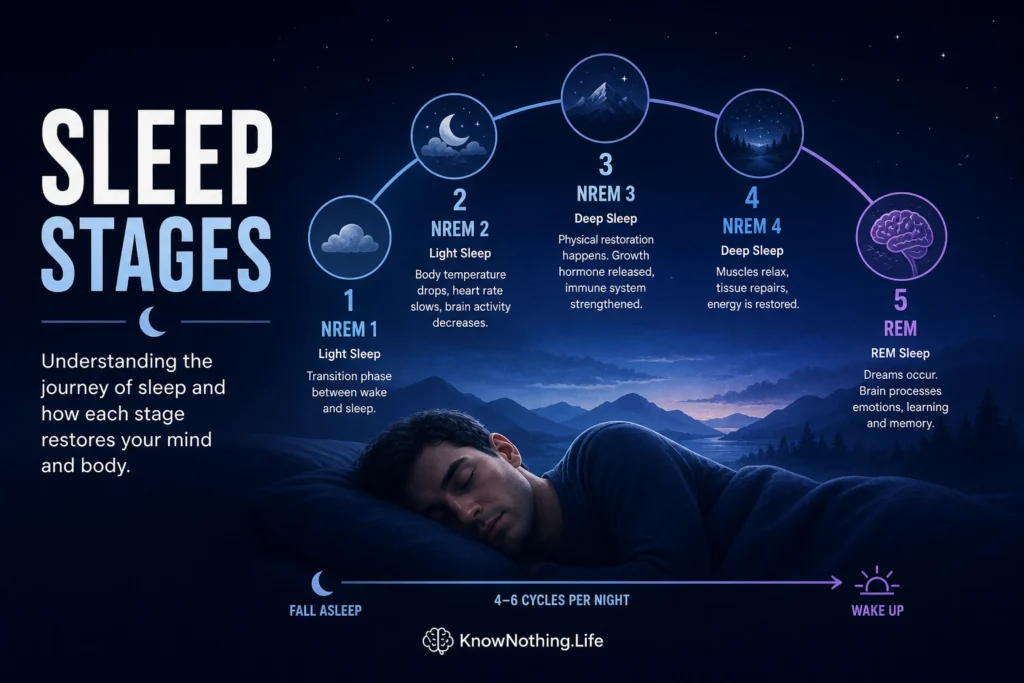
Sleep architecture refers to the structured pattern in which sleep stages occur across the night. A typical sleep cycle lasts approximately 90 to 110 minutes and repeats four to six times during a full night’s rest. Within each cycle, the brain transitions through progressively deeper stages of NREM sleep before entering REM sleep, after which the cycle begins again. This rhythmic pattern is regulated by both circadian rhythms and homeostatic processes that balance sleep need and wakefulness.
Early in the night, deep NREM sleep dominates, providing physical restoration and recovery. As the night progresses, REM periods become longer and more frequent, reflecting a shift toward cognitive and emotional processing. This distribution suggests that different stages serve complementary functions, with deep sleep supporting bodily repair and REM sleep contributing to memory integration and emotional regulation.
The organization of sleep stages is not fixed but varies across individuals and across the lifespan. Infants, for example, spend a much larger proportion of time in REM sleep, while older adults often experience reduced deep sleep. Disruptions to sleep architecture—whether due to stress, illness, or environmental factors—can impair the restorative functions of sleep, highlighting the importance of maintaining healthy sleep patterns.
Stage 1: Light Sleep and Transition
Stage 1 sleep, the lightest stage of NREM sleep, represents the transition between wakefulness and sleep. During this phase, brain activity begins to slow, shifting from the fast beta waves associated with alertness to slower alpha and theta waves. Muscle activity decreases, eye movements slow, and individuals may experience brief, dreamlike sensations or hypnic jerks—sudden muscle contractions that can create the sensation of falling.
Although Stage 1 sleep is brief, typically lasting only a few minutes, it plays an important role in initiating the sleep process. It marks the point at which external awareness diminishes and internal processes begin to dominate. However, because this stage is so light, individuals can be easily awakened and may not even realize they have fallen asleep.
From a psychological perspective, Stage 1 highlights the fluid boundary between consciousness and unconsciousness. As William James described consciousness as a “stream,” Stage 1 represents a moment where that stream begins to shift, blending waking thought with the emerging patterns of sleep. This transitional quality underscores the gradual nature of sleep onset rather than a sudden switch from wakefulness to unconsciousness.
Stage 2: Stabilization and Early Processing
Stage 2 sleep constitutes a deeper level of NREM sleep and typically accounts for the largest portion of the sleep cycle. During this stage, brain activity is characterized by distinctive patterns known as sleep spindles and K-complexes—brief bursts of activity that are believed to play a role in memory consolidation and sensory processing. Heart rate slows, body temperature decreases, and the body continues to relax.
One of the key functions of Stage 2 is to stabilize sleep by reducing responsiveness to external stimuli. While individuals can still be awakened, it becomes more difficult than in Stage 1. This stage acts as a buffer, protecting deeper stages of sleep from disruption and allowing the brain to engage in processes that support learning and memory.
Research has suggested that sleep spindles, in particular, are associated with the consolidation of newly acquired information. Studies in cognitive neuroscience indicate that individuals with higher spindle activity may exhibit better learning outcomes, pointing to a connection between Stage 2 sleep and cognitive performance. This stage, though often overlooked, plays a critical role in preparing the brain for both deep sleep and REM activity.
Stage 3: Deep Sleep and Restoration
Stage 3, often referred to as slow-wave sleep (SWS) or deep sleep, is the most restorative stage of NREM sleep. During this phase, brain activity is dominated by slow delta waves, reflecting a state of synchronized neural activity. Physical processes such as tissue repair, immune function, and growth hormone release are most active during this stage, making it essential for bodily recovery.
Deep sleep is also associated with reduced responsiveness to external stimuli. Individuals awakened during Stage 3 often experience grogginess and disorientation, a phenomenon known as sleep inertia. This reflects the depth of the state and the brain’s relative disengagement from the external environment.
From a cognitive perspective, Stage 3 plays a role in consolidating declarative memories—facts and information that can be consciously recalled. Research by scientists such as Matthew Walker, in his work Why We Sleep, emphasizes the importance of deep sleep for both physical and mental health. Walker notes that “sleep is the single most effective thing we can do to reset our brain and body health each day,” highlighting the central role of slow-wave sleep in this process.
REM Sleep: Dreaming and Integration
Rapid eye movement (REM) sleep is perhaps the most distinctive stage of the sleep cycle. During REM sleep, brain activity becomes more similar to wakefulness, with fast, desynchronized waves. At the same time, the body enters a state of temporary paralysis, preventing individuals from acting out their dreams. This combination of high brain activity and physical immobility creates the conditions for vivid dreaming.
REM sleep is closely associated with emotional processing, creativity, and memory integration. During this stage, the brain appears to reorganize and connect information acquired during waking life, contributing to problem-solving and insight. As Allan Hobson proposed in his activation-synthesis theory, dreams may arise from the brain’s attempt to make sense of internally generated signals during REM sleep.
The importance of REM sleep is underscored by its increasing duration across the night. Early sleep cycles contain relatively little REM activity, while later cycles are dominated by longer REM periods. This pattern suggests that REM sleep plays a crucial role in preparing the mind for waking life, integrating experiences, and regulating emotions.
The Function and Significance of Sleep Stages
Each stage of sleep contributes uniquely to overall health and functioning, forming an integrated system that supports both body and mind. NREM stages, particularly deep sleep, are essential for physical restoration, immune function, and energy conservation. REM sleep, by contrast, is more closely linked to cognitive and emotional processes, including memory consolidation and emotional resilience.
Disruptions to sleep stages can have significant consequences. Conditions such as insomnia, sleep apnea, and circadian rhythm disorders can alter the balance of sleep stages, reducing the effectiveness of sleep. For example, insufficient deep sleep may impair physical recovery, while reduced REM sleep can affect mood and cognitive performance. These disruptions highlight the importance of both quantity and quality of sleep.
The study of sleep stages also has broader implications for understanding consciousness. Sleep represents a natural laboratory in which the brain cycles through different states of awareness, from near-unconsciousness in deep sleep to the vivid, internally generated experiences of REM dreaming. As such, it provides valuable insights into how the brain constructs and modulates conscious experience.
Conclusion
Sleep stages reveal that rest is not a passive state but a highly structured and dynamic process. From the light transitions of Stage 1 to the deep restoration of slow-wave sleep and the vivid dreaming of REM, each phase contributes to the complex architecture of sleep. Together, these stages form a cycle that sustains physical health, cognitive function, and emotional balance.
The work of researchers such as Eugene Aserinsky, Nathaniel Kleitman, and Matthew Walker has transformed our understanding of sleep, revealing it as an active and essential component of human life. Their findings underscore the importance of respecting and protecting sleep as a fundamental biological need.
Ultimately, the study of sleep stages invites a deeper appreciation of the rhythms that govern human existence. In the quiet cycles of the night, the brain engages in processes that restore, reorganize, and prepare us for the challenges of the day. Sleep, far from being a simple absence of activity, is a vital and intricate system—one that continues to shape our health, our minds, and our experience of the world.