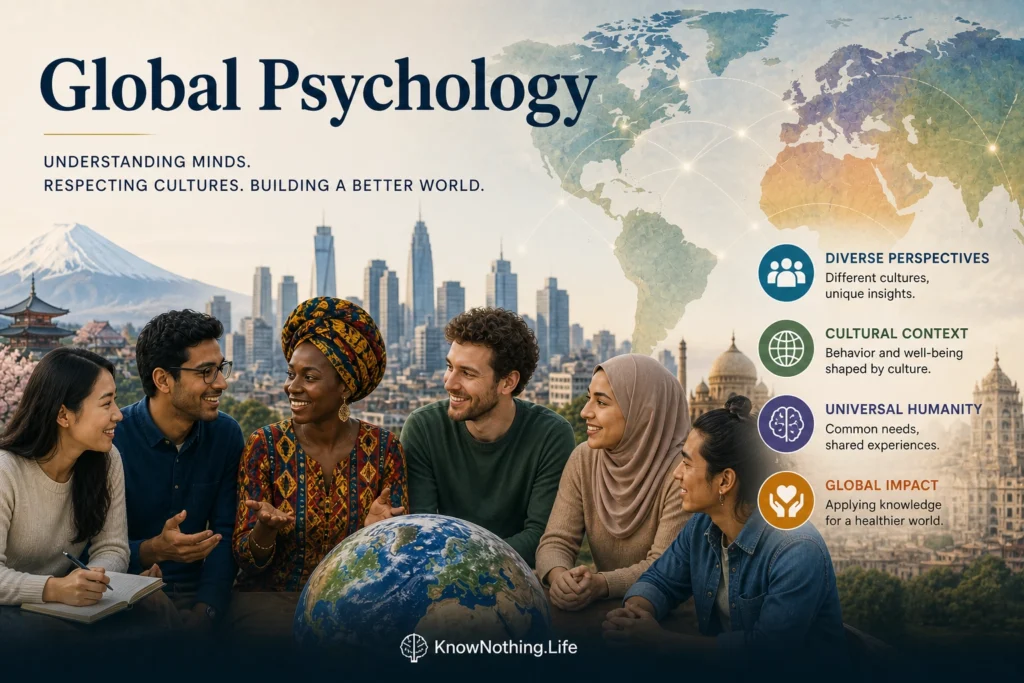
Global psychology is an emerging and increasingly necessary perspective within the human sciences. It seeks to understand psychological processes not as isolated, universal mechanisms detached from context, but as phenomena embedded within diverse cultural, social, economic, and historical environments. As the world becomes more interconnected through globalization, migration, digital communication, and international institutions, the limitations of psychology rooted primarily in Western contexts have become more apparent. Global psychology responds to this challenge by expanding the scope of inquiry to include multiple cultural perspectives, diverse populations, and a broader understanding of what it means to be human.
Historically, much of mainstream psychology developed in Western, Educated, Industrialized, Rich, and Democratic (WEIRD) societies. Joseph Henrich, along with Steven Heine and Ara Norenzayan, highlighted this bias in their influential paper “The Weirdest People in the World?” arguing that findings from these populations were often mistakenly generalized as universal human tendencies. This critique has reshaped the field, encouraging psychologists to adopt a more global perspective. Global psychology is not simply about adding more cultures to existing frameworks; it is about rethinking foundational assumptions and developing theories that account for the full range of human diversity.
Historical Foundations and Shifting Perspectives
The roots of global psychology can be traced to early cross-cultural research and anthropological studies that challenged the universality of psychological theories. Scholars such as Franz Boas and later Margaret Mead demonstrated that behavior, personality, and development vary significantly across cultures. Mead’s work, particularly in Coming of Age in Samoa, questioned assumptions about adolescence as a universally turbulent period, showing that cultural context plays a crucial role in shaping developmental experiences.
In psychology, the work of John W. Berry helped formalize the study of cultural variation through systematic research. Berry’s framework for cross-cultural psychology emphasized the importance of comparing psychological processes across societies while accounting for cultural context. His contributions, including Cross-Cultural Psychology: Research and Applications, established methodological standards for studying global diversity. These early efforts laid the groundwork for global psychology by demonstrating that cultural context is not a peripheral variable but a central factor in understanding human behavior.
Culture and the Construction of Mind
One of the central insights of global psychology is that the mind is not independent of culture. Psychological processes such as perception, cognition, emotion, and motivation are shaped by the cultural environments in which individuals develop. Richard A. Shweder argued that cultural psychology should focus on how “cultural traditions and social practices regulate, express, and transform the human psyche.” This perspective challenges the idea of a single, universal model of the mind, emphasizing instead the diversity of psychological experiences across cultures.
Research in this area has shown that cultural differences influence even basic cognitive processes. Richard E. Nisbett, in The Geography of Thought, demonstrated that Western and East Asian cultures often promote different styles of reasoning, with Western cultures emphasizing analytic thinking and East Asian cultures emphasizing holistic thinking. These differences are not merely intellectual; they affect how people perceive relationships, interpret events, and make decisions. Global psychology therefore requires an understanding of how cultural contexts shape the very structure of thought.
Globalization and Psychological Change
Globalization has introduced new dynamics into the study of psychology by increasing contact between cultures and accelerating social change. Advances in technology, communication, and transportation have made it easier for ideas, values, and practices to circulate across borders. This has led to both convergence and diversification in psychological patterns. On one hand, global influences such as media, education, and economic systems can create shared experiences and common cultural references. On the other hand, local cultures adapt these influences in unique ways, resulting in hybrid identities and practices.
Anthony Giddens argued in Modernity and Self-Identity that globalization has made identity more reflexive, requiring individuals to actively construct and maintain their sense of self in a rapidly changing world. This process can lead to greater flexibility and creativity but also to uncertainty and tension. Global psychology examines how individuals navigate these changes, balancing local traditions with global influences. It also explores the psychological impact of phenomena such as migration, transnationalism, and cultural exchange, which reshape identities and social relationships.
Mental Health in a Global Context
One of the most important applications of global psychology is in the field of mental health. Psychological disorders, symptoms, and treatment approaches are deeply influenced by cultural context. What is considered normal or pathological behavior varies across societies, as do the ways in which distress is expressed and understood. Arthur Kleinman emphasized that mental illness must be understood within its cultural context, arguing in Patients and Healers in the Context of Culture that illness is both a biological and a cultural phenomenon.
Global psychology highlights the need for culturally sensitive approaches to mental health care. Standard diagnostic categories developed in Western contexts may not fully capture the experiences of individuals in other cultures. For example, some cultures express psychological distress through physical symptoms, while others may interpret it through spiritual or social frameworks. Effective treatment requires an understanding of these cultural differences, as well as the ability to integrate local practices and beliefs into care. This perspective is essential for addressing global mental health challenges and reducing disparities in access to treatment.
Research, Ethics, and Representation
Global psychology also raises important questions about research methods and ethics. Conducting research across cultures requires careful consideration of language, measurement, and interpretation. Concepts that are meaningful in one culture may not have direct equivalents in another, making it difficult to compare results. Researchers must ensure that their methods are culturally appropriate and that they accurately reflect the experiences of participants.
The issue of representation is particularly significant. Historically, many populations have been underrepresented in psychological research, leading to a limited understanding of human diversity. Urie Bronfenbrenner emphasized the importance of considering multiple levels of context in understanding human development, from immediate environments to broader societal influences. His ecological systems theory provides a framework for integrating cultural, social, and environmental factors into psychological research. Global psychology builds on this approach by advocating for more inclusive and representative research practices that reflect the diversity of the global population.
Toward an Inclusive Psychological Science
Global psychology represents a shift toward a more inclusive and comprehensive understanding of human behavior. It challenges the dominance of Western perspectives and calls for the integration of diverse cultural viewpoints into psychological theory and practice. This does not mean abandoning the search for universal principles but refining it to account for cultural variation. The goal is to develop a psychology that is both globally relevant and locally meaningful.
Suman Fernando, a key figure in transcultural psychiatry, argued that mental health practices must move beyond Eurocentric models to address the needs of diverse populations. His work highlights the importance of cultural competence and the recognition of alternative knowledge systems. Global psychology, in this sense, is not only a scientific endeavor but also an ethical one. It seeks to ensure that psychological knowledge serves all people, not just a privileged subset.
Conclusion
Global psychology expands the scope of psychological inquiry by situating the mind within a complex web of cultural, social, and global influences. It recognizes that human behavior cannot be fully understood without considering the contexts in which it occurs. By integrating insights from diverse cultures and disciplines, global psychology offers a more accurate and inclusive account of human experience.
As the world continues to change, the importance of global psychology will only increase. It provides the tools to understand cultural diversity, navigate cross-cultural interactions, and address global challenges such as mental health disparities and social inequality. Ultimately, global psychology reminds us that while human beings share certain fundamental capacities, the ways in which these capacities are expressed are shaped by the rich diversity of cultural life.