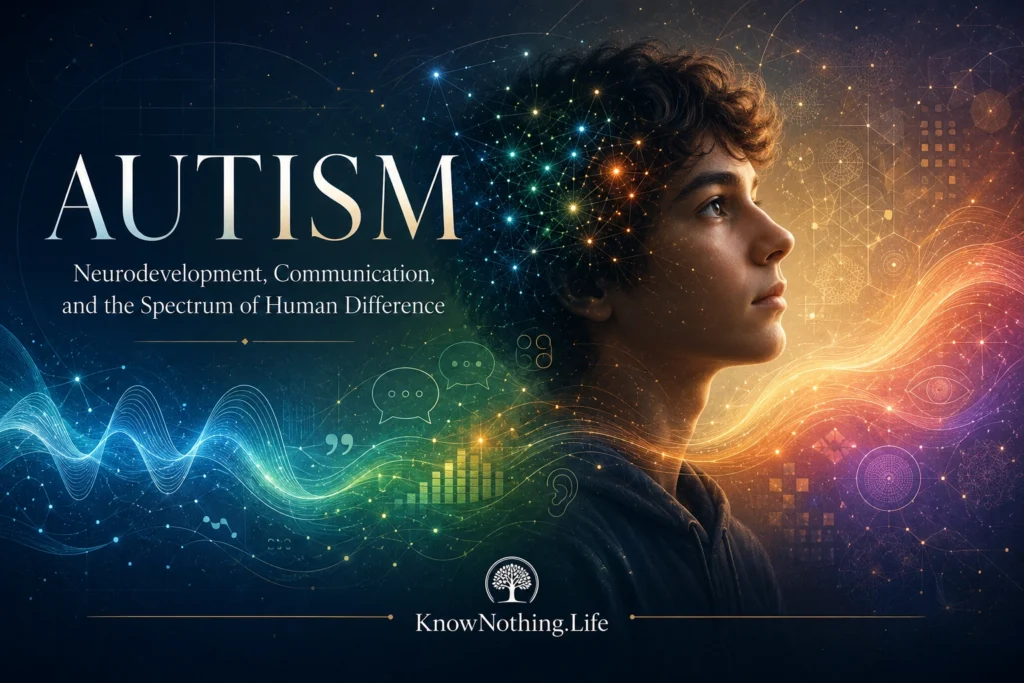
Autism, formally called autism spectrum disorder, is a neurodevelopmental condition that affects communication, social interaction, sensory experience, learning, movement, and patterns of behavior. It is called a “spectrum” not because autism is vague, but because autistic people differ widely in language, intelligence, sensory sensitivity, independence, support needs, personality, and life experience. Some autistic people speak fluently, live independently, and mask their difficulties for years. Others are nonspeaking, require substantial daily support, or communicate through gestures, devices, writing, or behavior. The National Institute of Mental Health describes autism as a neurological and developmental disorder that affects how people interact, communicate, learn, and behave, with signs generally appearing in the first two years of life.
The public image of autism has changed dramatically over the last century. For decades, autism was often framed narrowly through deficit, isolation, or abnormality. Today, a more complete view recognizes both disability and difference. Autism can involve serious challenges, including communication barriers, anxiety, sensory overload, self-injury, sleep problems, epilepsy, gastrointestinal issues, and difficulty navigating everyday social demands. It can also involve intense interests, unusual memory, deep pattern recognition, honesty, precision, creativity, and powerful forms of attention. The challenge is to avoid two mistakes at once: treating autism only as tragedy, or romanticizing it as a simple gift. Autism is not one life story. It is a broad human condition that requires both respect and support.
The History of Autism
The modern clinical history of autism is usually traced to Leo Kanner’s 1943 paper “Autistic Disturbances of Affective Contact.” Kanner described children who showed profound differences in social engagement, language, repetition, and resistance to change. His most famous phrase, “extreme autistic aloneness,” shaped early understandings of the condition, though it also encouraged later stereotypes that autistic people were emotionally unreachable. Kanner’s case descriptions included children with strong memory, unusual language, intense focus on objects, and distress when routines were disrupted. His paper helped define autism as a distinct clinical pattern, but it also reflected the limits of its time.
Around the same period, Austrian pediatrician Hans Asperger described children who had social and communication differences but often possessed strong verbal ability and specialized interests. His 1944 work later influenced the diagnosis of Asperger’s syndrome, though that diagnosis was eventually folded into autism spectrum disorder in the DSM-5. In NeuroTribes, Steve Silberman argues that autism was long misunderstood because the broader spectrum view was overshadowed by narrower clinical models. Silberman defines neurodiversity as the idea that conditions such as autism, dyslexia, and ADHD should be understood as naturally occurring cognitive variations rather than only “checklists of deficits and dysfunctions.” His work helped popularize a cultural shift: autistic people should not be studied only as patients, but also listened to as interpreters of their own experience.
Core Features of Autism
Autism is diagnosed through patterns in two broad areas: differences in social communication and interaction, and restricted or repetitive behaviors, interests, or activities. The CDC summarizes the DSM-5 framework by noting that a diagnosis requires persistent difficulties in social communication and interaction, along with at least two types of restricted or repetitive behavior. These features may include limited back-and-forth conversation, differences in eye contact or facial expression, difficulty interpreting social cues, repetitive movements, strong need for sameness, highly focused interests, and unusual responses to sensory input.
These traits vary widely. One autistic child may line up toys, avoid loud sounds, repeat phrases, and struggle with pretend play. Another may speak early, memorize facts, dislike unpredictable social situations, and become overwhelmed by fluorescent lights or crowded rooms. An autistic adult may appear socially fluent at work but become exhausted from masking, scripting, or constantly monitoring body language. The CDC notes that autistic people may also have different ways of learning, moving, or paying attention, and that these characteristics can make daily life challenging.
Communication and Social Understanding
Autistic communication is often misunderstood because it may not follow typical social rhythm. Some autistic people speak very little or not at all, while others speak with great fluency but struggle with implied meaning, small talk, sarcasm, or shifting conversational expectations. Echolalia, the repetition of words or phrases, was once dismissed as meaningless imitation, but many clinicians and autistic advocates now recognize that it can serve communicative, emotional, regulatory, or learning purposes. A repeated phrase may express a need, recall an emotional association, or help the person organize experience.
Social difficulty in autism should not be reduced to lack of feeling. Many autistic people feel deeply but may express emotion differently. They may miss conventional cues, but non-autistic people also frequently misread autistic communication. This has led some researchers and advocates to emphasize the “double empathy problem,” a term associated with Damian Milton, which suggests that social misunderstanding often runs both ways. The autistic person is not simply failing to understand the non-autistic world; the non-autistic world is often failing to understand autistic signals, sensory needs, and communication styles.
Sensory Experience and Repetition
Sensory experience is central to autism. Many autistic people are unusually sensitive to sound, light, texture, smell, taste, pain, temperature, or touch. A sound that seems mild to one person may be piercing to another. A shirt tag, buzzing light, crowded hallway, or unexpected touch can become overwhelming. Others may seek sensory input through rocking, spinning, pressure, movement, or repeated sounds. The CDC lists unusual eating and sleeping habits, gastrointestinal issues, anxiety, stress, and unusual emotional reactions among characteristics that may occur alongside autism.
Repetitive behaviors and routines can also be misunderstood. Hand-flapping, rocking, repeating phrases, arranging objects, or returning to a favorite topic may look odd from the outside, but these behaviors can regulate emotion, create predictability, express excitement, or reduce distress. Temple Grandin, one of the best-known autistic writers, has often described autism from the inside as a difference in perception and thinking. In Thinking in Pictures, she writes, “I think in pictures. Words are like a second language to me.” Her statement captures an important truth: autism is not merely a list of outward behaviors. It is also an inner style of processing, sensing, remembering, and organizing the world.
Causes and Development
Autism does not have one single cause. Research points to complex interactions among genetics, brain development, biology, and environment. Autism tends to run in families, and many genes appear to contribute small or significant effects. Some genetic syndromes and medical conditions are associated with higher likelihood of autism, but many autistic people do not have one identifiable genetic explanation. The current scientific consensus rejects older myths that blamed autism on cold parenting or emotional neglect. Those theories caused enormous harm and are not supported by modern research.
Autism is developmental, meaning its signs emerge as the brain and nervous system develop. NIMH notes that autism can be diagnosed at any age but is described as developmental because symptoms generally appear early in life. Early signs may include reduced response to name, limited gestures, delayed speech, unusual play, intense distress with change, repetitive movements, or reduced shared attention. However, some autistic people, especially those with fluent language or strong masking skills, are not diagnosed until adolescence or adulthood. Late diagnosis can bring grief over years of misunderstanding, but it can also bring relief, self-knowledge, and access to support.
Diagnosis and Support
Autism diagnosis should involve careful developmental history, observation, caregiver or self-report, and assessment by qualified professionals. There is no single blood test or brain scan that can diagnose autism in ordinary clinical practice. Clinicians look for patterns of communication, social development, sensory behavior, restricted interests, repetitive behavior, and functional impact. The CDC explains that DSM-5 criteria are used as a standardized framework for diagnosis.
Support should be individualized. Some autistic people need speech therapy, occupational therapy, augmentative and alternative communication, behavioral supports, educational accommodations, job coaching, sensory-friendly environments, or help with daily living. Others primarily need understanding, flexibility, and relief from constant social masking. The most ethical supports do not aim to erase autistic identity or force superficial normality. They aim to improve communication, safety, autonomy, emotional regulation, learning, and quality of life. A child should not be trained merely to look less autistic; they should be helped to communicate, participate, and flourish.
Neurodiversity, Disability, and Identity
The neurodiversity movement has changed how many people think about autism. It argues that neurological differences are part of human variation and that society should make room for different minds. This view does not deny disability. Rather, it challenges the assumption that every autistic trait is automatically a defect. Silberman writes in NeuroTribes that many daily challenges faced by autistic people are not simply “symptoms,” but hardships created by a society that refuses basic accommodations. That insight is especially important in schools, workplaces, medicine, and public spaces.
At the same time, neurodiversity should not flatten the spectrum. Some autistic people need lifelong intensive support, and their needs must not be erased by focusing only on high-achieving or verbally fluent autistic adults. A serious autism framework must hold both truths: autism is a real disability for many people, and autistic people deserve respect, agency, and inclusion. The goal is not to decide whether autism is “good” or “bad” in the abstract. The goal is to understand the person, reduce suffering, support communication, and build environments where autistic lives can be lived with dignity.
Final Thoughts on Autism
Autism is a complex neurodevelopmental condition involving differences in communication, social interaction, sensory processing, attention, movement, routine, and learning. It has been described by clinicians such as Leo Kanner, reinterpreted by historians such as Steve Silberman, illuminated by autistic writers such as Temple Grandin, and reshaped by the voices of autistic advocates themselves. The strongest modern understanding of autism combines science with humility. It recognizes diagnostic patterns, but it does not mistake the diagnosis for the whole person.
To understand autism well, one must look beyond stereotypes. Autism is not simply silence, genius, awkwardness, lack of empathy, or childhood disorder. It can involve disability, beauty, frustration, intensity, vulnerability, originality, and profound difference in how the world is experienced. The question should not be how to make every autistic person appear typical. The better question is how to support communication, reduce unnecessary suffering, respect different forms of intelligence, and create a world less hostile to minds that do not move through life in the usual way.