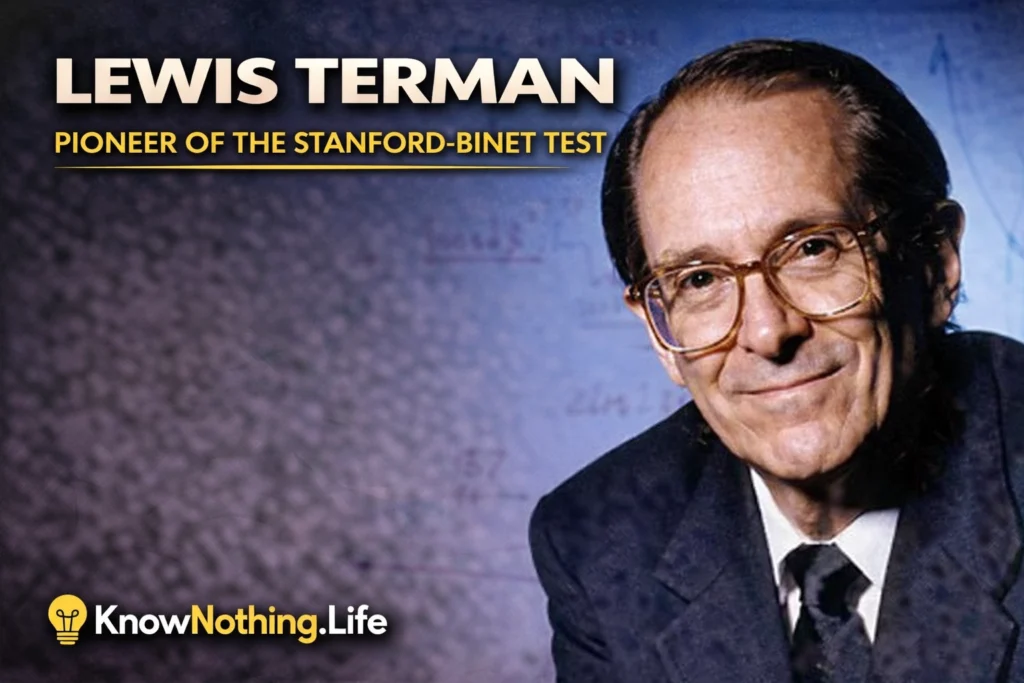
Few psychologists have shaped modern intelligence testing as strongly, or as controversially, as Lewis Terman. Best known for creating the Stanford-Binet Intelligence Scale and launching one of the longest-running studies of gifted children in history, Terman helped make IQ testing a central feature of American psychology, education, and public policy. His work transformed intelligence from an abstract philosophical idea into something schools, courts, armies, and researchers attempted to measure, compare, and classify.
Terman’s legacy is deeply divided. On one side, he helped legitimize the study of gifted children and challenged the old stereotype that highly intelligent children were physically weak, socially awkward, or emotionally unstable. On the other side, he also supported eugenic ideas and promoted uses of testing that reflected the racial, class, and hereditarian assumptions of his era. To understand Terman honestly, one must hold both truths together: he was a major architect of modern psychological assessment, and he was also part of a troubling movement that often used measurement to justify inequality.
Early Life and Education
Lewis Madison Terman was born on January 15, 1877, in Johnson County, Indiana, into a rural farming family. Unlike many future academics raised in elite intellectual environments, Terman came from modest circumstances and worked his way into higher education through determination and academic promise. His early life helped shape his belief that intelligence could be identified early and cultivated, especially in children whose abilities might otherwise be overlooked.
Terman studied at Central Normal College before continuing his education at Indiana University and later Clark University, where he earned his doctorate under G. Stanley Hall. His doctoral work focused on differences between bright and less able children, foreshadowing the lifelong interest that would define his career. At Clark, Terman entered a psychological world increasingly fascinated by measurement, heredity, child development, and educational classification. These influences shaped both his scientific contributions and the limitations of his worldview.
The Stanford-Binet Intelligence Scale
Terman’s most famous contribution came through his revision of Alfred Binet and Théodore Simon’s intelligence scale. Binet’s original test had been developed in France to identify children who needed educational assistance. Terman adapted, expanded, and standardized the scale for American children, publishing the Stanford Revision and Extension of the Binet-Simon Intelligence Scale in 1916. This became widely known as the Stanford-Binet.
The Stanford-Binet made intelligence testing far more influential in the United States. Terman’s version helped popularize the intelligence quotient, or IQ, as a numerical expression of mental ability. His book The Measurement of Intelligence presented the test as a practical tool for schools, clinics, and institutions. He wrote, “The child’s intelligence is to be judged by his success in the performance of certain tasks.” That statement captures both the practical strength and the danger of his approach: intelligence became observable through performance, but performance could also be mistaken for the whole person.
Testing, Classification, and American Schools
Terman believed intelligence testing could help schools become more efficient. He argued that children differed widely in ability and that education should be adjusted accordingly. In his view, testing could identify students who needed special support, students who were ready for advanced work, and students whose school placement did not match their mental development. This vision made him one of the most influential figures in educational psychology.
At the same time, Terman’s confidence in testing went far beyond Binet’s original caution. Binet had warned against treating intelligence as fixed or reducing a child to a number. Terman was more willing to classify children by IQ and connect test results to future educational and vocational paths. He did emphasize careful procedure, noting that “intelligence is too complicated to be weighed, like a bag of grain,” but his broader system still encouraged schools to sort children into categories that could shape their opportunities.
World War I and Mass Testing
During World War I, Terman contributed to the development of large-scale group intelligence testing through the Army Alpha and Beta programs. These tests were designed to classify military recruits quickly and efficiently. The Army testing program helped move intelligence testing from the school clinic into national administration, proving that mental tests could be deployed on a massive scale.
The wartime testing movement increased the cultural authority of IQ. After the war, intelligence testing spread through schools, universities, immigration debates, employment systems, and public policy. Terman became one of the leading voices arguing that psychological measurement could improve social organization. His work helped make testing seem modern, scientific, and objective. Yet the same tools were often used in biased ways, especially when test results were interpreted without proper attention to language, culture, education, poverty, and discrimination.
The Genetic Studies of Genius
In 1921, Terman launched the longitudinal study that became Genetic Studies of Genius. He selected more than 1,000 California children with very high IQ scores and followed them across their lives. The children became informally known as “Termites,” though Terman himself treated the project as a serious scientific investigation into gifted development. His goal was to challenge the belief that gifted children were fragile, eccentric, or doomed to social maladjustment.
The study produced important findings. Many of the gifted children were healthy, socially competent, academically successful, and professionally accomplished. Terman showed that intellectual giftedness did not necessarily come with emotional weakness or physical frailty. This helped create the modern field of gifted education and encouraged schools to recognize that highly able students also have special educational needs.
Major Works and Contributions
Terman’s major works include The Measurement of Intelligence (1916), The Use of Intelligence Tests (1916), The Intelligence of School Children (1919), and the multi-volume Genetic Studies of Genius. These works helped define the American testing movement and made intelligence assessment a central part of educational psychology. He also helped develop the Stanford Achievement Test, further expanding standardized assessment in schools.
His writing combined scientific ambition with reformist confidence. He believed psychology could help society identify talent, reduce educational waste, and match individuals to appropriate roles. At his best, Terman helped teachers and researchers take gifted children seriously. At his worst, he treated intelligence as too fixed, too hereditary, and too easily ranked by standardized tools. His career reveals both the power and danger of psychological measurement.
Eugenics and Controversy
No serious biography of Terman can ignore his connection to eugenics. Like many early twentieth-century psychologists, Terman believed intelligence was strongly inherited and that society should encourage reproduction among the intellectually “fit” while discouraging it among those labeled “unfit.” He supported eugenic organizations and ideas that are now recognized as scientifically flawed and morally dangerous.
This part of his legacy is especially troubling because IQ testing was often used to reinforce racial and class hierarchies. Early tests frequently confused educational opportunity, English-language familiarity, cultural background, and social privilege with innate intelligence. Terman eventually backed away from some eugenic positions, but he did not fully publicly repudiate them. His life therefore stands as a warning: scientific tools can become harmful when combined with prejudice, social ranking, and exaggerated claims about heredity.
Criticism and Reassessment
Terman’s work has been criticized on several grounds. Critics argue that his view of intelligence was too narrow and that IQ tests cannot capture the full range of human ability, including creativity, wisdom, emotional intelligence, practical judgment, artistic talent, or moral character. Others argue that his confidence in testing ignored the powerful effects of environment, culture, poverty, schooling, nutrition, and discrimination.
His gifted-child study also had limitations. The sample was not representative of all gifted children, and it missed some forms of creativity and unconventional genius. Famously, William Shockley and Luis Alvarez, who later won Nobel Prizes, were not included in Terman’s gifted group because their test scores did not qualify them. This irony illustrates one of the central limits of IQ testing: it may identify certain kinds of academic ability, but it cannot perfectly predict creativity, discovery, or greatness.
Legacy and Lasting Influence
Lewis Terman died on December 21, 1956, but his influence remains deeply embedded in American education and psychology. The Stanford-Binet became one of the most important intelligence tests in history, and his work helped make IQ a familiar concept in schools and public life. His research on gifted children helped establish gifted education as a legitimate field and challenged harmful stereotypes about intellectually advanced children.
At the same time, Terman’s legacy remains inseparable from the ethical failures of early testing culture. His career shows how easily measurement can become classification, and how classification can become exclusion when guided by biased assumptions. Modern psychology still uses intelligence testing, but it does so with greater awareness of cultural bias, environmental influence, and the need to interpret scores carefully.
Final Thoughts
To study Lewis Terman is to study one of the most influential and complicated figures in the history of psychological assessment. He helped bring intelligence testing into American education and gave researchers new tools for studying cognitive ability. He also promoted ideas that contributed to harmful systems of ranking, exclusion, and eugenic thinking.
His legacy is not simple admiration or simple condemnation. It is a lesson in the responsibility that comes with measurement. Terman showed that tests can reveal meaningful differences and help identify children who need support or advanced opportunities. But his career also reminds us that no score can define a human being. Intelligence may be measured in part, but human potential is always larger than the number assigned to it.