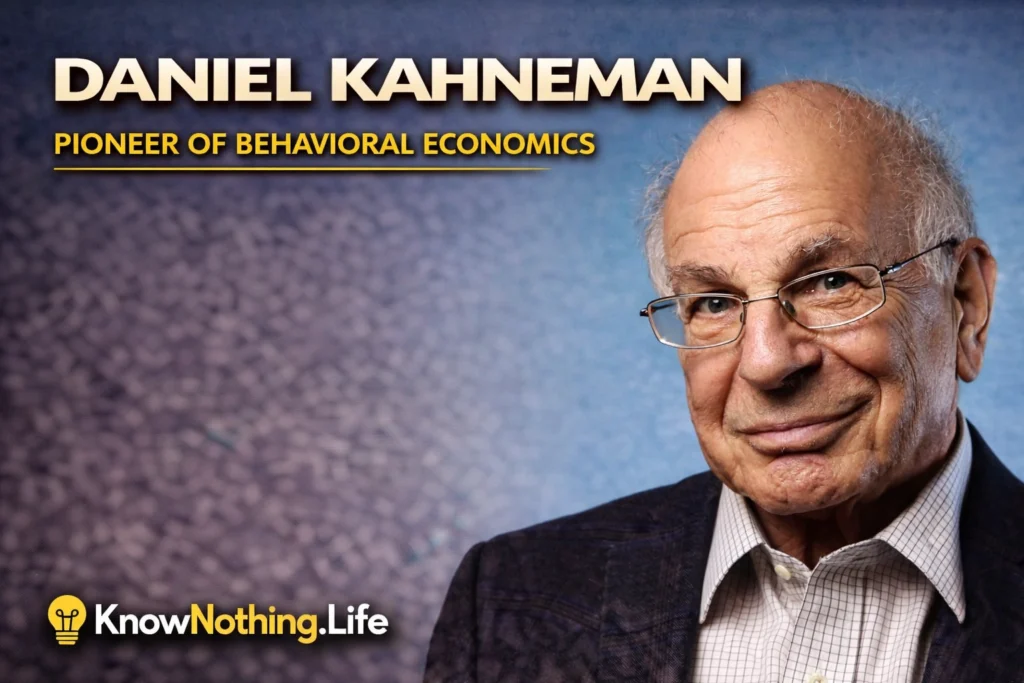
Daniel Kahneman was born on March 5, 1934, in Tel Aviv, then part of the British Mandate of Palestine, while his mother was visiting family. His childhood, however, was shaped largely in Paris, where his family lived during the German occupation of France. Kahneman later described early experiences of danger, disguise, fear, and moral uncertainty as formative, not because they gave him a simple theory of human nature, but because they made behavior itself seem mysterious. The world of adults did not appear fully rational or transparent. People were frightened, kind, cruel, evasive, brave, and inconsistent, sometimes within the same day. That early sensitivity to contradiction became one of the deep signatures of his work.
After his father died in 1944, Kahneman moved with his mother and sister to Palestine. He studied psychology and mathematics at the Hebrew University of Jerusalem, served in the psychology branch of the Israeli military, and later earned his Ph.D. from the University of California, Berkeley, in 1961. His early academic work focused on perception, attention, and effort, culminating in Attention and Effort, published in 1973. That book already showed the central question that would define his career: how does the mind allocate its limited resources, and why does it so often mistake speed, familiarity, and confidence for truth?
The Collaboration with Amos Tversky
Kahneman’s most famous intellectual partnership began in Israel with Amos Tversky, a brilliant mathematical psychologist whose style differed sharply from his own. Kahneman was cautious, introspective, and alert to error; Tversky was bold, elegant, and dazzlingly analytical. Their temperaments created friction, but also one of the most productive collaborations in twentieth-century social science. Together they investigated how ordinary people make judgments under uncertainty, not as abstract calculating machines, but as living minds that rely on shortcuts, impressions, and stories.
Their landmark 1974 Science article, “Judgment under Uncertainty: Heuristics and Biases,” helped change psychology, economics, medicine, law, and public policy. Kahneman and Tversky argued that people often use heuristics such as representativeness, availability, and anchoring when making estimates. These shortcuts are “highly economical and usually effective,” but they also produce “systematic and predictable errors.” That phrase captured the revolutionary force of their work. Human irrationality was not random noise. It had structure. People could be wrong in patterned ways, which meant that judgment itself could be studied scientifically.
Prospect Theory and the Challenge to Economic Rationality
The next major breakthrough was prospect theory, introduced in their 1979 paper “Prospect Theory: An Analysis of Decision under Risk.” Classical economic theory often assumed that people evaluate choices according to final wealth and rational utility. Kahneman and Tversky showed that real people tend to evaluate outcomes relative to reference points, feel losses more intensely than equivalent gains, and change their preferences when the same choice is framed differently. A person may reject a gamble when it is described in terms of possible gain, yet accept a logically similar gamble when it is framed as avoiding loss.
This work was devastating to the image of the perfectly rational economic actor. It did not say that people are foolish; it showed that people are psychologically situated. They are moved by fear, regret, comparison, framing, and the pain of losing what they already consider theirs. Kahneman later received the 2002 Nobel Memorial Prize in Economic Sciences for “having integrated insights from psychological research into economic science,” especially concerning judgment and decision-making under uncertainty. Tversky had died in 1996 and could not share the prize, a fact that made Kahneman’s recognition inseparable from the absent collaborator whose mind had helped build the theory.
Major Works and Public Influence
Kahneman’s books and edited volumes map the development of a whole intellectual movement. Attention and Effort examined the limits of mental capacity. Judgment under Uncertainty: Heuristics and Biases, edited with Paul Slovic and Amos Tversky, gathered foundational research on intuitive error. Choices, Values, and Frames, edited with Tversky, extended the implications of prospect theory. Well-Being: The Foundations of Hedonic Psychology, edited with Ed Diener and Norbert Schwarz, reflected Kahneman’s later interest in happiness, memory, and the difference between life as experienced and life as remembered.
His most widely read work, Thinking, Fast and Slow, published in 2011, brought decades of research to a general audience. The book popularized the distinction between fast, automatic, intuitive thinking and slower, effortful, analytical thinking. Kahneman did not present these as literal brain regions, but as useful characters in a drama of judgment. System 1 jumps to conclusions; System 2 checks, calculates, and sometimes lazily endorses what System 1 has already suggested. His famous formula, “What you see is all there is,” captured the mind’s tendency to build confident stories from incomplete evidence. Another line, “Nothing in life is as important as you think it is, while you are thinking about it,” showed his gift for turning experimental insight into memorable human wisdom.
Happiness, Memory, and the Self
Kahneman’s later work on well-being deepened his reputation as more than a theorist of error. He explored the difference between the experiencing self, which lives through moments, and the remembering self, which turns those moments into stories. This distinction helped explain why people may judge a vacation, medical procedure, career, or relationship not by the total sum of experience, but by peaks, endings, and remembered meaning. In this sense, memory is not merely a record of life; it becomes a decision-making authority over the future.
That insight complicated popular ideas about happiness. Kahneman showed that people are not always reliable predictors of what will make them happy, and they are not always accurate judges of what made them happy in the past. A life can feel one way while being lived and another way when narrated afterward. This made his work especially influential in behavioral policy, where the design of institutions, forms, defaults, medical choices, retirement plans, and public messages can either respect human limits or exploit them. Kahneman’s science had a moral edge: if minds are predictably vulnerable, systems should be designed with humility.
Noise, Legacy, and Lasting Importance
In 2021, Kahneman, Olivier Sibony, and Cass R. Sunstein published Noise: A Flaw in Human Judgment, a book that shifted attention from bias to inconsistency. Bias means judgments lean in a predictable direction; noise means similar cases receive different judgments for no good reason. The concept applied to hiring, sentencing, medicine, insurance, performance evaluation, and management. It extended a theme present throughout Kahneman’s career: institutions often trust judgment more than judgment deserves to be trusted. Better decisions require not only smarter individuals, but better procedures.
Kahneman died on March 27, 2024, at the age of ninety. By then, his influence had spread far beyond psychology departments. Economists, physicians, judges, investors, military planners, designers, teachers, and policymakers had absorbed his central lesson: the human mind is not a transparent instrument of reason. It is fast, adaptive, emotional, story-making, and often overconfident. Kahneman’s greatness lay in the discipline with which he studied those flaws, including his own. He did not humiliate human reason; he made it more honest. His legacy is a permanent warning against easy certainty and a lasting invitation to think again.