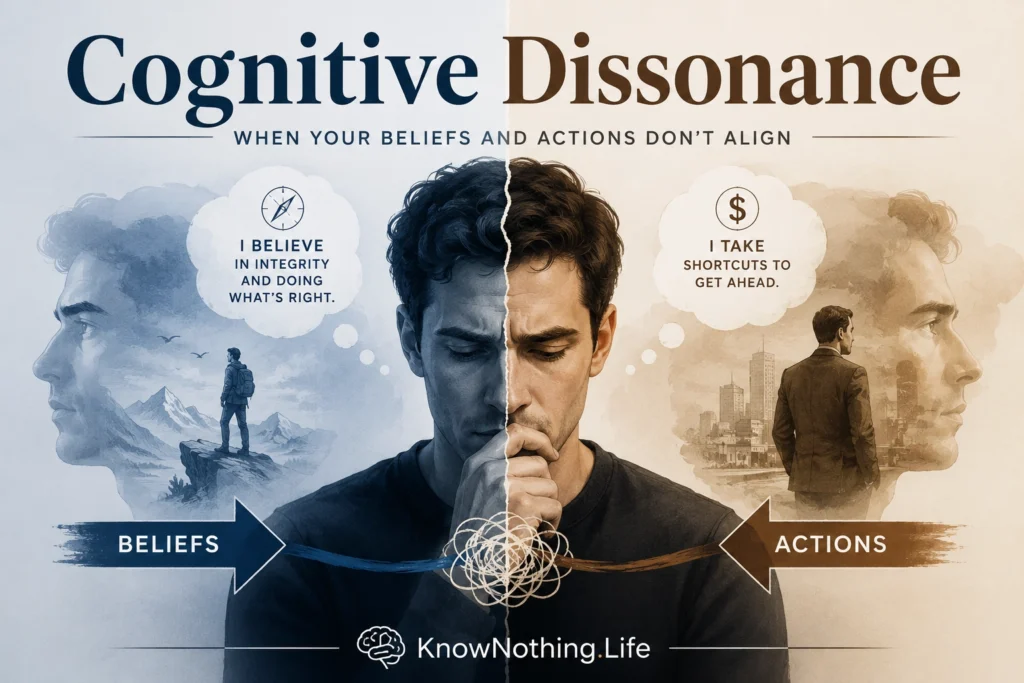
Cognitive dissonance is one of the most important concepts in modern psychology because it explains a strange feature of human behavior: people often protect their beliefs even when those beliefs conflict with evidence, values, or actions. A person may know smoking is dangerous but continue smoking. Someone may believe honesty matters but lie to protect their image. A person may stay in a harmful relationship while insisting it is healthy. Another may make a bad decision and then convince themselves it was the right one. These contradictions create psychological discomfort, and the mind works hard to reduce that discomfort.
The term was introduced by social psychologist Leon Festinger in his 1957 book A Theory of Cognitive Dissonance. Festinger argued that people have a strong need for internal consistency. When beliefs, attitudes, and behaviors clash, the result is mental tension. That tension motivates people to restore balance. Sometimes they do this honestly, by changing behavior or updating beliefs. But often they do it defensively, by rationalizing, denying, minimizing, blaming, or selectively interpreting facts. Cognitive dissonance reveals that human beings are not purely rational truth-seekers. Much of the time, they are self-protective meaning-makers trying to preserve a stable sense of identity.
What Cognitive Dissonance Means
Cognitive dissonance occurs when a person holds two or more conflicting thoughts, beliefs, values, or behaviors at the same time. The conflict produces discomfort because the mind wants coherence. For example, “I am a good person” may conflict with “I hurt someone.” “I make smart choices” may conflict with “I wasted money.” “I value health” may conflict with “I avoid exercise.” The inconsistency threatens the person’s self-image, so the mind looks for a way to reduce the tension.
There are several ways to reduce dissonance. A person can change behavior, such as quitting smoking after accepting the health risks. They can change a belief, such as deciding the risk is exaggerated. They can add a new justification, such as saying stress relief matters more than long-term health. They can minimize the issue, compare themselves favorably to others, or avoid information that increases discomfort. The important point is that dissonance does not always lead people toward truth. It often leads them toward whatever explanation feels psychologically survivable.
Festinger and the Birth of the Theory
Festinger’s theory emerged from his interest in belief, commitment, and social influence. One of the famous early studies involved a doomsday group that believed the world would end on a specific date. Festinger and his colleagues described the case in When Prophecy Fails. When the predicted catastrophe did not occur, some believers did not simply abandon the belief. Instead, they intensified their commitment, interpreting the failure as proof that their faith had saved the world.
This response seems irrational, but cognitive dissonance explains it. The believers had invested deeply in the prophecy. They had risked reputation, relationships, and normal life. When reality contradicted the belief, the dissonance was enormous. Accepting that they were wrong would have meant facing humiliation, grief, and wasted sacrifice. Strengthening the belief was psychologically easier than abandoning it. This pattern appears far beyond religious prophecy. People may double down on failed ideologies, bad investments, unhealthy relationships, or mistaken decisions because admitting error would be too painful.
The Classic $1 and $20 Experiment
One of the most famous demonstrations of cognitive dissonance came from Festinger and James Carlsmith in 1959. Participants completed a boring task and were then asked to tell another person that the task was interesting. Some were paid $20 to lie, while others were paid only $1. Surprisingly, those paid $1 later rated the boring task as more enjoyable than those paid $20.
The logic is powerful. The $20 group had an obvious external justification: they lied for money. The $1 group had little external justification, so they experienced more dissonance. “I lied” conflicted with “I am an honest person,” and the small reward was not enough to explain the behavior. To reduce discomfort, they shifted their attitude: perhaps the task really was not so boring after all. This experiment showed that people may change beliefs to fit actions, especially when they cannot easily justify those actions externally.
Self-Justification and Identity
Cognitive dissonance is strongest when the contradiction threatens identity. People do not merely defend isolated opinions; they defend the kind of person they believe themselves to be. Psychologist Elliot Aronson emphasized this point, arguing that dissonance is especially powerful when people see themselves as competent, moral, intelligent, or fair. When evidence challenges that self-image, the mind often reacts defensively.
This is why people may become more defensive when corrected on matters tied to morality or intelligence. A simple mistake may not matter much. But if the mistake suggests “I was foolish,” “I was cruel,” “I was manipulated,” or “I hurt someone,” the discomfort becomes personal. The mind may respond by blaming circumstances, attacking critics, rewriting memory, or insisting the action was justified. Carol Tavris and Elliot Aronson explored this dynamic in Mistakes Were Made (But Not by Me), showing how self-justification allows ordinary people to slide gradually into dishonesty, cruelty, or denial while still seeing themselves as good.
Cognitive Dissonance in Everyday Life
Cognitive dissonance appears constantly in ordinary life. A person buys an expensive product and then searches for reasons it was a smart purchase. Someone stays in a job they dislike and tells themselves stability matters more than fulfillment. A person treats a friend unfairly and then convinces themselves the friend deserved it. A student procrastinates and then says they work better under pressure. These explanations may contain some truth, but they often also protect the person from discomfort.
Consumer behavior offers a simple example. After making a major purchase, people often experience “buyer’s remorse.” The mind wonders whether the choice was wrong. To reduce dissonance, the buyer may read positive reviews, avoid negative ones, emphasize the product’s benefits, or criticize alternatives. This does not mean every justification is false. It means the mind is motivated to feel consistent with its decision.
Relationships and Emotional Dissonance
Relationships often produce intense cognitive dissonance because love, loyalty, fear, memory, and identity become intertwined. Someone may know a relationship is unhealthy but still defend it. They may think, “This person hurts me,” while also thinking, “They love me,” or “I chose them,” or “I do not want to start over.” The contradiction creates emotional tension. To reduce it, the person may minimize harm, overvalue good moments, blame themselves, or focus on the partner’s potential rather than their pattern.
This is one reason people stay in toxic dynamics. Leaving requires not only a practical change but a psychological admission: something they invested in may not become what they hoped. That realization can be painful. Dissonance can make people cling to explanations that preserve hope, even when evidence suggests the relationship is damaging. The mind is not always defending the other person. Sometimes it is defending the meaning of its own investment.
Politics, Religion, and Group Belief
Cognitive dissonance becomes especially powerful in politics, religion, and group identity. Beliefs in these areas are rarely just private opinions. They are tied to community, morality, belonging, family history, and personal identity. When evidence challenges a group belief, people may feel as if their entire social world is being threatened. The result can be selective exposure: seeking information that confirms existing views and avoiding information that creates discomfort.
This helps explain why facts alone often fail to change minds. If accepting a fact would force someone to reject a group, admit moral error, or lose status, the psychological cost may be enormous. People may reinterpret evidence, distrust sources, or attack the messenger. Cognitive dissonance does not mean people are incapable of changing. It means belief change often requires emotional safety, identity repair, and a way to move forward without total humiliation.
The Sunk Cost Trap
Cognitive dissonance also explains the sunk cost fallacy. People often continue investing in something because they have already invested so much. A failing business, unhappy marriage, expensive degree, bad friendship, or losing strategy may continue because quitting would mean admitting that prior effort did not produce the hoped-for result. The mind says, “I cannot stop now, or everything I sacrificed will have been for nothing.”
The tragedy is that continuing can create even more loss. The rational question is not “How much have I already invested?” but “What is the wisest choice now?” Dissonance makes that question hard because it forces people to confront regret. The more someone has sacrificed, the more they may need the decision to have been worthwhile.
Why Cognitive Dissonance Can Be Useful
Although cognitive dissonance often leads to denial, it is not always harmful. The discomfort can also push people toward growth. When someone recognizes a contradiction between values and behavior, they may change. A person who values kindness may apologize after realizing they were cruel. Someone who values health may improve habits after acknowledging avoidance. A person who values truth may update their beliefs after encountering strong evidence.
In this sense, dissonance is a moral and psychological signal. It tells people that something does not fit. The question is whether they respond with defense or reflection. Mature self-awareness does not eliminate dissonance. It uses dissonance as information. Instead of asking, “How can I prove I was right?” it asks, “What is this discomfort trying to show me?”
Final Thoughts
Cognitive dissonance explains why people resist evidence, justify mistakes, defend bad decisions, and reshape beliefs around behavior. The mind wants consistency, but it does not always achieve consistency through honesty. Sometimes it reduces discomfort by changing behavior or learning. Other times it reduces discomfort by denial, rationalization, avoidance, or blame.
The theory remains powerful because it reveals a central truth about human nature: people are motivated not only by facts, but by the need to see themselves as coherent, competent, and good. We do not simply believe what is true. We often believe what allows us to live with ourselves.
The challenge is to notice dissonance without immediately escaping it. Contradiction can be painful, but it can also be clarifying. When beliefs and actions conflict, the discomfort may be an invitation to become more honest. Cognitive dissonance becomes dangerous when it protects illusion. It becomes transformative when it leads to responsibility, humility, and change.